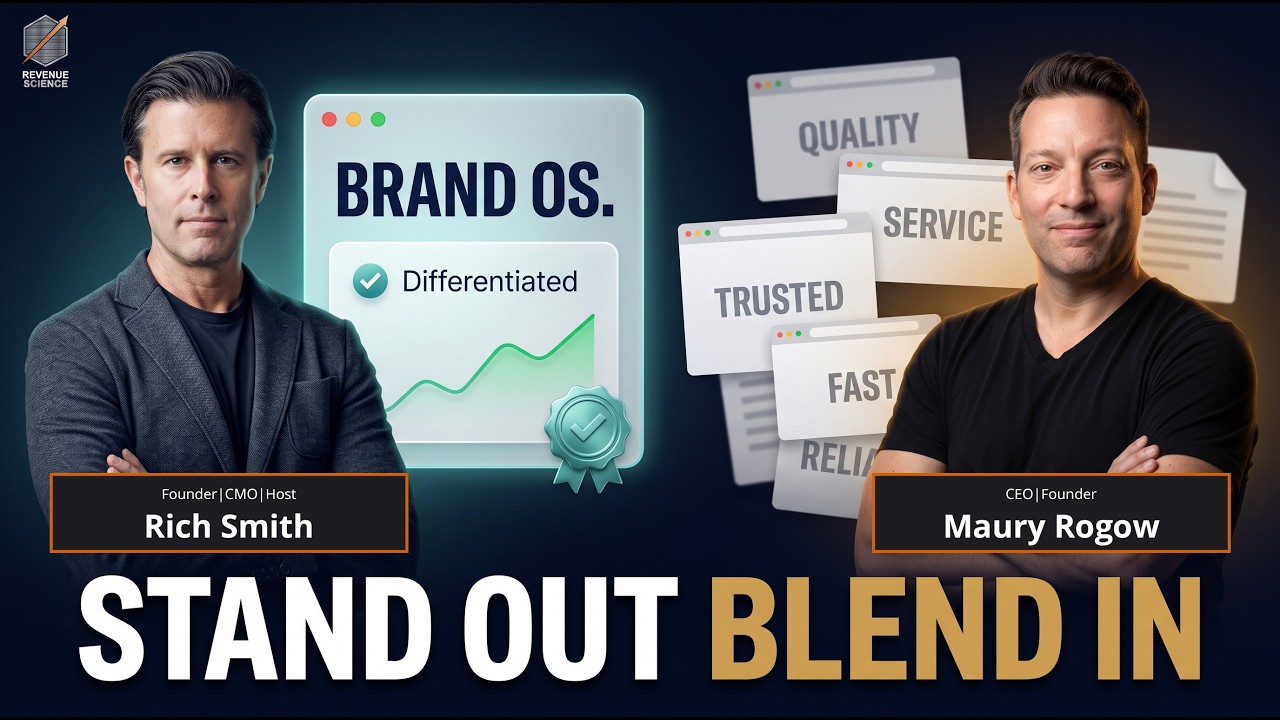
[0:00] Rich Smith: Pull up your website. Pull up a website of your main competitors, two of them. And then you can do the little settings. Turn off the color. Just do grayscale. And look at your messages. Look at their messages. Is a customer going to know how you are different and special. You're not Superman or Iron Man or Wonder Woman. You're the toolkit that they use. You are the smart one in the room that helps other people win.
[0:43] Rich Smith: Welcome to Revenue Science, the show where we translate marketing and sales complexity into boardroom clarity for founders, leaders, and CEOs who are building predictable growth systems. I'm Rich Smith, CMO, founder, executive adviser, and lucky enough to be your host today. Thank you for listening today, and please join our goal of helping more leaders to successfully grow their companies by liking and subscribing to this podcast.
[1:11] Rich Smith: Entrepreneurship is the engine that drives our economy. And when founders succeed, they improve the lives of their family, their employees, their community, and lastly, but most importantly, their customers. Today's guest is Maury Rogow, CEO and founder of RIP Media Group, creator of the story to sales methodology, and someone with a truly unusual background that sits at the intersection of Hollywood storytelling and enterprise growth. Maury built his career in business development at organizations like AAA, Lucent, and Geotel before its billion-dollar acquisition by Cisco. Then he took an unconventional turn into film and media production, bringing together the worlds of storytelling and business strategy in a way very few people can.
[1:58] Rich Smith: Today, Maury and his team have helped companies ranging from startups to global brands create stories and campaigns responsible for hundreds of millions of dollars in revenue impact. What I'm particularly excited to explore today is how storytelling becomes more than just a communication tool — how it shapes attention, simplifies complexity, influences decisions, and ultimately becomes a system for driving growth. Maury, welcome to the show.
[2:28] Maury Rogow: Happy to be here, Rich. Thank you so much.
[2:29] Rich Smith: Yeah, it's great to have you here today. Um, I I know our audience is going to love uh this episode because you really uh you know, you really staked out an important topic and space. So, um I'm excited to get into it.
[2:44] Maury Rogow: Thank you.
[2:46] Rich Smith: Uh maybe one place to start would be tell us about uh RIP Media Group. You know, who you serve, what problems you solve, where your focus is today.
[2:58] Maury Rogow: Sure. So, RIP Media Group. RIP Media Group was formed because I kept seeing the same problem, and I'm now talking hundreds of times in companies that are startups that just raised, you know, 5 to 10 million to companies that are flowing along with 500 million in revenue. The problem is they're not differentiated from their competition. They're not differentiated from their competition. Sales team isn't differentiating what they're doing versus the other sales team. Product marketing has the problem. So, they fall on their face at one point or another.
[3:29] Maury Rogow: So I help them get their story right — the best story, to the right audience at the right time — and help their sales increase. So it's worked out, you know, beautifully. I mean, I started off in high-tech and then I moved to Hollywood, and I ended up producing films there and uh switched over to commercials, which I had a great time with, but it just kept leading me to telling stories in every phase of my career. Work with the executives themselves and it's been a really, really fun ride. So, uh, that's what we do. We're helping you get your story to the right people so that they can understand how you stand out and not why you blend in and why you're a price tag. That's the problem.
[4:14] Rich Smith: Yeah. I I I love that. And um, you know, as you and I talked about before, um, you know, huge believer in the power of differentiation and the power of telling stories. Uh I typically talk about it slightly differently than you do, but I think the essence of it is identical uh to to what I often do with companies. Um that's why I thought it would be great to speak with you.
[4:40] Maury Rogow: Honestly, I feel like we have the same... and honestly, this is the difference for a lot of companies that are out there. Like you and I are in a sense in the same market helping the same people, helping companies grow. Um working with chief marketing officers and CEOs. We tell it a little bit of a different way and it resonates differently for different audiences. Some people are going to love you and they're not going to like how I deliver, and some people vice versa. And it's... that's what's great. You can't win with everybody.
[5:06] Maury Rogow: And these these companies that start off and they start doing well and they're selling their product, and they're like, "The world is our market." Oh, no it's not. You have to hone your message to the right audience every time. You get spoiled; that's when these companies fall on their face. And I've seen companies that are at that 10 million mark and then they can't get over it, or the big ones at the hundred million because now it's: you must scale, your managers have to be directors, you know, that kind of thing. You have to grow, and that's a big place where people just fall on their faces. And, you know, I'm talking about large companies we've heard of. They really need help, especially at those markers, you know, those big points where if you make it through this, you will double, you will triple, you'll be purchased for 8x, you know, that sort of thing. So, yeah, I love this piece.
[5:58] Rich Smith: Yeah. You know, when I get the comment, "Well, the world is our market," I usually ask back something like, "Okay, well, tell me what you're the best in the world at." Typically they can't answer that question because it's too big, right? And my point there is like, you've got to be able to use a superlative about what you do. So, first, best, fastest, cheapest, only, proprietary, patented, right? You have to be able to use a superlative. And you finish the sentence with "in the world."
[6:30] Rich Smith: And people look at me and say, "How can we say that? We're not the best in the world. How do we even know if we're the best in the world?" It's all about how you define the world, right? You're using too big of a lens. Define your world more narrowly where you can be the best, solve people's problems in that space, and then expand out from there, right? Like if you're a coffee shop in Manhattan on 44th and Fifth Avenue, well, to you the world may be that block. You just need to be the best coffee shop on that block in Manhattan and you'll make a ton of money because people are walking by all the time, right? So you've got to think creatively about how you define the world, and I think that really kind of resonates with people when we get into it.
[7:23] Rich Smith: But going back to storytelling, look, I think this is something... if you think about the entirety of human history, how did we communicate information? How did we teach the next generation about values and about things that they should be paying attention to? It was all storytelling. It is wired into our DNA.
[7:52] Maury Rogow: Yeah, go ahead, jump in. I don't mean to make this a monologue.
[7:56] Maury Rogow: No, no, this is again a conversation, right? I don't want to let what you just said pass — "What's your world?" I think that's extremely important. And the way I've said this... some companies really like it and say, "Yes, that's exactly what we need." Others say, "No, that's not the way we're going, that doesn't fit." I would rather help a company get the right message into the 10,000 ears of the people that can buy from them than make sure they're just a worldwide brand that's known in a big branding campaign. There is a place for that; those are very fun. Activation and large brands, those are some of the best campaigns because they're not measured.
[8:38] Maury Rogow: But marketing needs to be measured in my mind. Marketing and sales are tied together, the way I think of things. And so you need to make sure that those 10,000 people know and you're top of mind. That's your world, right? That's the world you operate in. So it's the 10,000 or the 30,000, whatever it is. But that's going to make the difference if you can get in their ears in the next year. It could double your company; it could quadruple it.
[9:01] Maury Rogow: And then the other piece you're saying, I've got to jump in because this is why I wrote the book, this is why I'm out there speaking and love this. Yes, we're a bag of science walking around. We are an amygdala, we are cortisol, right? Which isn't just fight, flight, or freeze — it's really, "Are the rules being followed in my body for me?" And then you have dopamine, which everybody's learned about because of social media. You put a post out, it hits, you get the likes, little dopamine triggers are released, so we feel good about that.
[9:42] Maury Rogow: Again, it's something to know personally, but think about that from a brand standpoint, from a story standpoint, right? When you go back to the original early version of us, nobody was saying, "Og, tell us about the hunt today," and he posted a PowerPoint presentation with bullets, right? He said, "Three went out, two came back. The bear is that direction." It was fear, it was delivering a story, and then the great hunt was told. And so, as hopefully funny or ridiculous as that sounds, we still learn that same way. We learn through stories.
[10:28] Maury Rogow: And that's why my time in Hollywood was so valuable, because I started to see, wait, there's actually story structures that we can pull and put into certain places in the sales funnel, in the marketing funnel, that Hollywood's been using on us for 80 years. Here's the trailer, here's the teaser, here's what we're going to feel at the end, but we're going to get a cliffhanger. So, I have my rules of the story now, and I broke them down.
[10:57] Maury Rogow: Along the lines of what we're saying here, there are certain stories that resonate, and you can deliver a story in one sentence, though I think two sentences is very effective. I call it the epic story: start with empathy, hit the problem, what's the impact of that problem, and what's the change, the transformation, or the call to action? Right? So, people aren't learning enough about how to tell their story or product-market fit, and they're going to lose money — they're going to lose their livelihoods if they don't. That's a huge impact. So, they listen to Rich Smith on this podcast to learn how to bring it together, and they listen every week. There's your epic story.
[11:42] Rich Smith: Yeah, there you go. Well, if you read Joseph Campbell, he would say basically there are really only about a dozen stories that ever existed in human history, and all we do is repeat those formats over and over again in various forms. Highly recommend some of his writing. The Hero's Journey by Joseph Campbell is an amazing book. He did a lecture series talking about myths that's all audio. It's fantastic. We'll put a link in the show notes.
[12:20] Rich Smith: But going back to storytelling: one of the things you and I probably hear from CEOs all the time is, "Isn't that just a creative tool? How does that actually tie to revenue?"
[12:39] Maury Rogow: That is a classic. "It's fluffy Hollywood, California, granola-type stuff. It doesn't matter." It does matter — to an incredible degree. Because when I say the word "story," what am I really saying? It's your brand position, it's the messaging, it's how your salespeople communicate, it's your pitch, the investor pitch, the customer pitch, the founder story. As people move through the decision-making process, they need to be able to remember you so that they can communicate to the decision-makers if you're not talking directly to them. And even if you are talking to the CEO, sometimes they have a board they've got to prove or justify this decision to.
[13:22] Maury Rogow: So if you give them a bag of PowerPoint or bullet points that they just go through as a checklist, it's not going to be memorable. If you can share a story so that your champion can tell that story, that's what moves the revenue needle. That's what makes the difference. I have examples all over the place of the winner versus the loser on this. We know the famous one: Nokia was doing great. We all had a Nokia phone in our pocket, that little tiny thing where we could walk around, call, and text message. Steve Jobs stands on stage and says, "You can have a thousand songs in your pocket." Perfect. It's real, it's mindblowing.
[14:15] Maury Rogow: Because the battle back then was over megabits. You could have 32 megabits, which calculates to like eight or ten songs. He said, "You can have a thousand songs in your pocket." He wasn't even the first, wasn't even top 10 MP3 player makers out there. His story moved that revenue needle. Is Apple one of the top five most valuable companies on Earth right now? Yes, it can move the revenue needle.
[14:54] Maury Rogow: There are many other versions with much smaller companies. On the flip side, did Sears and Toys "R" Us tell the right story to their shareholders or internal employees? It's not always just external; you need to be telling the right story to your employees. If you're saying the wrong things, and now we're laying AI into it to multiply that story — which I'm a fan of, by the way — if you tell the wrong story and AI multiplies it, you've just multiplied a deal-losing sequence out to the world internally and externally. It makes a huge difference.
[15:34] Maury Rogow: Can I throw a challenge out, Rich?
[15:44] Rich Smith: Yeah, please.
[15:45] Maury Rogow: Whoever's listening: pull up your website. Pull up the websites of two of your main competitors. Turn off the color, just do grayscale, and look at your messages versus their messages. Is a customer going to know how you are different and special? You're probably saying "best service, highest quality, fastest response" — those five things that everybody says. It means nothing; it's falling on deaf ears now. You need to be unique.
[16:24] Rich Smith: The question I always ask is: pretend I'm your ideal target customer. Tell me why I should buy from you and not buy from one of your competitors, and you can't say people, service, or quality. You do that and you typically get blank stares. Then you look at their website and their competitors' websites, and chances are pretty good all of them are saying some flavor of people, service, and quality. So how do you expect to stand out?
[17:01] Rich Smith: I worked for financial institutions for large parts of my career. Raise your hand if your bank advertises that they have bad rates and high fees. They all advertise great rates. Even if it's true, nobody believes it because everybody is saying the same thing. That's really the point. If everybody is saying that, your target customer can't tell the difference until they actually buy from somebody, and by then it's too late for them.
[18:13] Maury Rogow: If you're all saying the same thing, you're a price tag. If you are the lowest price, good for you this year, but you're in a race to the bottom. That means lower margins, lower prices, fewer salespeople. Nobody wants to work in that environment. So it's all about reframing.
[18:35] Maury Rogow: You need to put a frame on it that somebody can relate to. Instead of just an elevator pitch, you say, "Two nights ago, I was woken up at 2:00 a.m. because a client was trying to close on their house at 8:00 a.m., and we..." and you tell that story. That's the story people remember. They care, their phones are on all night, it's not just an overseas contact center. Those little snippets dropped into conversation are what people remember. Think of a keynote you've seen: it's probably the story of the person who missed every soccer game until they implemented this software, and now they get home by 6:00 p.m. to be there for their family. That's why stories, messaging, and positioning matter.
[19:51] Rich Smith: The power of a story is unlocked when it's tied to the main pain, fear, or problem that your target customer is looking to solve. Missing soccer games is something most people with children and full-time jobs have experienced, so it's a pain you can relate to and understand. If you have a product that solves that problem, it unlocks a lot of power.
[20:42] Rich Smith: I'd love to talk about the difference between storytelling versus marketing. How do you differentiate the two?
[20:53] Maury Rogow: Great question. Let me add one more: brand/branding versus storytelling versus marketing. People used to lump us in with branding. My simple answer is: your brand is what people say about you after you leave the room. Maya Angelou said people don't remember what you say, they remember how you made them feel. That's branding. It's the lasting image, not your logo or tagline — those are just memory cues. Your brand is what people say about you when you aren't there.
[22:01] Maury Rogow: Storytelling is all of it — having the right story across all communication channels internally and externally. Marketing is the execution of that story or those stories. In a typical B2B customer journey in tech, fintech, or biotech, a sale isn't going to happen in one call; it happens over 7 to 10 stages over months. At each stage of marketing and sales, you have to add value with a memorable story, or you'll be forgotten and reduced to a price tag.
[23:04] Rich Smith: That's right on. I kind of feel like marketing is everything and needs to be involved in all those things. There's a difference between big-M marketing (strategy, insights, storytelling) and little-M marketing (tactical execution). You've got to start with big-M before moving to little-M. That brings me to my next question: you've said that the best product doesn't always win — the best story wins. Why do smart companies still get this wrong?
[23:52] Maury Rogow: Smart companies get this wrong every single day because they get attached. They start talking less about solving a problem and forget about the customer they need to fall in love with. Your sales and marketing teams have to love solving the problem your customers have. Instead, companies start talking about themselves. You see big brands shoot themselves in the foot in Super Bowl commercials when it's all "us, us, us" instead of being about the customer and solving problems.
[25:18] Rich Smith: I say a lot of the same things. One trick I play is asking companies to count the number of times they say "we," "our," or their brand name on their homepage versus "you" and "your." Almost always, "we/our" vastly outnumbers "you." If your website is for your customer and you're just talking about yourself, it's not going to be effective.
[26:08] Maury Rogow: Leaning on my Hollywood background: you're not the hero of the story. You're not Superman, Iron Man, or Wonder Woman; you're the toolkit they use. Batman is a great example — he's a regular guy with cool gadgets who uses his mind. You are the smart one in the room that helps other people win. If you position yourself as the big hero, people will just think you're arrogant and won't want to work with you.
[27:25] Rich Smith: I had forgotten that you're a Pittsburgh boy like me. That football right there was signed by Terry Bradshaw, and that puck by Mario Lemieux. You can't help but be a Steelers fan for life.
[27:52] Maury Rogow: It's in the blood.
[27:54] Rich Smith: Going back to storytelling: I often write about reducing friction in buying decisions. How does a great story reduce cognitive load for buyers?
[28:14] Maury Rogow: Cognitive load is real. We are hit with 70,000 pieces of information a day. Just three or four generations ago in the 1800s, that's roughly what people saw in their entire lives. We've had to adapt that much in 100 to 120 years. When buyers have multi-million dollar decisions to make where mistakes can be costly, you need to help simplify the story for them.
[29:50] Maury Rogow: Take CRM software. Everyone says, "We help salespeople stay organized and sell more." That burns calories because everyone from Salesforce to Pipedrive says that, and salespeople hate it because they just want to sell. The real frame shouldn't be "CRM software" — it should be "revenue generation" and making it so easy for salespeople that AI infuses their workflow, letting them talk through their call after stepping out the door so everything updates automatically. The frame you use has to be the bigger picture.
[31:35] Maury Rogow: The founder story is also critical. Why did they start the company? People want to know about the struggles and that they were the underdog. That's relatable, unlike saying, "We got $100M in funding and we're untouchable." People relate to the person who took the lumps, figured it out, and is here to help.
[32:25] Rich Smith: What stands in the way of sales in B2B or B2C is uncertainty. Executives making multi-million dollar software decisions are putting their personal reputation and capital at stake. If it blows up due to security flaws or regulatory issues, the executive looks bad to their peers, General Counsel, and Head of IT. A differentiated story removes uncertainty and reduces cognitive load for the buyer.
[34:32] Maury Rogow: Beautifully said. That explains "No one ever got fired for buying IBM" or Nvidia. Instead of chest-beating about SOC 2 compliance, you need to revisit their points of pain, the specific ways you solve them, layer in a fast story showing the before and after, and bring in a testimonial from a peer who had that exact experience. That format reduces uncertainty.
[36:36] Rich Smith: Storytelling is often misunderstood in B2B because people think, "I'm selling to a business, so I don't need to make it personal." They miss that the buyer is a person with the same cognitive biases and concerns as anyone else. How do you talk to B2B companies about creating a memorable story?
[37:34] Maury Rogow: You help their stories become your stories by asking, "Can you tell me the story of why you're in this situation and how this happened?" Build rapport through true curiosity. The tougher sale is B2B because there are multiple decision-makers and departments with different needs. You have to ask great questions that dig deep to the core and fall in love with the answers. The answers to those pain-point questions give you the exact material you need to solve.
[40:02] Rich Smith: People are not rational; we're feeling, meaning-making machines that think every now and then. Storytelling fits directly into that architecture of how we make decisions.
[40:33] Maury Rogow: We are meaning-making machines because every decision affects the future. Business people are constantly thinking, "Will this cost me my job?" — it's driven by fear. It's about whether I will thrive or die based on this decision. It's actually easier to sell fear and pain than it is to sell "thrive." A good marketing and sales strategy uses a mixture of both to tap into psychology.
[42:32] Maury Rogow: I created something called the Unicorn Story after analyzing over a hundred pitch decks from billion-dollar companies. It follows six steps for B2B sales or fundraising:
1. There's a huge change happening in the world right now.
2. There will be winners and losers.
3. Here are the reasons why and how we're helping the winners.
4. Here's why you need to buy.
5. Here's why you need to buy now and buy from us.
6. How else can I help and serve you?
[43:32] Maury Rogow: Pitching an eight-slide Unicorn Story gets people leaning in asking, "How do you help us?" If you don't have your brand locked in and your story tight over the next few years as AI spend accelerates, you'll be left on the side of the road.
[44:38] Rich Smith: Apple dominating the MP3 market with the iPod is instructive for today's AI world. When the iPod came out, there were dozens or hundreds of companies making MP3 players, and now they're all gone. The same will happen with AI platforms; clear winners will emerge, and much of what helps them win is the story they tell.
[46:05] Maury Rogow: In the '90s tech boom, everyone invested in the picks and shovels — Cisco then, Nvidia and Micron now. During early internet days, we had AOL and Netscape, which was just step one. We're in step one of AI now. I'm not a coder, but I built a tool over a weekend called the Sales Differentiation Index that scans your website against competitors to see if you stand out. If someone like me with no dev background can build that, the future is wild. The one thing I'll bet on is that if your brand and story aren't strong, you'll be left behind, because buyers don't care about underlying code anymore — they care if it works and solves their problem.
[49:06] Rich Smith: With the growth of AI tools for content, video, and copywriting, are we becoming more authentic or more generic?
[49:25] Maury Rogow: 100% generic, because people aren't using the tools correctly. Smart brands feed their unique voice, knowledge base, and brand perspective into AI first so it has something proper to bounce off of. Without that hard work, you just get "AI slop." Big companies are solving this by building sovereign, in-house AI to protect their brand and internal knowledge base.
[51:18] Rich Smith: AI tools assimilate everything that already happened, like driving a car by looking in the rearview mirror. They struggle to see where the road is going. The creative spark — the "why it matters" — remains a human element that connects on an emotional level.
[52:26] Maury Rogow: Humans will remain the key decision-makers for the foreseeable future. Brand positioning, messaging, and product-market fit are the hard parts. Anyone can build a software widget by tomorrow, but nobody will know or care unless you have the right marketing, execution, and brand story.
[53:30] Rich Smith: The basis of competition used to be manufacturing efficiency in the engineering age. Today, the basis of competition is ideas, because manufacturing can be done anywhere quickly.
[54:11] Maury Rogow: To illustrate internal storytelling: one CEO announced to his staff that he admired companies laying off 40% of their team to replace them with AI. By framing it that way, employees panicked thinking they were in that 40%, and top talent started quitting immediately. The story you should tell with AI is how it enables your team. Creativity is a uniquely human trait, and how you communicate changes everything.
[55:55] Rich Smith: Maury, this has been a great conversation. For our audience, if people want to get in touch with you, learn more about your work, or read your writing, where should they go?
[56:24] Maury Rogow: You can find me on LinkedIn under Maury Rogow (M-A-R-Y R-O-G-O-W) or through RIP Media Group. My new book is coming out called Why Buyers Say No. The website is up, and I'm happy to send a few free chapters to any of your listeners.
[56:57] Rich Smith: Fantastic, we'll put that link in the show notes. Maury, thanks again for being here.
[57:07] Maury Rogow: Thank you, Rich, appreciate you.
[57:15] Rich Smith: Thank you for your time and attention on Revenue Science today. Please join our goal of helping more leaders grow their companies by liking and subscribing to this podcast. To connect with me, go to richmsmith.com.