It is early June. The boardroom has a familiar smell — stale coffee, fresh anxiety, and a whiteboard that hasn’t been fully erased since Q1.
Marcus, the CEO of a SaaS company, stares at the pipeline report, wishing that it showed them getting closer to the rule of 40. Unfortunately, conversion is down. Deals are stalling. The sales team wants new talk tracks. The product team is finishing three new modules. Marketing is drafting a campaign around all of it.
“If we just show them everything we can do,” Marcus says, “they’ll have to see the value.”
His CMO quietly jots a note down on her MacBook: “The feature trap. Again.”
More features. More packages. More use cases. More proof points.
The logic feels airtight: if buyers are not converting, give them more reasons to say yes.
But that logic is wrong. And the science explains exactly why.
The counterintuitive truth about choice
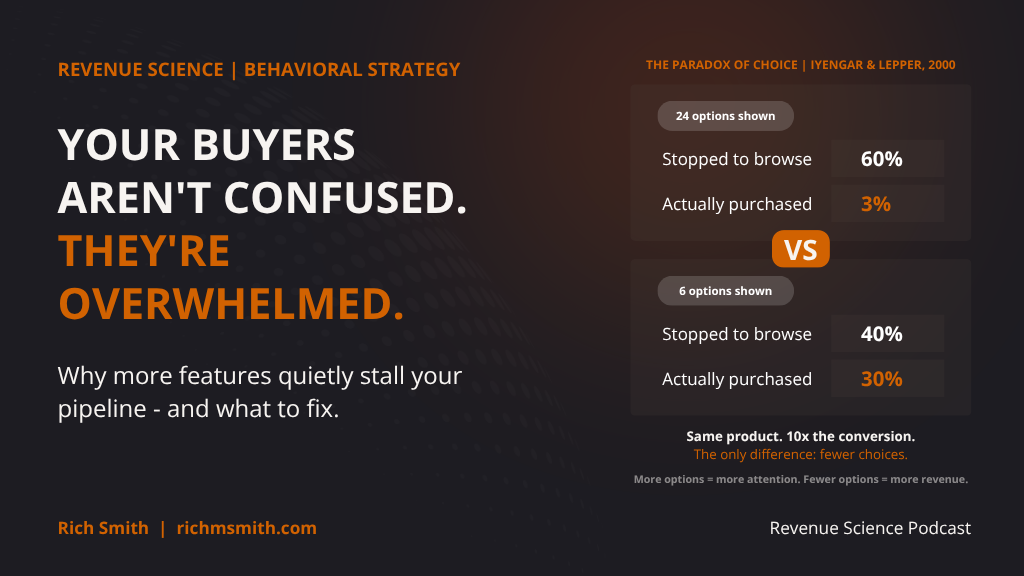
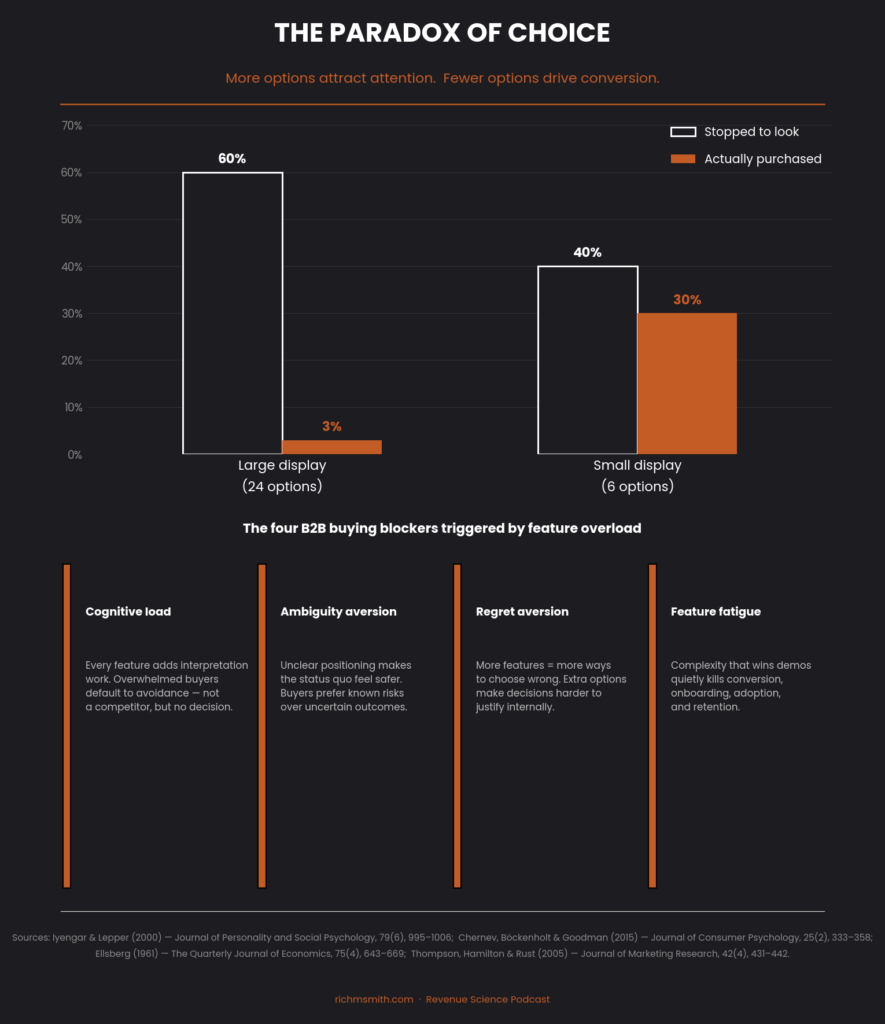
In 2000, psychologists Sheena Iyengar and Mark Lepper ran a now-famous experiment at an upscale California grocery store. On alternating days, they set up a tasting booth with either 6 varieties of jam or 24. The large display attracted more attention — about 60% of shoppers stopped, versus roughly 40% at the smaller display. But when it came to buying, only 3% of shoppers who saw 24 jams made a purchase, compared to roughly 30% of those who saw just 6 (Iyengar & Lepper, 2000).
More options generated curiosity. Fewer options generated commitment.
That distinction — between attention and conversion — is one of the most important and most ignored concepts in revenue strategy. And most companies optimize entirely for the wrong one.
Now apply that to your product page, your sales deck, or your pricing table. How many options are you putting in front of a buyer who is already uncertain?
What is actually happening inside the buyer’s brain
The behavioral mechanisms are well-documented and map directly onto B2B buying.
Cognitive load and ambiguity aversion. Every feature you present adds interpretation work — what it means, whether they need it, how it compares, whether it changes implementation. When the cognitive cost becomes too high, the brain defaults to avoidance. Chernev, Böckenholt, and Goodman’s (2015) meta-analysis found that choice overload is most likely when the choice set is complex, the decision is difficult, and the buyer’s goal is unclear — a near-perfect description of the average B2B evaluation. Layer in what Ellsberg (1961) called ambiguity aversion — the well-documented preference for known risks over uncertain outcomes — and the status quo becomes the safe harbor. Unclear positioning doesn’t just confuse buyers. It actively pushes them toward doing nothing.
Regret aversion. The more features you present, the more ways there are to choose wrong. Tversky and Shafir (1992) found that people are significantly more likely to defer decisions when additional options make the choice harder to justify. In B2B, that looks like stalled pipeline and “let’s revisit next quarter.”
Feature fatigue. Thompson, Hamilton, and Rust (2005) demonstrated that customers weight capability more heavily before use and usability more heavily after use. Feature-heavy positioning may generate demos. It quietly damages conversion, onboarding, adoption, and retention.
The companies that figured this out
When Steve Jobs returned to Apple in 1997, the product line had sprawled into dozens of overlapping configurations that confused both customers and the organization. Jobs drew a simple two-by-two grid — consumer versus professional, desktop versus portable — and told the teams Apple would build one great product per quadrant and nothing else. By fiscal year 1998, Apple had reversed a $1.045 billion loss into a $309 million profit (Apple Inc., 1998 Annual Report). Clarity was the product strategy.
The same logic held at Procter & Gamble. By reducing Head & Shoulders variants from 26 to 15, P&G reportedly increased sales by approximately 10% (as cited in Goldstein, Martin, & Cialdini, 2008). Fewer choices made the decision easier, and easier decisions got made.
This pattern is not limited to consumer products. Bain & Company’s research found that when a food brand in Belgium reduced its SKU count by 42%, revenues grew 17% (Bain & Company, 2024). McKinsey’s analysis of simplification programs found revenue gains of one to four percentage points and margin improvements of three to six points — even as SKU counts dropped by 25% (McKinsey & Company, 2023).
The mechanism is consistent: when buyers can immediately self-identify, they move faster and spend more.
April Dunford’s frame changes everything
On a recent episode of the Revenue Science Podcast, I spoke with April Dunford about exactly this dynamic. Her central argument: positioning is not a messaging exercise. It is a revenue strategy — and it starts not with your features but with your buyer’s alternatives.
As Dunford writes, “Positioning defines how your product is a leader at delivering something that a well-defined set of customers cares a lot about” (Dunford, 2019, p. 17). Not everyone. Not all use cases. A specific buyer, against specific alternatives. Her framework moves in sequence: competitive alternatives first, then differentiated capabilities, then value, then segment, then market category. A feature inventory does not appear anywhere in that sequence.
A feature is not inherently valuable. It is only valuable in relation to what the buyer would otherwise do. “AI-powered analytics” is a capability. Positioning answers: compared to what? A spreadsheet? A legacy BI tool? A manual process? Until the alternative is clear, the value cannot be clear — and the buyer cannot commit.
The executive playbook: subtract to grow
Before you add anything to your H2 strategy, run this diagnostic.
Audit what you lead with. List every feature on your homepage, sales deck, and proposals. Classify each: differentiated and valuable; valuable but not differentiated; or neither. Only the first category belongs at the center of your positioning. Everything else is cognitive tax on the buyer.
Rebuild around the real alternative. For each segment, ask: what would this buyer do if we did not exist? Your positioning must defeat that actual option — not a theoretical competitor list. The answer might be a spreadsheet, a manual process, or doing nothing. That is your real competition.
Give sales a narrative, not a tour. The strongest sales story explains why the status quo is no longer safe, why this specific capability matters for this specific buyer, and why acting now beats waiting. That is a decision guide. A feature list is not.
Executive bottom line
More features do not automatically create more value. In many cases, they create more work for the buyer — and buyers who have to work too hard default to the safest choice available: doing nothing.
The companies that grow fastest in H2 may not be the ones that add the most. They may be the ones that subtract the most strategically — cutting the noise, clarifying the choice, and making it easy for the right buyer to say yes.
Revenue comes from reducing the cognitive cost of commitment. That is not a slogan. It is a mechanism.
About Rich Smith: Rich M. Smith is an executive advisor, behavioral marketing strategist, investor, and CMO known for helping leaders finally understand not only how their strategy works, but why. With three decades of experience leading growth across financial services, healthcare, technology, and consumer brands, Rich has guided companies through crises, rebuilt brands from the ground up, and helped position organizations for nine-figure exits. He blends behavioral science, human psychology, and real-world executive experience to take the smoke and mirrors out of marketing—giving CEOs a clear, trustworthy path to growth. Rich is the bridge between marketing and the boardroom, known for translating complex ideas into practical strategies teams can use immediately. Whether he’s speaking to founders, executives, or investors, Rich shows audiences how to think differently, communicate with confidence, and use what sets them apart to win. Connect at RichMSmith.com · LinkedIn
References
Bain & Company. (2024). Growth through simplicity: How CPG companies are winning by cutting SKUs. Bain & Company.
Chernev, A., Böckenholt, U., & Goodman, J. K. (2015). Choice overload: A conceptual review and meta-analysis. Journal of Consumer Psychology, 25(2), 333–358.
Dunford, A. (2019). Obviously awesome: How to nail product positioning so customers get it, buy it, love it. Ambient Strategy.
Ellsberg, D. (1961). Risk, ambiguity, and the Savage axioms. The Quarterly Journal of Economics, 75(4), 643–669.
Goldstein, N. J., Martin, S. J., & Cialdini, R. B. (2008). Yes! 50 scientifically proven ways to be persuasive. Free Press.
Iyengar, S. S., & Lepper, M. R. (2000). When choice is demotivating: Can one desire too much of a good thing? Journal of Personality and Social Psychology, 79(6), 995–1006.
McKinsey & Company. (2023). Simpler is (sometimes) better: The case for SKU rationalization. McKinsey & Company.
Scheibehenne, B., Greifeneder, R., & Todd, P. M. (2010). Can there ever be too many options? A meta-analytic review of choice overload. Journal of Consumer Research, 37(3), 409–425. https://doi.org/10.1086/651235
Schwartz, B. (2004). The paradox of choice: Why more is less. HarperCollins.
Thompson, D. V., Hamilton, R. W., & Rust, R. T. (2005). Feature fatigue: When product capabilities become too much of a good thing. Journal of Marketing Research, 42(4), 431–442. https://doi.org/10.1509/jmkr.2005.42.4.431
Tversky, A., & Shafir, E. (1992). Choice under conflict: The dynamics of deferred decision. Psychological Science, 3(6), 358–361.