She’d been on the evaluation team for three months. Two vendors remained. Objectively, both had comparable features, similar pricing, and decent references. But in the final meeting, she said something her VP wouldn’t forget: “I just trust the first company more.” When he pushed her to explain, she couldn’t. She mentioned a conference presentation. A logo she recognized. A salesperson who had been “really on top of things.” None of it added up to a rational evaluation. All of it added up to a decision.
That company won the deal. Not because they were measurably better. Because they had built a halo — and she’d been living inside it without knowing it.
Your buyers are not evaluating you. They’re inferring you.
As H2 planning kicks into gear, leadership teams are doing what they always do: adding more. More campaigns. More features. More sales headcount. More noise.
But there’s a more powerful growth lever hiding in plain sight — and it lives entirely in your buyers’ minds.
The halo effect, first documented by psychologist Edward Thorndike, describes how a general impression of someone or something spills over into judgments about specific traits (Thorndike, 1920). Nisbett and Wilson later showed that people don’t even realize this distortion is happening — they believe they are evaluating independently when they’re actually deriving everything from one dominant cue (Nisbett & Wilson, 1977).
In markets, this matters enormously. Halo in brand terms is a situation in which performance on one attribute — or a global impression of the brand — influences judgments on all other attributes, and it is especially pervasive in product-quality perceptions and strongly related to brand recommendations (Madden, Roth, & Dillon, 2012). Recommendations, of course, are tightly linked to referrals. Referrals are tightly linked to growth.
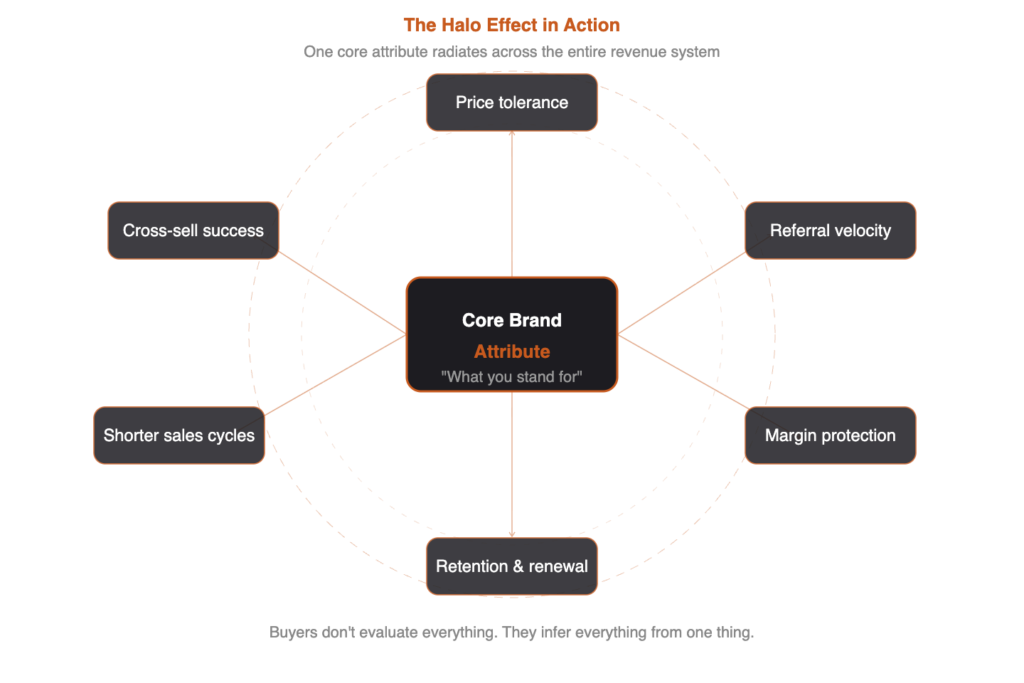
Put simply: your buyers are not evaluating your pricing, your features, your support, and your roadmap individually. They’re using one shortcut to infer all of it.
Why the brain takes the shortcut
Kahneman and Frederick showed that when people face a difficult judgment, they substitute an easier one — unconsciously (Kahneman & Frederick, 2002). The hard question is: “Is this company really better than the alternatives?” The easy substitute is: “Does this company feel trustworthy? Safe? Premium?“
The affect heuristic pushes the same mechanism further — people use fast feelings of “goodness” or “badness” to guide judgments automatically, meaning a salient attribute doesn’t stay merely descriptive. It becomes emotional shorthand (Slovic, Finucane, Peters, & MacGregor, 2007). “Trusted” lowers perceived risk. “Simple” makes complexity feel manageable. “Exclusive” makes buyers willing to wait.
This is especially potent in B2B, where career risk, compliance uncertainty, and switching costs make buyers intensely risk-averse. Strong brands help buyers infer product position, lower uncertainty, and simplify choice — and that mechanism is likely even more important in high-stakes categories where uncertainty is elevated (Erdem & Swait, 1998; Erdem, Swait, & Valenzuela, 2006).
The commercial consequence: pricing power and profit
Here’s where this stops being a “brand conversation” and becomes a boardroom conversation.
Strong associations don’t only make brands more memorable — they make them more defensible. Brand trust and affect combine to drive forms of loyalty that influence the outcomes executives care about most: market share and relative price (Chaudhuri & Holbrook, 2001).
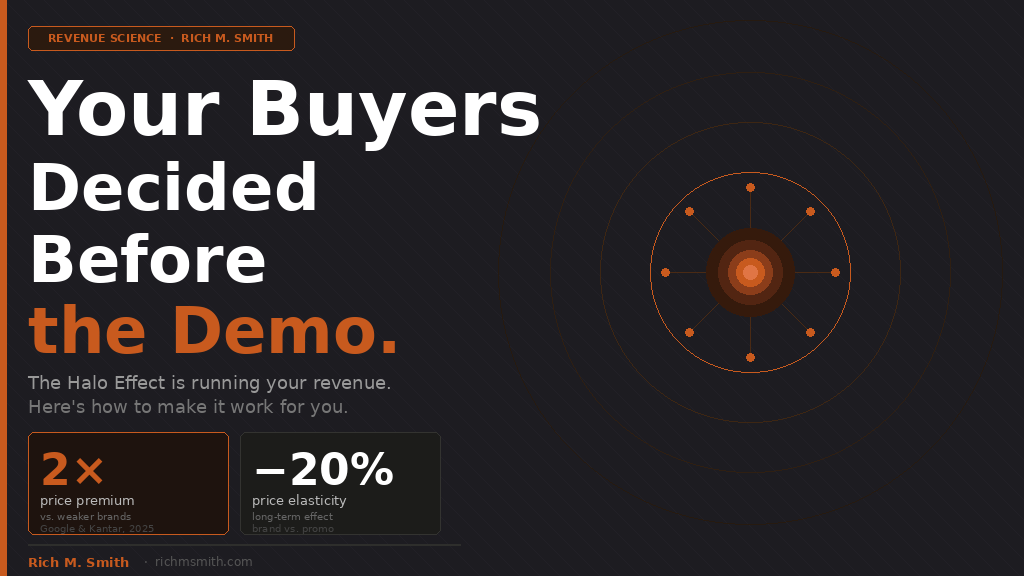
Strong brands can command prices up to twice those of weaker competitors, and moving toward more balanced brand building can reduce price elasticity by up to 20% in the long run (Google & Kantar, 2025). In a market where margin compression is relentless, that’s not a soft metric — that’s a survival advantage.
Halo also enables expansion. Central brand associations transfer across product-line extensions regardless of price tier, and brand-elicited affect can shape evaluations of adjacent offers even when similarity between the core brand and the extension isn’t especially high (Tafani, Michel, & Rosa, 2009; Yeung & Wyer, 2005). Translation: one well-built brand meaning can open the door to cross-sell and category expansion before those new offerings have earned it on their own.
Three companies. Three halos. One pattern.
Apple has taught buyers to let a tight cluster — integrated design, reliability, security, innovation — stand in for the entire company. Apple reported fiscal 2025 net sales of $416.2 billion, a services gross margin of 75.4%, and then its best March quarter ever at $111.2 billion in revenue in Q1 2026 (Apple Inc., 2025, 2026). That halo travels across devices, software, and services with remarkable pricing power.
Costco operates the same logic from the opposite aesthetic. Its philosophy centers on maintaining a perception of “pricing authority” — the consistent belief among members that Costco offers the most competitive values. With fiscal 2025 membership fees of $5.3 billion, U.S. and Canada renewal of 92.3%, and Executive members driving 73.6% of worldwide net sales (Costco Wholesale Corporation, 2025a, 2025b), the halo “Costco is on my side” does the work of re-evaluation on every category, every visit.
Ferrari shows halo operating as a profit engine at the extreme end. Ferrari protects a core attribute cluster — scarcity, performance, exclusivity — so rigorously that the halo shapes willingness to pay and willingness to wait, producing first-quarter 2026 revenues of €1.848 billion and an EBIT margin of 29.7% with an order book extending toward end of 2027 (Ferrari N.V., 2026).
The winning attribute is different in each case. What’s identical is the deliberateness: choose one, make it operationally real, protect it obsessively.
What your leadership team should actually do
First: choose a diagnostic attribute, not a tagline. The right question isn’t “What do we want to say?” It’s “What single attribute would buyers most logically use as a shortcut for our total value?” The best candidates are economically meaningful in purchase decisions, credible in today’s customer experience, and extensible across adjacent offers (Keller, 1993).
Second: turn it into a proof architecture. Marketing cannot create a durable halo for a promise the business doesn’t operationally deliver. Product design, pricing policy, service protocols, hiring standards, and post-sale experience all need to reinforce the same meaning (Magnoni, 2016). If the chosen attribute is “simple,” the onboarding cannot be confusing. If it’s “trusted,” billing cannot feel opportunistic.
Third: align the entire revenue system around one cue. The CEO narrative, marketing creative, website hierarchy, sales deck, demo sequence, pricing architecture, and customer-success scripts should all make the same conclusion easy to reach — not repetition for its own sake, but memory formation (LinkedIn B2B Institute, 2019, 2023). Buyers should be able to repeat your company’s meaning in one sentence without opening a deck.
Fourth: manage halo as a financial asset. The dashboard that matters isn’t a stack of soft brand KPIs. It’s a short set of commercial indicators: attribute ownership in brand tracking, win rate when the attribute appears in discovery, average selling price versus category norms, sales cycle length, cross-sell rate, renewal, and referral volume (Ailawadi, Lehmann, & Neslin, 2003).
Fifth: protect against halo reversal with the same discipline. “Bad is stronger than good” — once you’ve taught customers to use one core attribute as shorthand, failure on that attribute is disproportionately damaging (Baumeister, Bratslavsky, Finkenauer, & Vohs, 2001). A trusted SaaS company cannot afford a security lapse. A premium services firm cannot afford inconsistent delivery. The more the business depends on a halo, the more it must over-invest in the systems that prevent it from reversing.
The real H2 growth question
As your planning cycles close, the temptation will be to add: more messages, more channels, more capabilities. The Revenue Science approach asks a different question entirely.
What one market meaning do you want buyers to use as shorthand for your entire company?
Once you can answer that in a single sentence — one that your sales team, your marketing team, and your CEO would all say identically — the work becomes organizational. Align product, sales, marketing, and customer experience so the market reaches that conclusion almost automatically.
That’s how halo turns from a cognitive bias into a strategic asset.
About Rich Smith: Rich M. Smith is an executive advisor, behavioral marketing strategist, investor, and CMO known for helping leaders finally understand not only how their strategy works, but why. With three decades of experience leading growth across financial services, healthcare, technology, and consumer brands, Rich has guided companies through crises, rebuilt brands from the ground up, and helped position organizations for nine-figure exits. He blends behavioral science, human psychology, and real-world executive experience to take the smoke and mirrors out of marketing—giving CEOs a clear, trustworthy path to growth. Rich is the bridge between marketing and the boardroom, known for translating complex ideas into practical strategies teams can use immediately. Whether he’s speaking to founders, executives, or investors, Rich shows audiences how to think differently, communicate with confidence, and use what sets them apart to win. Connect at RichMSmith.com · LinkedIn
References
Ailawadi, K. L., Lehmann, D. R., & Neslin, S. A. (2003). Revenue premium as an outcome measure of brand equity. Journal of Marketing, 67(4), 1–17.
Apple Inc. (2025). Annual report on Form 10-K for the fiscal year ended September 27, 2025.
Apple Inc. (2026, April 30). Apple reports second quarter results. Apple Newsroom.
Baumeister, R. F., Bratslavsky, E., Finkenauer, C., & Vohs, K. D. (2001). Bad is stronger than good. Review of General Psychology, 5(4), 323–370.
Chaudhuri, A., & Holbrook, M. B. (2001). The chain of effects from brand trust and brand affect to brand performance. Journal of Marketing, 65(2), 81–93.
Costco Wholesale Corporation. (2025a). Annual report on Form 10-K for the fiscal year ended August 31, 2025.
Costco Wholesale Corporation. (2025b, September 25). Costco Wholesale Corporation reports fourth quarter and fiscal year 2025 operating results.
Erdem, T., & Swait, J. (1998). Brand equity as a signaling phenomenon. Journal of Consumer Psychology.
Erdem, T., Swait, J., & Valenzuela, A. (2006). Brands as signals: A cross-country validation study.
Ferrari N.V. (2026, May 5). Another quarter of strong mix. 2026 guidance confirmed.
Google & Kantar. (2025). The Effectiveness Equation: Brand equity & pricing power.
Kahneman, D., & Frederick, S. (2002). Representativeness revisited: Attribute substitution in intuitive judgment. In Heuristics and Biases: The Psychology of Intuitive Judgment (pp. 49–81). Cambridge University Press.
Keller, K. L. (1993). Conceptualizing, measuring, and managing customer-based brand equity. Journal of Marketing, 57(1), 1–22.
LinkedIn B2B Institute. (2019). The 5 principles of growth in B2B marketing.
LinkedIn B2B Institute. (2023). How B2B tech brands grow.
Madden, T. J., Roth, M. S., & Dillon, W. R. (2012). Global product quality and corporate social responsibility perceptions: A cross-national study of halo effects. Journal of International Marketing.
Magnoni, F. (2016). The effects of downward line extension on brand trust and brand attachment. Recherche et Applications en Marketing, 31(1).
Nisbett, R. E., & Wilson, T. D. (1977). The halo effect: Evidence for unconscious alteration of judgments. Journal of Personality and Social Psychology, 35, 250–256.
Slovic, P., Finucane, M. L., Peters, E., & MacGregor, D. G. (2007). The affect heuristic. European Journal of Operational Research, 177, 1333–1352.
Tafani, É., Michel, G., & Rosa, E. (2009). Vertical product line extension strategies: An evaluation of brand halo effect according to range level. Recherche et Applications en Marketing, 24(2).
Thorndike, E. L. (1920). A constant error in psychological ratings. Journal of Applied Psychology.
Yeung, C. W. M., & Wyer, R. S., Jr. (2005). Does loving a brand mean loving its products? The role of brand-elicited affect in brand extension evaluations. Journal of Marketing Research, 42(4), 495–506.