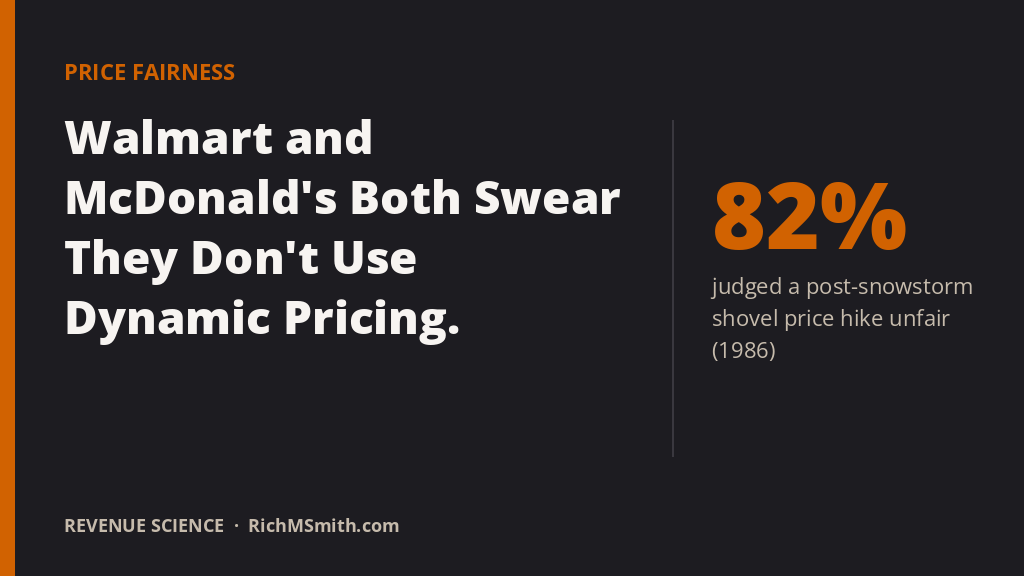
In early October, Walmart published an open letter to answer a charge it had heard for months: that its new digital shelf labels were infrastructure for surge pricing. Its head of corporate affairs, Dan Bartlett, was blunt. Walmart, he wrote, does not raise prices “in response to a hot afternoon or an approaching snowstorm” (eMarketer, 2026; The Shelby Report, 2026). Days later, after reporting on an AI pricing tool McDonald’s offers its franchisees, McDonald’s issued its own statement: “McDonald’s does not use dynamic pricing” (eMarketer, 2026; Retail Brew, 2026).
Two of the most sophisticated pricing operations in the world, both spending executive time to deny they do something every airline and hotel does openly. Maryland made the point for them: its ban on grocery pricing based on shoppers’ personal data took effect October 1 (Tasting Table, 2026). The interesting part isn’t the denials. It’s Walmart’s choice of example. A snowstorm. That is almost exactly the question three economists asked forty years ago.
The Snow Shovel Question
In 1986, Daniel Kahneman, Jack Knetsch, and Richard Thaler surveyed residents of Toronto and Vancouver about everyday pricing decisions. One scenario: a hardware store has been selling snow shovels for $15. The morning after a large snowstorm, it raises the price to $20. Is that fair?
Economically, it’s efficient. Demand rose; price followed. But 82% of respondents called it unfair (Kahneman et al., 1986).
Now change one detail. A grocer’s wholesale cost for lettuce rises because of a shortage, and the grocer passes the increase on to customers. Most respondents — 79% — said that was acceptable.
The authors called the pattern dual entitlement. Customers feel entitled to a reference price, the price they’re used to paying. Firms are entitled to a reference profit. Raising prices to protect your profit when your costs rise is fair. Raising prices because the customer’s need just went up is not, even when the dollar amounts are identical.
Same Money, Different Verdict
The study’s most useful finding for anyone who sets prices is about framing. When a popular car model is in short supply, a dealer who starts charging $200 above list price was judged unfair by 71% of respondents. A dealer who had been selling $200 below list and simply stops discounting was judged unfair by only 42% (Kahneman et al., 1986).
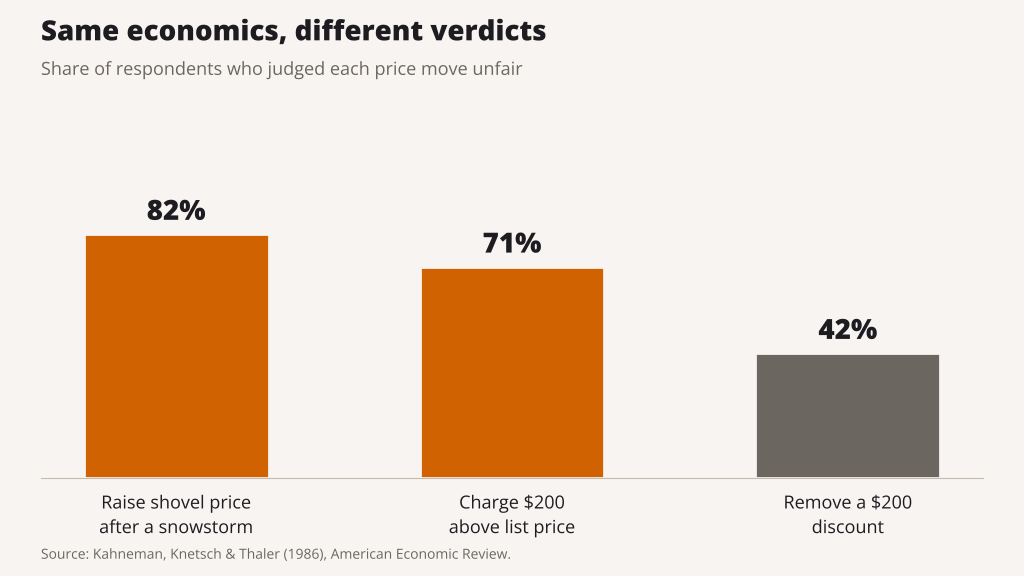
The customer pays exactly the same price in both versions. What changed was the reference point. A surcharge moves the customer’s reference price up. Removing a discount just returns to a reference price they already accepted.
Coca-Cola Learned This the Hard Way
In October 1999, Coca-Cola chairman Doug Ivester told the Brazilian magazine Veja that the company was evaluating a vending machine with a temperature sensor that could raise prices when the weather got hot. Coke, he explained, is “a product whose utility varies from moment to moment” (CNN Money, 1999).
The reaction was immediate. A Pepsi spokesman said machines that raise prices in hot weather exploit consumers in warm climates, and Coca-Cola said none of the machines were in use (CNN Money, 1999; The New York Times, 1999).
The same technology could have been described as a discount on cool days. Coke described a surcharge on hot ones, which is the snow shovel all over again.
Why This Is Now a B2B Problem
It’s easy to read this as a consumer story about burgers and soda. It isn’t. B2B companies are moving to usage-based pricing, consumption credits, AI-assisted quoting, and annual price-increase clauses. Every one of those is a price change a customer will judge against a reference point, and every one comes with a reason the customer will either accept or resent.
The lesson from 1986 is that customers don’t evaluate the size of a change nearly as much as they evaluate its justification. A 7% increase tied to a documented cost is easier to accept than a 4% increase that looks like you noticed they can’t leave.
That gap between what is economically efficient and what customers will accept is the Rationality Gap in pricing. Close it on purpose, or your customers will close it for you by churning.
The Price Fairness Test
Before your next price change, renewal increase, or new pricing model ships, run it through four questions.
- Is it tied to your cost or to their need? Passing on a real cost increase reads as fair. Charging more because the customer is busier, more dependent, or more desperate reads as exploitation, even if it’s priced identically.
- Are you raising their reference price or removing a discount? If you have flexibility, set list prices where you can defend them and use discounts for timing, volume, or commitment. Pulling back a discount is judged far more kindly than adding a surcharge.
- Can the customer explain it to their boss in one sentence? Your buyer has to justify the new invoice internally. If the reason doesn’t fit in a sentence, they’ll fill in a worse one.
- Would it survive a screenshot? Walmart and McDonald’s spent October answering screenshots, patents, and reports about tools. Assume your pricing logic will be seen. If it would embarrass you on LinkedIn, it will cost you at renewal.
None of this means you can’t use smart pricing. It means the logic behind the price is part of the product. Customers will forgive a higher price far sooner than a reason they don’t believe.
References
CNN Money. (1999, October 27). Coke price rises with heat. https://money.cnn.com/1999/10/27/companies/coke/
eMarketer. (2026, October). Smarter pricing tools are raising new questions about consumer trust. https://www.emarketer.com/content/dynamic-pricing-backlash-walmart-mcdonalds-consumer-trust
Kahneman, D., Knetsch, J. L., & Thaler, R. (1986). Fairness as a constraint on profit seeking: Entitlements in the market. American Economic Review, 76(4), 728–741.
Retail Brew. (2026, October 13). Walmart, McDonald’s push back against dynamic pricing fears. https://www.retailbrew.com/stories/walmart-mcdonalds-push-back-against-dynamic-pricing-fears
Tasting Table. (2026, October). This state just made a major grocery price change to save shoppers money. https://www.tastingtable.com/2276436/maryland-grocery-store-dynamic-pricing-ban-save-shoppers-money/
The New York Times. (1999, October 28). Coke tests vending unit that can hike prices in hot weather.
The Shelby Report. (2026, October 6). Walmart publishes open letter disputing dynamic pricing claims. https://theshelbyreport.com/2026/10/06/walmart-publishes-open-letter-disputing-dynamic-pricing-claims/