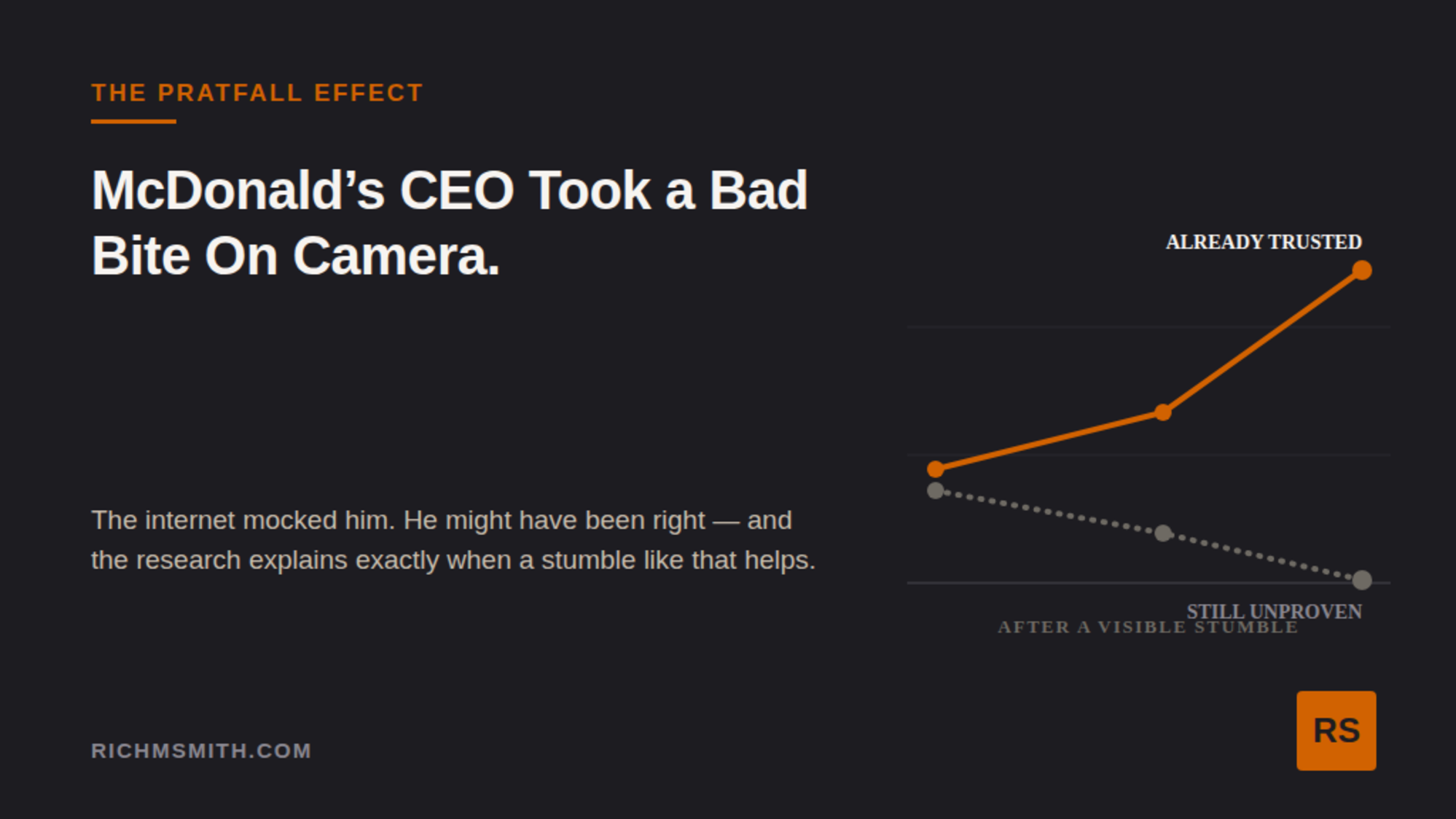
Chris Kempczinski, chairman and CEO of McDonald’s, picked up the company’s new Big Arch burger for a promotional Instagram Reel, stared at it for a beat too long, took a bite so small it barely qualified, and called it “a product.” Burger King replied that it couldn’t finish it either. Wendy’s piled on. Commenters piled on harder. By the time the joke ran its course, Axios reported nearly 47,900 mentions of McDonald’s and an estimated reach of 5.8 billion on the campaign’s biggest conversation day (Axios, 2026), while Fortune reported roughly 11 million Instagram views and about 30% follower growth for Kempczinski himself (Fortune, 2026).
McDonald’s went on to report 3.9% U.S. comparable-sales growth for the quarter, with the Big Arch promotion described on the earnings call as performing in line with expectations (McDonald’s Corporation, 2026). That’s a real result, but it isn’t proof the awkward video caused it. What the video does show is something more useful to a CEO who will never approve a script like that on purpose: getting visibly, harmlessly wrong in public didn’t cost Kempczinski anything. It may have bought him something.
Why the Mockery Didn’t Backfire
Social psychologists Elliot Aronson, Ben Willerman, and Joanne Floyd ran the study that explains why, six decades before anyone had a smartphone. Forty-eight college students listened to a recording of a quiz-show contestant who either performed brilliantly (92% correct, honor student, track team) or averagely (30% correct, ordinary grades, cut from the team). Half the recordings ended with the contestant spilling coffee on his new suit. The other half didn’t.
The competent contestant’s likability score rose from 20.8 to 30.2 after the spill. The average contestant’s score collapsed from 17.8 to −2.5 (Aronson et al., 1966).
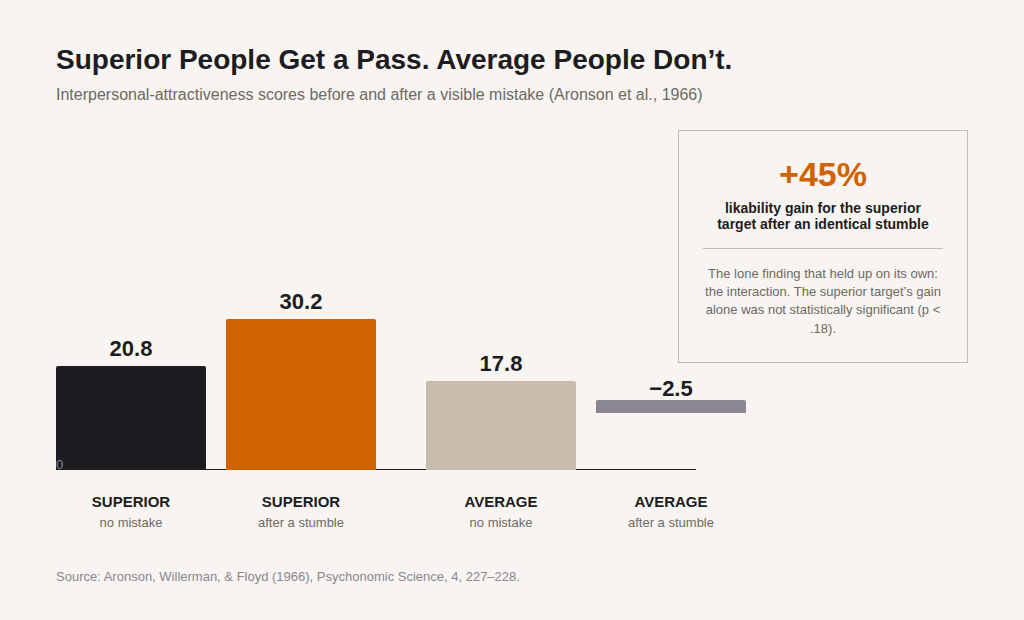
That’s the pratfall effect, and the honest version of it — the one most retellings skip — has a catch worth building a strategy around. The boost for the competent contestant, on its own, didn’t reach statistical significance. The only result that held up cleanly was the interaction: how much a stumble helps or hurts depends entirely on whether the audience already believes you’re good at your job.
Imperfection Is a Multiplier, Not a Substitute
Modern research sharpens the same point. A 2026 study of more than three thousand participants found that people who reacted to their own small, harmless mistakes with amusement were rated as warmer, more competent, and more authentic than people who reacted with embarrassment — but that advantage weakened or reversed the moment the mistake actually harmed someone else (Göksel et al., 2026). In marketing, Ein-Gar, Shiv, and Tormala (2012) found that a minor negative detail could improve product evaluations, but mainly when it came after the positives had already been established, not before.
Put together, the research describes a two-signal model. An audience is constantly asking two questions about your brand or your executive team: can you do the job, and can I relate to you? Polish protects the first signal. It can quietly suppress the second. A visible, harmless imperfection can restore the second signal — but only once the first one is already secure.
Domino’s Proved It with a P&L, Not a Meme
The clearest precedent for revenue leaders predates social virality entirely. In 2009, Domino’s ran national ads airing real customer complaints about its pizza — the crust, the sauce, the taste — on camera, alongside footage of employees reformulating the recipe (Columbia Business School, n.d.). It was the Pizza Turnaround campaign, and it broke every instinct a brand has to hide criticism instead of amplifying it.
The result wasn’t a viral moment. It was 14.3% U.S. same-store sales growth in the first quarter after launch, which the company’s own investor release attributed to traffic tied to the new pizza (Domino’s Pizza, 2010). The distinction that matters for revenue leaders: Domino’s didn’t just admit a flaw. It paired the admission with visible, immediate remediation. That’s the competence signal staying fully intact while the relatability signal gets a genuine boost — the same interaction Aronson found in a lab, playing out at the scale of a public company’s P&L.
A Three-Question Test Before Your Next Campaign, Launch, or Executive Post
Before your team ships — or reshoots into safety — anything that shows a founder, a product, or a company being less than perfect, run it through three questions.
- Is competence already established? An unproven vendor admitting a flaw reads as a warning sign. A market leader doing the same reads as human.
- Does the imperfection harm anyone, or does it just look a little awkward? Harmless is humanizing. Costly to a customer is an accountability problem, not a relatability opportunity — and no messaging framework changes that.
- Does the strength still show through? Domino’s showed the fix on camera. Kempczinski was still, visibly, the chairman and CEO running one of the most recognized restaurant companies on earth. Strip away the underlying evidence of capability, and the same imperfection just reads as incompetence.
None of this is a case for manufacturing mistakes. It’s a case for not reshooting every hesitation, laugh, or slightly awkward moment out of your executive content once your competence is no longer in question. The audience already knows you’re good at the job. What they’re deciding, every time you show up, is whether you’re real.
References
Aronson, E., Willerman, B., & Floyd, J. (1966). The effect of a pratfall on increasing interpersonal attractiveness. Psychonomic Science, 4, 227–228. https://doi.org/10.3758/BF03342263
Axios. (2026, March 12). How McDonald’s CEO’s viral burger video turned memes into money. https://www.axios.com/2026/03/12/kempczinski-mcdonalds-viral-moment-sales
Columbia Business School. (n.d.). Domino’s wins by eating a little humble pie. https://business.columbia.edu/insights/brand-talk/dominos-wins-eating-little-humble-pie
Domino’s Pizza. (2010, April 22). Domino’s Pizza announces first quarter 2010 financial results [Press release]. https://ir.dominos.com/news-releases/news-release-details/dominos-pizza-announces-first-quarter-2010-financial-results
Ein-Gar, D., Shiv, B., & Tormala, Z. L. (2012). When blemishing leads to blossoming: The positive effect of negative information. Journal of Consumer Research, 38(5), 846–859. https://doi.org/10.1086/660807
Fortune. (2026, March 6). McDonald’s CEO’s viral burger taste test has a silver lining. https://fortune.com/2026/03/06/mcdonalds-ceo-did-a-burger-taste-test-that-became-a-cautionary-tale-for-execs-but-theres-a-silver-lining/
Göksel, S., Sezer, O., & Berman, J. Z. (2026). Transcending embarrassment: On the reputational benefits of laughing at yourself. Journal of Personality and Social Psychology, 130, 1078–1101. https://doi.org/10.1037/pspa0000477
McDonald’s Corporation. (2026, April). McDonald’s reports first quarter 2026 results. https://corporate.mcdonalds.com/corpmcd/our-stories/article/Q1-2026-results.html