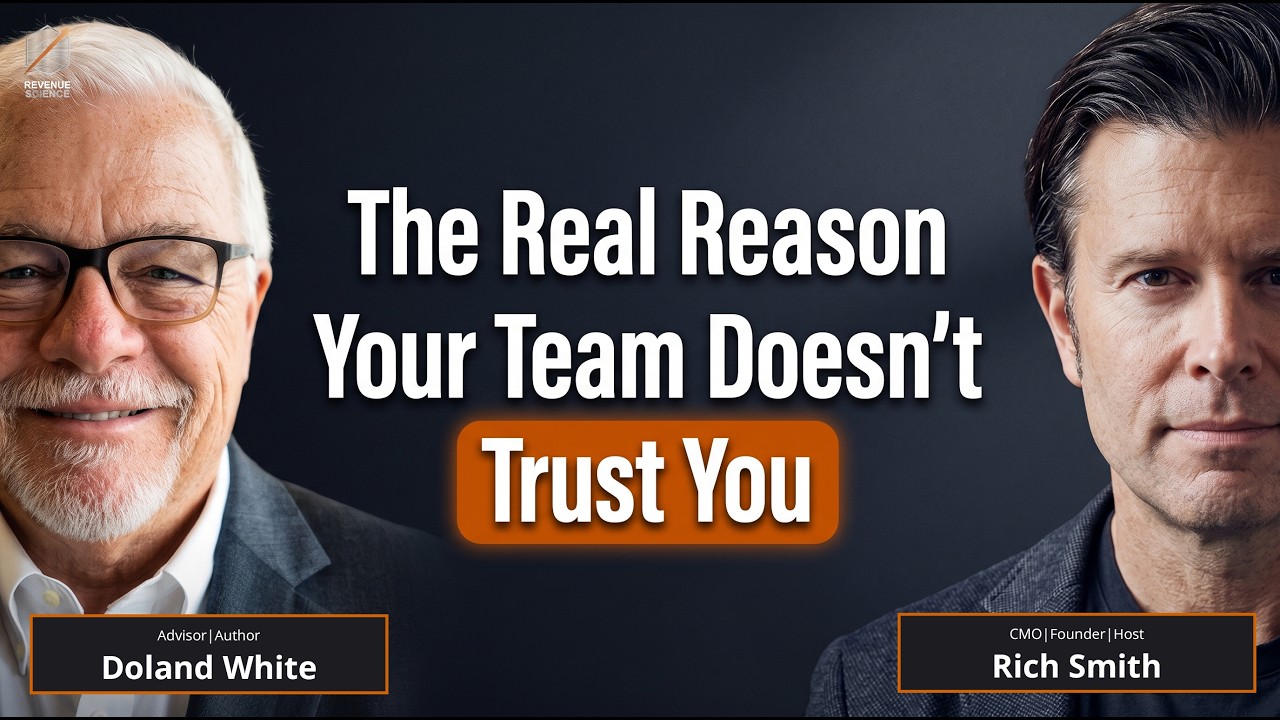
[0:00] Doland White: There's the old colloquialism: when you're in the jar, you can't read the label. When you're in the jar and you're hung up on the day-to-day, it's hard to really see that. And it does take a little bit of coaching to say, "Hey, let's just take a pause. Let me look at your calendar. Let's do something simple."
[0:30] Rich Smith: Welcome to Revenue Science, the show where we translate marketing and sales complexity into boardroom clarity for CEOs, founders, and growth leaders building predictable revenue growth systems. I'm Rich Smith — CMO, founder, executive adviser, investor, and your host. Thank you for joining us today, and please help us reach more leaders by liking, subscribing, and sharing this episode.
[0:56] Rich Smith: Entrepreneurship remains one of the most powerful forces for improving lives. When founders succeed, they create opportunities for employees, value for customers, and stronger communities. Today's guest is Doland White, founder of Doland White Consulting, host of the Next Interview Show, executive leadership coach, and author of "Lead with Confidence: How to Build Trust, Create Ownership, and Lead at Scale."
[1:21] Rich Smith: Dolan brings a perspective that's particularly relevant to our audience, because his leadership philosophy wasn't developed in a classroom — it was forged through decades serving as a COO, president, CEO, and adviser across multiple industries. Throughout his career, Dolan observed a pattern that many leaders miss: companies rarely fail because they lack opportunity. More often, they fail because growth outpaces leadership. Decisions bottleneck at the top. Accountability becomes unclear. Teams become dependent instead of empowered. Trust erodes. And eventually the organization becomes incapable of scaling beyond the capacity of its leaders.
[2:01] Rich Smith: What I find especially interesting is how closely this connects to themes we discuss frequently on Revenue Science — many of the revenue problems CEOs think are marketing problems, sales problems, or operational problems are actually leadership and behavior problems in disguise. Today we're going to explore trust, accountability, ownership, decision-making, behavioral science, founder bottlenecks, and what it truly means to build an organization that can scale without everything running through the CEO. Dolan, welcome to Revenue Science.
[2:38] Doland White: Thank you, Rich. It's an honor to be here with you. I appreciate the opportunity. It's great to be talking to you again.
[2:44] Rich Smith: We had a lot of fun together on your podcast, and I'll let you tell the audience about your show in a minute — but we had such a good conversation there, we decided we needed to do it on mine as well. So here we are, and we'll probably talk about some of the things we covered before, but I think we'll also go into some different areas, because I'd really like to explore more around your backstory, your career, how you got to be where you are, and the lessons you learned along the way. So, take us back to the beginning — what experiences early in your career most shaped the leader you've become today?
[3:19] Doland White: That's such a great question. For the sake of the audience, I'm 73, so we're going way, way back in time. My first real job was as a chef, and there's no "managing" in a kitchen — basically my job was to learn, and then go tell people what to do. So my leadership experience was limited to: do it the way I taught you, do it when I tell you, and get it done. Very command-and-control.
[4:00] Doland White: I made the decision to leave that career — although I still get to cook, just for myself now — and joined an organization and started learning about technology. I was fascinated by it, wanted to learn how to code and how it all worked. Through a couple of starting opportunities, I got the title of director, so now I'm going to go direct and lead people. What I started to learn, kind of the hard way, was that telling people what to do really wasn't leadership — it was command and control, and the results varied, because I really wasn't focusing on empowerment. I spent a good part of my early career being that guy saying, "okay, go do this," and then "why did we miss the mark, how did that happen?"
[5:18] Doland White: Early on in the technology industry, back when computers were first emerging into the household, I was blessed with an organization that brought me in purely based on what they thought my potential was, and made me president and CEO of an international consulting company — about 40 or 50 people. My boss was a guy named Jim McCay, and I had to learn very quickly how to work with people to move toward an outcome and build trust that they had the ability to actually go do it, without being told every step — because we just couldn't scale otherwise. Jim was my first mentor in that space; he'd call me into his office and fundamentally help me with my thinking. I learned a lot from him.
[6:21] Doland White: Those opportunities stacked through my career, and we were ultimately acquired — I became part of a group inside IBM along with another company, and my responsibilities grew geometrically. What I learned through all that ultimately became the framework I use today: there's really four pieces to it. There's trust, which includes autonomy. There's communication, which includes transparency. There's growth, and to get to growth you need innovation. And then you have to have accountability built in — and that's not like a Trello board, it's the agreement between people that we're going to go do something together and move toward that common outcome. I got to grow into that structure and framework across my career.
[7:25] Rich Smith: You've served as a COO, president, CEO, and now you're an adviser to other CEOs — of those four things, which lesson took the longest to learn?
[7:47] Doland White: Oh gosh, that's such a great question. The one that was most difficult to master for me was really developing trust, which is the cornerstone — without trust in an organization, or with your team, you can't get to anything else. The dynamics of trust: I have to trust me first, and then if I can trust me, I can trust someone else. And then on the reciprocal side, that person has to trust themselves, be willing to make the commitment, and then be able to trust me. If you break any of those four pieces, you really haven't reached what I'd define as deep trust. That's the one for me — trust.
[8:54] Rich Smith: That's a great example, and I like your definition. What did it cost you before you learned it?
[9:05] Doland White: It's funny — when I think of that cost, it really came down to, on the business side, not getting to the outcomes we were supposed to get to. At one point I had a team with about a $200 million quota — a big number. I had black hair in those days. And the lesson kind of came through stepping back and asking, why are we consistently missing the number, why are we consistently not achieving the outcome? It was because there was no meaning, there was no trust — there was nothing there that mattered with the team. So the cost for me was really breaking the code and learning how to recognize those symptoms, and that took years.
[10:16] Rich Smith: And all those things are interrelated too — it was a little unfair of me to ask you to pick just one, because they all affect each other. I'd tend to agree that trust is probably the most important, and sometimes the hardest to learn, and it's not just within the organization — trust starts with yourself, then it's trust in the organization, and if the organization doesn't have trust within itself, customers aren't going to trust it either.
[11:00] Doland White: Yeah, there's not a chance — it just won't happen. It's funny you mention that, because over the years I started really studying the science of trust — it takes three to seven consistent interactions over a three-to-six-month period to build trust. You can't just show up and say, "hey, trust me." That automatically puts up a defense mechanism, a wall.
[11:37] Rich Smith: We were re-watching Raiders of the Lost Ark with my stepdaughter last night, and there's a scene where Harrison Ford, as Indiana Jones, says to Marion, "trust me," with a big smile — and she clocks him.
[11:55] Doland White: That's exactly right — if you have to say that, you're not going to find trust.
[12:07] Rich Smith: I had my first live-fire learning experience about the value of trust — and usually you learn the most when you lose it. I happened to be chief marketing officer of AIG Bank during the financial crisis. Talk about being in the crucible — we were ground zero for everything going on. Overnight we went from a trillion-dollar market-cap company nobody had heard of, to one on the lips of every broadcaster on every TV station across the country. There was no shortcut — rebuilding trust meant we had to get out there, say what went wrong, say what we were doing about it, repeat that over and over, and make sure we actually hit those milestones. It took three or four years, but the brand came back to being highly valued and well respected in the market.
[13:16] Rich Smith: Speaking of failures — you just wrote a book, which I mentioned in the intro. Most leadership books are written after a success, so I'm wondering: was there a failure, a frustration, or a leadership mistake that ultimately became the foundation of "Lead with Confidence"?
[13:45] Doland White: Thanks for that question. The book was written to be a field guide — inside it, I take great joy in talking about things that didn't work and the lessons learned, and then here's what not to do instead. There's an old term in the software industry: people don't learn from working on code that works, we learn through trial and error. The book focuses on those four domains — trust and autonomy, communication and transparency, growth and innovation, and accountability — all with the understanding that they're so tightly coupled. To succeed as a leader inside an organization, you have to really understand those domains at depth. That's the lesson I wanted to bring forth. I had fun writing it — one of the joys was the memories: "oh yeah, I remember that day that didn't go quite the way I thought it would," and what I took from there that changed how I led from that point forward.
[15:23] Rich Smith: So when did you first realize that leadership wasn't primarily about managing people, but about creating conditions where people can succeed?
[15:44] Doland White: For me — I spent 32 years in the software industry, and I'll use that as the frame, because when I left it I became CEO of a marketing company, and later chief operating officer of a big company. One of the things that happened in the software industry was I was blessed with a global responsibility for creating a partner ecosystem. One of the lessons that came out of that was discovering the importance of getting to what Simon Sinek calls "the why" — I call it "the for the sake of what." What is it that inspires you? When organizations say "we're going to grow revenue 10% more this year," that's cool, but for the person driving the forklift, what do they get out of it? There's a connection to the why, the "for the sake of what" — that probably was the biggest connection for me, being out with partners all over the planet, deeply coupled with their business, breaking the barrier of "us and them," and really getting into why.
[17:14] Doland White: That moment as a leader took me toward working with people to help them get to what really matters to them. I teach this today to executives: when you have a team, you have love and care for the people in that team, and you should love your team — but it's beyond that. It's important to know what their family goals are, what their spouse's goals are — because that's the layer you're accountable and responsible for as a leader. Once you as a leader realize that at depth, and that you have that deep responsibility to your organization and your customers, it changes everything for you. The money then takes care of itself.
[18:14] Rich Smith: I like the way you put that. I've always had the philosophy within my teams that my job is to make you as successful as you can be, to help you achieve the potential you have — and in some cases I may see potential you don't even see, and I'm going to push you.
[18:36] Doland White: Isn't that amazing when that occurs? I think it's like anything in nature — if it's not growing, it's dying. People flourish when they're in a circumstance where they feel like they're growing and developing, and that's independent of the role within the organization — every role can have that element to it. I think it's one of the keys to a high-performing, well-functioning team. And you know what — you lose people, right? Usually your best people, they move on to other opportunities, and you've got to be okay with that.
[19:19] Rich Smith: Right, you've got to be okay with that, because it says to everybody else: "hey, if I work with him, that might be me next, making that big move."
[19:44] Doland White: It's funny — there's a rule I love telling executives: not everyone is going to make the journey with you. There was a gentleman who was my boss — we used to trade roles, sometimes I was his boss, sometimes he was mine, depending on where we were. I remember him calling me one day and saying, "Hey Dolan, I found this job, senior director at this other company, you'd be a perfect fit." He was my boss, and I had to pause and ask, "So, do I need to pack? Is this a hint?" And he said, "No, no, no — I just see potential that this would be a great move for you. We'll figure it out here, but you go succeed there." It taught me a lifelong lesson: that's what we do, help people to that next step in their lives.
[20:42] Rich Smith: I often hear it described as helping people do more than they think they're capable of — that stretch.
[20:55] Doland White: That's the stretch.
[20:57] Rich Smith: You said something interesting about who's on the journey with you. One of the recurring themes in both our work is that organizations often become dependent on their leader. How does that happen?
[21:21] Doland White: I think there are two sides to it. When you're in the body of a personality-led organization, there can be a persona dependence, and the team can feel like "we have to have Zig in place in order to make revenue" — and then Zig has passed on, and they haven't made the leap to a new strategy. On the flip side, I think dependence on the leader happens because the leader often has a misguided feeling that if they're involved in everything — the decisions, the meetings, fully present — that they're living the model of being shoulder-to-shoulder with the team. But really they're "in the do" with the team rather than "in the lead" with the team.
[22:23] Doland White: So the team becomes dependent on them being there, because they know the leader's going to make the decision, going to "call the ball" — the old colloquialism — rather than the leader being in the leadership position, shoulder-to-shoulder, working with the team on: how do I help you? What can I do to help you make better decisions, gain greater clarity, know that I've got your back — deep trust. That's one of the things I've seen happen a lot: leaders in there with the team, but calling all the shots, so the team stays connected to them and becomes the constraint. They go slow because they can't make decisions at velocity.
[23:16] Rich Smith: What are some warning signs that a founder or CEO has become the bottleneck in their own business?
[23:22] Doland White: Look at your calendar. One of my favorite exercises to take leaders and their directs through is a three-column exercise: in one column, write down everything you do; in the next, write down everything you can delegate; and in the far-right column, write down everything that doesn't matter, that you shouldn't even know about. Make a determination on the value of your time — be a student of your calendar. It's a tactical exercise, but it opens up the conversation: am I really inserting myself in all these decisions? What else could I do? It opens the door to: maybe I can delegate, maybe I can trust — Andy is my favorite name, I've never met an Andy in a company, so I use him a lot — maybe I can trust Andy, and Andy can make these decisions without me being involved.
[24:40] Doland White: That gives leaders a chance to step back — and I'm guilty of this in my own business too. We're inside the jar. There's the old colloquialism: when you're in the jar, you can't read the label. When you're hung up on the day-to-day, it's hard to see that. It takes a little coaching to say, "hey, let's just take a pause, let's look at your calendar, let's do something simple."
[25:11] Rich Smith: I think that's a great practice — something I need to do more of, frankly. It's just human nature, because we want to say yes to things, people ask for our time, and if you're not careful, pretty soon you're living everybody else's agenda and not yours, and you're not driving forward the things you need to, because you're beholden to all these meetings that aren't really aligned with your objective.
[25:46] Doland White: There's a great book out there — for anyone listening — by Keith Cunningham, called "The Road Less Stupid," a killer title. It's about engaging yourself in thinking time, having the opportunity to ask those questions and think through the challenges you're facing. We just finished teaching a mastermind before joining you today, and one conversation we had was, "companies would be so much easier if they didn't have people in them" — which gives you the opportunity to step out, take some thinking time and a breath, and do your job, which is to cause change.
[26:37] Rich Smith: But many CEOs actually believe they're empowering their teams when they're really just creating dependency. Why is that distinction so hard to recognize?
[26:50] Doland White: I think a lot of times, Rich, there's an egoic nature to being a leader. There's a thing I talk about called the "five lies" — one of the first is, "I have to know all the answers." Ego generally lives behind that: if I don't know the answer, it means I'm not leading you properly, so I'm going to make it up as I go — which is kind of half-true for leadership sometimes. But there's that egoic part where it's hard to let go, and it still pins back to trust — that's an indication of not trusting yourself. You have to be comfortable saying, "I don't know, let's explore that."
[27:46] Rich Smith: Or not trusting your team, which could come from a lot of things — maybe you have the wrong team members, that's possible, or it could be that you should be able to trust them and you've got to get out of your own head and realize other people can do things. As a young manager, I remember feeling exactly like that — I had to know everything, had to be smarter, better, faster than everyone else on my team. As I got older, and now I have plenty of gray hair to show for it, I learned that you're actually better off hiring people who are smarter than you — if they're smarter, they work harder, they're experts in a particular area, and they can teach you something. That's a much greater formula for success.
[28:52] Doland White: Oh yeah — surround yourself with smart people, surround yourself with people who will challenge you. There's a rule I always told my team: if I take three people into a room for a meeting on a consistent basis, and all three don't challenge me periodically, every meeting, I'm going to get three other people. We want to be around that. I love your philosophy, because that's the moment you emerge as a leader — you recognize, hey, I could learn more things, and if I have smarter people around me, I'm going to learn from them, and the value is I'm going to teach them things they don't know.
[29:46] Rich Smith: Exactly, it's a fair trade. And if you look at it that way, there's really nothing to be afraid of. I think part of that ego problem is we're just afraid of looking like we don't know something, or looking stupid — and the reality is, surround yourself with people smarter than you, or who work harder, or are experts in a particular area, and you'll all learn from each other and get better. Because if you're always the smartest person in the room, how is the organization growing? Are you going to do everything, all the time? Probably not.
[30:40] Doland White: Right — and that's where you become the constraint, if we're limiting it to the knowledge that I have. We have a problem.
[30:56] Rich Smith: I write a lot about friction in buying decisions — I'd think there's an equivalent on the leadership side within an organization. What's the equivalent of "leadership friction" that slows an organization down?
[31:17] Doland White: I think there are two sides to that. One side is you want friction in your organization — one benefit of friction is that change creates friction in and of itself. Anytime anything changes, we don't like it — we like it when other people have to change, we don't like it when we have to be the one to change. We're just not wired that way, which is why I shop at the same grocery store — don't make me go someplace else, I know where everything is, I don't care if it costs more, I can find it.
[31:59] Doland White: Inside an organization, from a leadership perspective, there are layers of friction — between the most senior layer and their reports, then the "chewy nougat layer" of directors and managers below the VPs, and then the layer with the guy driving the forklift. Friction runs throughout the body of your organization. What happens, I think, is friction is always created because there's no clarity somewhere, somehow — at any given layer, throughout that ecosystem that is your company. When you break clarity, you break confidence, and when you break confidence, you create friction, because the team doesn't know what to do. You end up with people saying "this too shall pass, we've tried this before" — the "yeah, buts" start occurring.
[33:09] Doland White: The trick — the symptom — is that wherever you are in the organization as a leader of a team (not the manager of the team, that's a different job), you need to detect that friction and go back and focus on clarity, make sure clarity is intact. Without that, you don't have confidence or buy-in, you can't get there.
[33:30] Rich Smith: You make a good point — it's not that we're after a frictionless environment, because some friction is necessary. Think about the cars we love to drive — they all depend on friction: where the rubber meets the road, that's where you need it. Same is true in organizations — there's good friction. In a regulated environment, you need legal and compliance review of what you're doing. The trouble I see is those things often go too far, and there's too much internal friction created — it becomes sclerotic, it clogs the arteries of the entire company.
[34:26] Doland White: Yeah, and then you end up in that slow spiral of death — nothing moves.
[34:32] Rich Smith: I wonder if you could share an example — maybe a company you worked for or with — that believed it had a sales problem, but the real issue was leadership.
[34:53] Doland White: Yeah, that's a great question. I have a specific example: I was CEO of a marketing firm — won't mention the name, it's me — and I made a determination that what my team, including my sales team, needed was more structure. Not more clarity or focus on developing skills — just structure. I found a methodology I liked, brought it into the company, made it a CEO directive — command and control: "we're going to implement this, and you people are going to follow these steps." That meant more meetings, more check-ins, calendars filled up. I became a constraint.
[36:05] Doland White: One of the immediate things I noticed was that revenue wasn't spiraling up, it was spiraling down — because the team that should have been focused on sales was instead focused on reporting on sales. The team focused on customer acquisition wasn't acquiring clients, they were focused on reporting on acquiring clients. We were busy reorganizing the hierarchical structure of the team so we could be even more "effective," which meant people were changing seats, and revenue went down, acquisition went down.
[36:57] Doland White: About the end of the first quarter, I had that "aha" moment — my CFO, bless her heart, sat across the table, closed my office door, and laid it out very nicely: "here's what you've done." We had a great conversation and spent the next quarter undoing all of it, moving from a highly organized reporting structure to really measuring what mattered, relieving those pressures, focusing on the team, asking "what is it that you need" rather than "here's what you need" — flipping it upside down. When we did, revenue fell back in line, and then over the next 18 months actually doubled.
[37:55] Rich Smith: It's great that you had the self-awareness, or at least the curiosity, to figure that out — because many times people aren't curious about it, don't recognize when they're in that situation. Have you ever quantified the cost of low trust within an organization?
[38:18] Doland White: Such a good question. I could make up some numbers quickly, but one of the indicators of low trust inside an organization is turnover. Right now, industry turnover sits somewhere between 35 to 70%, and people attribute it to cultural change, or "it's the Gen Zs and Gen Xs." I think the real quantification, as a leader, is: look at your team, not just the numbers — look at the people, look at your churn. If your churn is high, chances are your trust is broken inside the team, something has gone wrong. We all want to go home at the end of the day and have our partner ask "how was your day?" and be able to say "I feel valued." We all seek value.
[39:46] Doland White: It's kind of like with your kids — I had the same rule with my sons: if I couldn't go home and tell them what I did that day, I shouldn't be doing it. That's the indicator — if you suspect broken trust, go look at the turn rate in your team, and not just your team, your customer turn rate too.
[40:10] Rich Smith: Trust is really a cultural issue in many ways, and that's not something that changes for the better quickly — culture is a long game, it takes months or years to change. The flip side is you can burn the culture really fast. How do leaders most often unintentionally destroy trust within their organizations?
[40:52] Doland White: I think they do that by not doing what they say. There's an old John Wayne quote about the willingness to get on your horse, ride into battle every day with wet pants. Part of what happens is our teams hear what we say, but they watch what we do. In my career, I've been in organizations where I've heard CEOs say X and not get anywhere near it — do Y or Z, or something else entirely. It's hard to fake authenticity. That's what happens: you say one thing and behave differently, and trust breaks — you can't even get to trust.
[42:11] Rich Smith: The same is true for organizations — I gave the AIG example earlier. Rebuilding trust was really about saying what you're going to do and then doing it, and if it's not working out or you have to change course, being honest and transparent about that. People will trust you a lot more if they feel you're being straight with them, even with bad news, than if they feel you're just trying to tell them what they want to hear.
[42:53] Doland White: It's funny you mention that — I've told my teams for decades: look, when we go do something, we're going to go do things we don't know the outcome of. As an executive, a CEO or founder, we set the strategy, living at the top of the pyramid — vision, strategy, tactics. When we go execute on the strategy, I'm not going to dictate the tactics; I'll help vet them, but I'm not the tactic guy — I don't know how to drive a forklift, don't want to, but I'll help with other things. Only three things are going to happen, and if we all agree to that, we're good: one, it's not going to work, and we decide not to do it anymore; two, it's going to work and we like the result, we stay there; three, it's working and we decide to turn up the volume. Only one of those three is going to occur — that's the greatest risk we've got, and it's up to us to measure against those three dials. I call it the rule of threes.
[44:11] Rich Smith: It's pretty straightforward.
[44:25] Doland White: Hopefully we're going to do more — hopefully it was a really good thing.
[44:34] Rich Smith: Our Revenue Science listeners know I spend a lot of time studying behavioral science — what cognitive biases or errors do you see hurting leaders most often?
[44:58] Doland White: That's such a deep question — this could make it a two-hour podcast. I think there's a tendency in leadership to be outcome-focused, and in doing that, we lose track of the cognitive biases — we're still working with people. The outcome matters, the "for the sake of what" matters, but because we're still working with people, there are all the nuances of humans, the triune brain, that come into it. How am I conducting myself, how am I influencing without opening my mouth, what do people think of me when I'm not even in the room?
[46:10] Doland White: There are biases that occur there. When you allow yourself as a leader to become outcome-focused and move away from noticing what you're noticing, being aware of your team, asking probing questions — which requires trust and deep relationships — without those things in place, you're bordering back on command and control. "Now we've got to go get the outcome" — and yes, the outcome is important, but it really is about the people, you've got to stay focused there.
[46:55] Doland White: One I've experienced myself and try to fight in myself, and seen in multiple organizations I've worked for and with, is confirmation bias — it's really insidious. You only seek out the data that confirms what you already believe, and when you start doing that, people want to please you — they'll walk into the staff meeting, the boardroom, your office, and tell you what you want to hear.
[47:40] Rich Smith: And if that dovetails with your prior opinion on the topic, you're falling right into that confirmation bias trap — I think that's a really pernicious one.
[47:56] Doland White: I agree — I think there's an innate desire to be liked, and part of being liked is hanging out with people who agree with you, rather than people who will challenge you in an appropriate way. Remind friends and family — you can challenge me with anything, but if you tell me I'm short and overweight, I'm going to come for you. I was actually talking about this in a presentation this morning, built around excuses — the four domains that create excuses on your teams. Confirmation bias falls into some of this: it's defending my position rather than dealing with the condition, and not seeking out information that might be contrary to the decision I want to make.
[48:52] Rich Smith: And that's the real danger — when you fall victim to confirmation bias, you're not looking for the pitfalls, you're not seeing the dark corners that could cause you to change course, and instead you're blindly going down a path you already believed in.
[49:28] Doland White: Yeah, and that can be a slippery slope, because our "humanness" gets in the way — there's ego that lives inside confirmation bias, there's fear, confirmation bias can be trapped in fear of punitive action. If everybody around me agrees with the decision I'm making, then the board of directors will have more confidence in me because everybody's on board. That's one of my favorite phrases in companies, and I hate it — I don't want everybody on board, I want a committed decision on what we're going to do, but I don't want everybody agreeing. I want the opportunity to be challenged.
[50:29] Rich Smith: It's "disagree and commit," right — we're going to disagree about a course of action, but I want those contrary opinions in the room. Tell me I'm crazy, tell me why this isn't going to work — give me those contrary opinions. At the end of the day, we may still choose that course of action, and everybody commits to it. Part of what makes that work is you're involving people in the decision, even if you don't take their opinion — the fact that you asked makes them feel involved, more committed to the outcome, and more bought in, even if it's a direction they initially didn't agree with.
[51:30] Doland White: I'm glad you mentioned that, because I think that's something leaders get hung up on — there's a feeling that if I ask your opinion, I'm obligated to act on it, because otherwise I might hurt your feelings. There are ways to mitigate that as a leader, but having everybody involved creates that sense of ownership. It's funny — as you were talking, I thought of Jeff Bezos's first public shareholder meeting in 1997, where he talked about two rules: one, when you have 80% of the information you need, make a decision; two, get to a committed decision — not everybody has to agree, but get to a committed decision.
[52:30] Rich Smith: I heard General Powell speak once, and his advice was very similar to Bezos's — he said if you get to 70% sure, you need to act.
[52:53] Doland White: Whether it's 70 or 80, we're not going to quibble over much there — you get to 70%, you need to act.
[53:03] Rich Smith: I think one thing a lot of leaders really struggle with is creating accountability without creating fear.
[53:10] Doland White: Yes — and outside of that statement lives trust, that domain of knowing, from an accountability perspective, that you do have my back. That's the habit as a leader of interceding — "it's not going the way I would do it, therefore it's not going to get the outcome, nobody's going to do it the way I do it" — well, candidly nobody should be me other than me; my wife will fortify that statement.
[53:55] Doland White: On the other side of accountability is the cadence of measurement — there's really only two pieces to it: quantitative (what am I working toward, an amount) and qualitative (how are we doing it). Accountability is an opportunity, and I think a lot of leaders lose that — it's not just giving somebody something to do and stepping out, it's: how do I partner with you on this, you own it, you run it, but I literally work for you through this process. Let's flip the model — I'll work for you, and you run it, and when you have problems you can come to me, we'll have a cadence of communication.
[54:47] Doland White: One of the things with accountability is trust on the outside — they've got to know I have their back. It's Drucker-ism to a degree — you've got to measure something, but you also need that qualitative part, where we're partnering because we've agreed to do this together. There's a rule of threes here too — there's only three reasons why people fail: either they made a decision not to do it (which could be procrastination, or just deciding not to); or they weren't clear on it, and that's your fault; or they agreed to do it and don't have the skills to do it, and that's still your fault, not theirs.
[55:52] Rich Smith: I'd often say to people on my team: my job is to get you what you need to be successful. If we agree on a course of action, an objective — we're going from point A to point B — your job is to figure out how we get there. That's not my job; if I'm doing that job, I don't need you, one of us is redundant. Your job is to figure out how we get from A to B, and to tell me what you need, and I'll help you figure that out. My job is to give you the resources to get there.
[56:41] Rich Smith: I think one of the reasons a lot of leaders default to leading from a place of fear is they're focused on the wrong things — outcomes, not action and activity. You can do everything right and still fail — there are business realities, of course, we're all eventually accountable to the overall success of the business — but at a micro level, you can't go to a salesperson and say "I need you to sell $5 million in the next quarter." That doesn't work.
[57:33] Rich Smith: You have to go to them and say, "show me your activity, show me the leads, show me the conversations you've had, let me listen in on what customers are saying" — manage the activity, and the outcome will likely happen. If you try to just hold people accountable to an outcome, that creates fear, because there's so much uncertainty and a feeling that they're not in control of their destiny.
[58:03] Doland White: I love that, Rich — that's so important, because when you have that opportunity to collaborate with that person, to your point: to your left and right shoulders, behind you, are footballs — your job is downfield, blocking and tackling. My job is to make sure you get from here to that goalpost, consistently, and I'll go knock those things down.
[58:45] Doland White: When you have those moments with your team, rather than handing them a quota — as a young sales manager, I'd end up asking "why didn't you hit your number" — rather than starting with, let's go back and look at your activities, look at your skills, let me listen to a couple of your conversations, and figure out how I help you get to that number. That gives you the opportunity to measure: are they in the right role? Is that really their role, or should they be doing something else?
[59:16] Rich Smith: And it can become a large issue with your most talented people too. You mentioned football — I'm a Steelers fan, grew up in Pittsburgh. There's a great story Franco Harris used to tell about being coached by Chuck Noll, the longtime first coach of the Steelers. During practice, the play was going to the other side of the field, and Harris jogged downfield lightly, taking it easy. Chuck called him over and said, "what are you doing on that play?" Harris said, "well, the ball's going over there, so I'm not really involved." Chuck said, "it doesn't matter if the ball's not coming to you — what can you do to help the team on this play?"
[1:00:07] Rich Smith: Harris said that was a wake-up call — it changed the direction of his career. From that point forward, he never took a play off. Even if the ball was going to a receiver on the other side of the field, he'd be downfield blocking for that guy — and that's what turns a five-yard play into a touchdown, or a five-yard play into a fifty-yard play.
[1:00:36] Doland White: I love that, because it's those small moments of commitment that dramatically change outcomes — and not only that, your team becomes a team.
[1:00:59] Rich Smith: And it's usually your most talented people — they do everything they're supposed to do, and do it really well, while the rest of us as humans tend to just want to do the minimum, just enough to hit our numbers, just enough to look good. But your most talented people are setting an example for the rest of the organization, so impressing on them: hey, you're doing a great job, but what else can you do to help the team?
[1:01:34] Doland White: I love that. As a leader, it's important to remember your team will only rise to the level of expectations you set for them — they'll give you what they perceive you're willing to accept. Very rarely will they go past that.
[1:01:54] Rich Smith: Exactly. Hey, this has been an outstanding conversation — I know we're at about an hour, I'm sure we could just keep going.
[1:02:05] Doland White: We could.
[1:02:08] Rich Smith: Let's end it with this: if you had to give a CEO listening to this show one piece of advice on what they could do to improve their leadership capability in the next 90 days, what would you tell them to go do?
[1:02:22] Doland White: I'd tell them one thing: what you think the problem is, is not it. Go talk to your team. Leave your office, go walk about, get out with the team — because what you think the problem is, is not it. It's too easy to fall into that trap. So I'd challenge CEOs listening to take that to heart. Many, many times in my career, working with CEOs and founders through acquisitions, divestitures, and everything else, that's proven itself true every time. So go do that — and if for any reason it doesn't work for you, send me an email and we'll have a talk.
[1:03:20] Rich Smith: That's great advice. And on that note, if one of our listeners wants to get a hold of you, learn more about your work, or pick up your book, where should they go?
[1:03:32] Doland White: Very easy — I'm a pretty hard guy to find, I'm the only Dolan you'll know other than my grandson. You can go to dolandwhite.com — D-O-L-A-N, last name White, just like the color, like my granddaughters always remind me, "like Snow White." There are a bunch of ways to reach out to me there, and I'd invite you to do that. I'm at a phase in my career where, if I can answer questions for you or have a conversation, I'm more than happy to do that — we'll find time.
[1:04:10] Doland White: Easy as that. And I'm blessed — thank you for having me on your podcast, after we did our episode together and the time we got to spend. I really enjoyed our conversation before, and this has been fun too.
[1:04:23] Rich Smith: Yeah, this has been great. I really appreciate you being here today — you've shared a lot of awesome insights I'm sure our audience will gravitate to and find ways to put to use. Really appreciate you being here.
[1:04:38] Doland White: Pleasure, pleasure, pleasure.
[1:04:43] Rich Smith: Thank you for your time and attention on Revenue Science today. I hope you have enjoyed and gained valuable insights to put into practice in your own life and work. Please join our goal of helping more leaders successfully grow their companies by liking and subscribing to this podcast. To connect with me, go to richsmith.com.