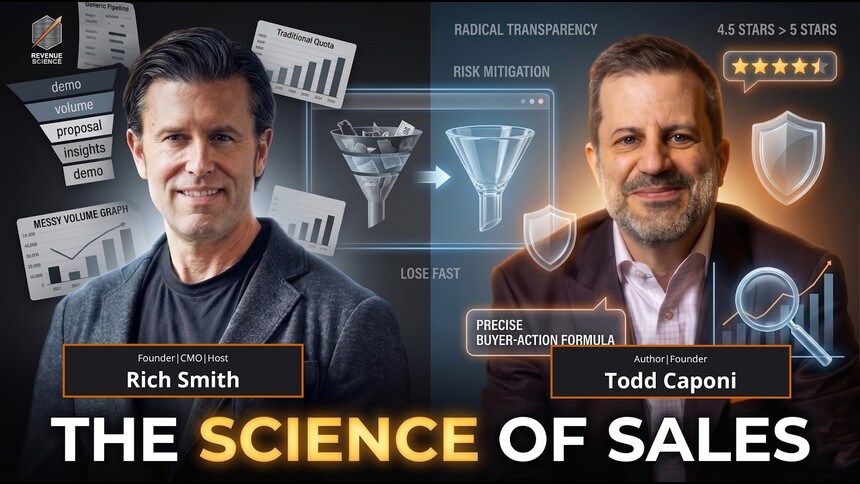
[00:00] Rich Smith: Welcome to the Revenue Science podcast. I’m Rich Smith, CMO, founder, investor, and your host. Here on our show, we translate marketing and sales complexity into boardroom clarity for CEOs and founders building predictable growth systems.
Today’s episode explores a topic that sits right at the intersection of marketing, sales, and behavioral science: transparency in the buying process and how it fundamentally reshapes revenue growth. Joining us today is Todd Caponi, founder of Salesmelon and the author of several influential books, including The Transparency Sale, The Transparent Sales Leader, and The Four Levers of Negotiating. Todd has spent decades studying how buyers actually make decisions and how sales and marketing organizations can align around honesty, trust, and evidence to win more deals.
If you’ve followed my work on behavioral science and decision-making, you know that most buying decisions are not purely rational. They’re influenced by risk perception, information asymmetry, and trust. Todd’s work challenges a lot of conventional wisdom in sales by arguing that radical transparency—even acknowledging weaknesses—can actually accelerate deals and increase credibility. So today, we’re going to explore how transparency changes negotiation dynamics, how CEOs should think about trust as a revenue lever, and why the future of sales may look very different from the scripts and playbooks many companies still rely on.
[01:47] [Intro/Music]
[01:52] Rich Smith: Before we dive in, a word from our sponsor, American Solutions for Business. Full disclosure: I’ve used American Solutions for Business at two companies where I was CMO. They did outstanding work every time, and their pricing was the most competitive I’ve found anywhere. They’re a top 10 national distributor of print promotional products and branded merchandise. And unlike most vendors, they actually manage your brand as a program, not just a purchase order. Visit [americanbus.com/rich](https://americanbus.com/rich) to receive your free private-labeled online ordering site. That’s [americanbus.com/rich](https://americanbus.com/rich). Again, [americanbus.com/rich](https://americanbus.com/rich).
[02:43] Rich Smith: Todd, welcome to the Revenue Science podcast.
[02:46] Todd Caponi: It is good to be here. Looking forward to nerding out with you for a little while here.
[02:49] Rich Smith: Yeah, yeah! Well, let’s, you know, let’s jump right into it. So I thought maybe a great place to start is if you could just give us the 60-second version of Salesmelon. You know, who you serve and what kinds of problems you solve—those sorts of things.
[03:09] Todd Caponi: Yeah. Um, so the short story is I was a longtime revenue leader, and I had a kind of a revelation around what transparency really is and how it applies to all things getting revenue. And so like a crazy person, I quit my job to write a book. My first book, The Transparency Sale. I thought the book would suck because I’ve never written a book before, what did I know? And it took off. And so here I am eight years later, I’ve written three books. But what I do is I teach and speak on all things transparency applied not only to the sales world—so messaging, positioning, negotiating—but also revenue leadership as well. So that’s kind of the short story of it.
[03:50] Rich Smith: Yeah, that’s great. Was there a particular inflection point where you realized that, you know, traditional sales tactics weren’t working and were actually undermining trust?
[04:05] Todd Caponi: Yeah. So what had happened was, in that last role, I was the Chief Revenue Officer of a company based in Chicago where I am, called PowerReviews. And while you’ve probably never heard of PowerReviews, the name probably gives it away: we were in the reviews space. So we helped retailers and brands collect and display ratings and reviews on their website, right? So you buy a pair of Crocs or a sweater at Vineyard Vines, you scroll down, there’s reviews—that was us doing the collect and display.
What had happened is my marketing team partnered with Northwestern University here out of Chicago just to look at buyer behavior when a website is acting as a salesperson. So nothing to do with business-to-business, human-to-human, or so I thought. Three data points came out of it, two of which, like I’d said, changed my life.
And so here’s the three. The first one didn’t change my life—was the idea that we all read reviews. Meaning, when we’re buying something that matters that we’ve never bought before, we go beyond what we’re seeing and hearing, and we want the peer feedback and the truth, basically. So we start reading the feedback. So that was no surprise.
The two that changed my life: Number one was, are you one of those weirdos that when you’re reading reviews, you skip the five-star review and you go right to the negatives—the fours, threes, twos, and ones? Well, turns out you’re not a weirdo. We all do that. Like, we all go to the negative most often first, but we all need the negative.
And then the last data point was on a five-star scale, when a product has an average review score between a 4.2 and a 4.5, turns out that’s optimal for purchase conversion. In other words, a product that has nothing but perfect five-star reviews doesn’t sell as well as a product that has negative reviews sitting right under it.
And so I looked at that and I was like, “All right, that’s weird. That’s when a website’s acting as a salesperson. Like, we need the negative. And if all we see is five-star, we’re less inclined to buy versus more inclined.” I looked at my team—we had a big team out there—I’m like, “Wait, we’ve been teaching our team to sell as though we’re perfect. Like we’re a five and everybody else blows. Are we doing a disservice to our buyers? Are we making it harder for them to decide? Are we slowing down decisions?”
And as I started digging into the behavioral and decision science on it, I realized the answer is yes. As it turns out, we as human beings, we need the negative to be able to predict. And so when we started to implement this idea—and I’m sure we’ll talk more about it here about what that means, it’s not some magic trick, it’s just being a good human—but when we’d start leading with, “Hey, in your shoes, you might not love this, but if you’re cool with that, you’re going to love this.” And we started presenting ourselves truthfully as imperfect.
And all of a sudden, sales cycles sped up. Win rates went up. We qualified in deals we should be working on better, lost deals we’re going to lose anyway faster, and we became the cool kids—like, the ones that differentiated ourselves in the way that we sold. Then we became Chicago’s fastest-growing tech company from 2014 to 2017.
And that—we can talk about my background here—like, I’m a sales nerd. Like, I collect sales history, but I love this profession too much not to at least get those ideas out there. So that was the inflection. Like, I wrote the book because I just wanted to get the ideas out there. Figured my friends would be like, “Oh, Todd, good for you. You wrote a book.” And then I’d go get a CRO role again. But like we said, here I am still talking about it. But that was it—this idea that transparency and imperfection sells better than trying to pretend you are all things to all people.
[07:49] Rich Smith: Yeah. You know, that’s just an amazing insight, and I think it’s something that you see in a lot of areas. I’d love to unpack it a little bit further with you. You know, from this kind of thing fascinates me as well. Like, how people make decisions and make buying decisions is something that, you know, I’ve just like built my career around because it’s so interesting to me. Um, and I think it’ll be interesting to our audience too.
So let’s, let’s talk. Is it really the trust factor? That when you see all five-star reviews, it just doesn’t come across as believable? Because, you know, no matter how good your product is, it’s not for everybody. I always say like, I’d rather be certain—I don’t want to be everybody’s cup of tea, I want to be the glass of champagne for a small group of people, or for a certain group of people, right? And, and so, is that where that’s coming from? When you see all five-star reviews, it’s just, just the trust goes out the window?
[08:48] Todd Caponi: Well, yeah. I mean, think about the last time you bought a car, um, or you were in a market and you had people trying to sell you stuff, right? Like, you feel like you want to go take a shower afterwards, first of all. But it doesn’t make you more confident in the purchase.
You know, the bottom line here is there was a long period where the sales world believed that people buy when they’re convinced, right? Like, we got to convince them. But that’s not actually how we buy. We buy when we can predict. Like, when you’re going to make a purchase, you’re in prediction mode. You’re trying to predict, “All right, do I really need to do something different? And then if so, what’s the right solution? Should I do that now?”
And that right solution is trade-offs. We’ve got to understand our options and understand the risk, and predict that if I buy this, and I buy this now, and I buy this for this amount, that, you know, two hours from now, two weeks from now, two months from now, I’m going to feel really good about it, and I’m going to understand the trade-offs, and I’m not going to be angry that I bought something and think, “Gosh, I wish I would have bought something else.” Like, our brain goes into this anxiety mode, and when you can illuminate that elephant in the room before it destroys all the furniture, that’s when the magic happens.
Like I said, greatest thing in the world is winning, but second best is losing fast. And the last point I’ll make on that is, um, I was doing a virtual keynote and I had the chat window open as I was talking, and I’m talking about this thing. And I remember as I told a story about a customer that was looking for some sales training stuff that I don’t really do—it was the prospecting, cold calling, like I could teach it but it wouldn’t be very good. And so like the prospect had reached out to me saying, “Todd, we’ve heard great things. We need prospecting and cold calling help and all that.” And I’m like, “All right, cool.”
Like I kind of dug into it and I was like, “Hey listen, I could do it, but if you made a list of the top 50 people that do it, I’d come in at around number 47 maybe. Can I recommend the top three? Because there’s three people I think are fantastic at it. I will make the connections.” This guy was like, “Really? What is it you do?” Right? The trust was built.
In the end, if I would have tried to sell that deal and do that, this guy very quickly would have realized, “Man, I could have done a lot better.” Now, remember in the chat, I saw somebody write, “Nooooo” in long—like, just “no” with a ton of O’s. And I’m like, “All right, hold on, stop. All right, who wrote ‘no’? Can you come off, like let’s have a conversation about it.” And she had said, “Hey Todd, things are sometimes uncertain. We’ve got targets to hit. We can’t be saying no. If we can do it, we got to go after it.”
And I’ll fast forward to the end. I remember when I got done with the keynote, I walked into my kitchen and my wife’s like, “Were you just yelling at somebody?” Yeah! Cuz I was telling her that, “Listen, you might get that deal. You might win it. Fantastic, good for you. But it’s going to cost you probably five, ten more deals that you never knew existed when that person’s telling their friends, when that person’s leaving feedback, when that person’s at a dinner with peers going, ‘Hey, don’t go with them.'”
So we’ve got to get out of this short-termism. In a world where feedback is proliferating everything, AI is exposing everything, peer connections have never been easier, we’ve got to play the long game. And to your point, if we’re not the right fit, our role and our goal should be to help customers achieve optimal outcomes as quickly as possible, whether it’s with us or with somebody else. That long game always swings around, because in that story, that CRO ended up hiring me to do a bunch of negotiation training instead. And so, like, that’s build trust, lose fast.
[12:32] Rich Smith: Yeah. And I think, you know, there’s um, there’s an element to that that is fascinating as well. And I think that in many ways, the word selling or sales is a misnomer. And honestly, the best sales processes that I see are more of a collaboration with the prospect to determine whether what we have is the right fit for them or not, and the right fit for us, right?
I think too many times, particularly in the B2B world, sales people go in feeling like, you know, they’re down here and their buyer is up here and they’ve got to, you know, maintain that status. And the reality is, you’re much better off if you come at it like this where, hey, we’re peer-to-peer. I’m a business person, you’re a business person. Let’s figure out, you know, here’s what we do, here’s what we do well, here’s what we don’t do well. Let’s figure out if that’s the right fit for you. How does that resonate with your thinking?
[13:30] Todd Caponi: It brings a tear to my eye. It’s beautiful, right? It’s this idea that, you know, like I had joked about behind me—so I collect sales history. Uh, my office is filled with late 1800s, early 1900s books, magazines, LPs. There’s an old phone from 1908 fully restored. Like, I’m a nerd of the highest order. But I will tell you this: that the original design of the modern sales profession in the late 1800s, early 1900s was around exactly what you just said.
As a matter of fact, the guy that I believe is the GOAT of sales philosophers is a guy named Arthur Sheldon. He wrote a book in 1911 called The Art of Selling. And in it, he firmly defines this: that true salesmanship is the science of service. Grasp that thought firmly and never let go, right? Like, sales was supposed to be a service profession—that we are there to help raise all ships for our economy, for our manufacturers’ customers, and be a resource for them to help get them into the right solution as quickly as possible, help them achieve optimal outcomes.
Service became the mantra for the entire sales profession to the point where in 1916, there was a massive sales conference—the first of its kind took place in Detroit, Michigan, July 1916, attended by 3,000 people. The keynote speaker was then-sitting president Woodrow Wilson at a sales conference! Like, that’s crazy. Also happened to be a world war brewing.
And two things: Number one, the whole mantra, the theme for the kickoff for this conference was “Service.” Just one word. And Woodrow Wilson’s keynote was all about service. At a time where, hey, Europe’s all beating each other up, let’s go and establish ourselves as a world power, salespeople, but we need you to perform a service for your customers to help them achieve optimal outcomes and take advantage of their distraction.
So yeah, that was a time when sales was trusted and respected and even admired. We ruined it—I can tell stories about that. But the point being that I think there’s an opportunity for us to get back to that kind of—we’re not going to fix all salespeople, of course—but if we can just come at it through that lens of what Arthur Sheldon said, that true salesmanship is the science of service, we can start to edge our way back. And that’s what you’re talking about, that coming in, “Hey, I’m here to be a partner and a guide for you, and I’m going to get you into the right solution even if that’s not with us.”
[16:00] Rich Smith: Yeah. And it really is, you know, it has to be a partnership, right? Because if you don’t do that, you know, you’re going to end up with an unhappy customer who’s going to leave a bad review. Uh, they’re going to churn, and you spent all this time and effort to book that deal or, you know, sell that account, and it’s just going to run out the window.
You know, I think a lot of—you alluded to this earlier—a lot of the buying decision really comes down to not what you can gain, it’s what—what’s the risk level that I’m taking when I make this buying decision? And some of the most successful salespeople that I’ve seen or processes that I’ve seen really focus on reducing the risk that the buyer is taking by choosing you. And there’s a lot of psychology behind that. And I know you’ve probably studied it—I’ve studied it—but love to get your thoughts on that.
[16:58] Todd Caponi: Well, yeah. I mean, I just look at part of our role as sales professionals, but also the entire revenue function within companies, I believe is about setting proper expectations that you consistently meet. To your point about the champagne, right? Like, “Hey, I want to be here, I’m not down here.”
Like, you think about the greatest business-to-consumer type organizations in the world, like, you know, IKEA. Like, IKEA is a disaster, right? You need a map when you walk in, you can’t find anything, you have to write down the code, go down to the warehouse, pull boxes onto a cart that doesn’t have brakes, roll it into your—
[17:37] Rich Smith: Can’t even begin to pronounce the names of anything.
[17:39] Todd Caponi: Yeah, like, or whatever! Uh, you got to jam it into your car Tetris-style. You f-bomb your way through that. You get home, you open the box, there’s 200 parts with no words other than “Sparta.” And what happens? Well, IKEA is the number one furniture retailer in the world for its 15th straight year. Like, why? It’s because they’ve literally branded what they give up to be great at their core. Everybody that walks in knows it.
Like Costco, right? You have to pay to walk in. You got to buy—you want some ranch dressing? You better like Hidden Valley Ranch. And you got to buy a gallon, and they’re not going to box it, and then somebody’s at the door checking your receipt to make sure you didn’t steal anything. Costco’s the number two retailer in the country behind Walmart, and the renewal rate would be the envy of every SaaS company in the world—it’s like 96%. It’s all around setting expectations and doing that early before the person walks in. Like, you don’t see people leaving IKEA going, “Why didn’t they help me furnish my living room?” Like, you knew when you walked in what you were getting.
I think the B2B world is missing a huge opportunity to do that so that instead of this funnel approach—just like, more with more and more, more, more and let’s hope some more pops out the back—instead create this cylinder approach that’s like, “Hey, this is what we’re good at, this is what we’re not.” And once you enter through the funnel, we’re going to help you, you know, make that prediction and hopefully alleviate that risk you’re talking about, Rich, and get you down to the bottom. If we’re not the right choice, cool, but hopefully we’re helping you predict earlier.
That was our whole mantra in my last role was, “Hey listen, let’s vet this thing because nobody wants to waste each other’s time. Here’s where we’re great, but we’ve got competitors that also happen to be in business and they’re growing and they’re doing well. It’s not because they suck, right? They’re pretty good at this. Let’s get you into the right bucket and get you going.”
[19:26] Rich Smith: Yeah. Uh, I think it’s, it’s just really refreshing to hear you say that, and it’s amazing how many organizations just don’t really grasp that or individual sales people grasp that. Um, wondering, you know, from your perspective, what does transparency look like at a strategic level for a CEO, not just an individual salesperson?
[19:50] Todd Caponi: Well, it has to be top-down, right? It absolutely has to be top-down and us being able to define where we win, where we don’t. You know, part of that goes to this idea that like, how do you really determine where you should be spending your time?
When I joined that last company of mine, my CEO was one of those old-school guys who was like, “Hey, if we lose, it’s cuz you got outsold.” Like, “No, that’s, that’s not why we lose. We lose because we’re not a good fit, because maybe we missed something, because maybe we didn’t help the customer predict and we dragged this thing along to where something—like, you know, there’s a million reasons.” And so I had to change the culture there.
And so one of the crazy things I guess I did is, you know, we had lost a deal and the rep got beat up, and I saw it right away and I was like, “All right, next loss, watch what happens.” We took it from here to here—I went a little over the top. Rep lost a strategic deal, comes into the office—we surprised him with a champagne toast. Uh, because I wanted to celebrate the loss, not only for the effort—like, he put in effort, he’s never gonna get that time back—but most importantly, we were trying to have him celebrate the lessons that could be learned. Like, “Hey, what do you wish you would have seen earlier? What did they say? What mistake—like, you make a mistake, we’re drinking! Like, hey, let’s party, right?”
Like, it was one of those things where we needed to create this environment where our reps could take an honest, customer-centric view and start to bubble those things up—that hey, our reviews say this, our customers say this, our reps see this, look at it by vertical, by geo, by company, like all that kind of stuff, and then roll that up so that our CEO starts to gain that focus and is comfortable with the idea that, hey, we’re not all things to all people, right? Especially if it’s a, um, a founder-led CEO. You’ve got, like, “Hey, this is our baby, it’s perfect.” Like, it takes some work, but you’ve got to create a culture and environment where that’s cool, and that starts at the top.
[21:53] Rich Smith: Yeah. And, and I wonder, are there particular sales metrics that CEOs often misunderstand or are misled by?
[22:04] Todd Caponi: Well, yeah. It’s often the um, the bucket of qualified opportunities, right? Like, “We need more, more, more, more means that everything funnels out, right?” And the way that I always looked at it is we’ve got to look at, first of all, our cycle length. That one of the important metrics was not only how long it takes us to win, but how long does it take us to lose? And if it’s taking us a long time to lose, we’re doing something wrong.
And so we always looked at that—if we could shrink our time-to-loss rate, then of course… and then again, transparency, it’s an aid in decision-making. So if we’re doing transparency right, our win—for our wins, those cycles should shrink, in some cases dramatically. Like, the first time I used this was on a deal where they were going to issue an RFP, they’re going to have us fly back and forth to New York, and I led with transparency. I was like, “Here’s where we’re not, here’s what we are, here’s where they’re great,” and they ended up deciding in 10 days without the RFP. We never flew there. We took a six-month and shrunk it down to a six-week. Now, how efficient is that? So that’s number one.
Number two, of course, is win rates. That when we get better at qualifying using transparency—that, you know, to where we know that the truth will sell it. If we are truthful, this should be an opportunity we’re in, and if we’re lying to ourselves, then it probably isn’t—qualify out of those. So we qualify in better and faster, qualify out the deals you’re going to lose anyway faster. And so cycle length, win rate—huge.
But then if you’re starting to do it right, those referrals start to go up. Your customers don’t churn like you had talked about—you sell a misfit, they leave. But even better is when those people start being the ones that when they change jobs, their first call is you. When you start seeing that, that’s a metric every CEO should love, right? That they’re taking you with them to their next company. And if you’re not embracing this type of approach, I don’t think that happens at all.
I’ve built my business—like, I haven’t made a cold call or prospected for my business in eight years. It’s all about create right expectations, create great outcomes, and they keep calling, right? And that’s, that should be the metric that every CEO loves.
[24:23] Rich Smith: Yeah, that’s great, you know, and I often think that um, shrinking cycle times is a good indicator that you’ve actually achieved product-market fit. And it’s not just “is the product right.” It’s—and again, this, I think this is one of the things about product-market fit that’s really misunderstood—is it’s not just the product, it’s your whole process and the experience that you provide to the customer. You have to bundle all of that together.
And, and when you start to get that right, you see sales cycles begin to shrink, win rates go up, time to loss actually goes down, because you, you know, you want to get those that are not a good fit out of your process right away so you’re not wasting valuable time on them, and you’re not wasting their time either.
[25:09] Todd Caponi: Exactly. Can I add one thing to that? Um, there was something I used to do wrong, and it was I’d measure my reps on pipeline load all the time. Uh, meaning, you know, “At all times you got to have 4x your quota in pipeline.” Like, I’m sure we’ve all heard that. It’s probably, listen, people listening that have got sales teams that are thinking that too.
I quickly discovered that that was not a good lens by which to measure my team, because if I’m measuring for 4x your quota in pipeline, my reps, they would have 4x their quota in pipeline, and most of it would be garbage so that I would stay off their back, and we would lose slowly, and our forecasts would become less accurate.
So we just had to throw out that metric and really look at pipeline quality, because the 4x assumes that you’re going to win maybe 30%. I mean, if the math is clear, it’s 25% but 30%. “You want to have more than you need.” Well, why, why are we losing 70, 75% of our deals? Why don’t we look at pipeline quality? And wouldn’t it be awesome to have 2x but we’re winning most of them? Like, that would be—that’s ideal.
We’re looking at the wrong metric when we’re just looking at, uh, that quantity that sits at the top. Again, that’s another CEO metric that they look at all the time, and we take to our board. And I used to blow that up with the board and go, “I, I really don’t care about any of that.”
I remember the board coming after—like, they’re like, “Todd, what’s wrong with marketing? Like, why don’t we have enough pipeline?” And I’m like, “Marketing’s awesome. They’re doing exactly what I want, right? We’re getting high-quality stuff in that we’re going to close a high percentage of, and I have no discomfort in our ability to continue to grow like we are because we’re working on the right opportunities.”
Remember, the most valuable asset we all have in our inventory to convert to revenue is our time. Why are we spending it on deals we’re going to lose anyway? Clear those out. 2x is cool with me if we’re winning, you know, 75% of those. That’s pretty awesome.
[27:06] Rich Smith: Yeah, it really is. And, and I, I think, you know, we often try to manage the outcomes, and, and it’s really impossible to manage the outcomes, right? You can manage the activity. And I loved your example about, you know, having a celebration, uh, for the salesperson that lost a big deal, uh, because that, that sends an amazing message culturally to the organization that, hey, we understand you can do everything right, and if we’re just not the right fit for that organization, then this isn’t going to work out. And, and that’s better for them, and it’s better for us in the long run to figure that out quickly.
[27:41] Todd Caponi: Yeah. And if you’re hearing over and over again reps tell you that the reason they lost is because the customer is an idiot, you’re doing it wrong. You’ve created the wrong culture. Like, that’s not why we lost. You know, customers are not stupid. They’re, they’re probably pretty smart. They’re making really good, informed decisions that, again, to your point, are designed to lower risk. What did we miss? What should we have done differently? Should we even have been working this opportunity? Match that up around the firmographics and the demographics of the people you’re selling to, start to spot the trends, because the worst thing in the world is to lose for the same reason over and over again and have no idea that that’s happening.
[28:21] Rich Smith: Yeah. And um, how would you—what would you recommend that a CEO do to diagnose whether they have that kind of problem in their organization or um, that there’s something that they need to do to improve that mindset and that transparency with their prospects?
[28:36] Todd Caponi: Well, hopefully if they’re listening, they probably already got it. Uh, that they’re probably already seeing that, “Ah, crap, like, I’m doing this, right?” But I mean, it, you know, it’s again, it’s win rates. So if our win rates are low, uh, we’re probably working on the wrong opportunities. Uh, or at least a big chunk of those, we probably can identify that, hey, we keep losing these. Let’s lead with that and qualify out, or when we do, they end up referring us to other places.
Number two, again, is time to loss. If it’s taking us as long to lose as it is to win, we’re probably doing something catastrophically wrong. And then if you don’t see your inbound channel lighting up at all, it probably means that you’re not setting proper expectations with your customers and they’re not willing to sing from the mountaintops about how awesome you are. Those are the, the three big ones.
The other one is, I would argue that if you keep losing to the status quo, um, that that’s part of it too. And obviously, most companies lose to the status quo more than anybody else. But part of the reason we lose to the status quo is because we’re not setting journey expectations. Meaning, our perception of a reward is biased by the journey to get to it. And if we show up and it’s a lot harder and a lot longer and a lot more complex, and I need to do more work to get there, our brain will immediately go, “Hey, I’m going to prioritize something else.”
That’s one of those things that we should be setting the expectation for up front—that, “Hey, listen, Rich, we’re going to go on this journey. Here’s what we typically see. We’ve done it a thousand times, or a hundred times, or even ten times. It always looks like this. These are the people that need to be involved. This is the process. This is the dollar range.” And set those proper expectations so that they’re not sitting there going, “You know what, I, I’m going to work on something else because this is too hard.” Set proper expectations.
[30:22] Rich Smith: Yeah, I think that’s, that’s critically important. And again, one of those things that’s, you know, under, underappreciated, undervalued. You know, we all deal with loss aversion, right? As buyers, because we’re all consumers as well. We all deal with loss aversion. And your B2B prospect is dealing with that as well. And in order to overcome that loss aversion, you typically—people value, uh, a gain only about half as much as they don’t like a loss, right?
And you have to think about that when you’re considering the cost of your product. Because the cost to your buyer is not just the dollars that they’re spending, it’s the time and effort that they have to put into making your product work and making it successful for them. And that’s got to be in the mix in your—and I love the way you framed that, because the whole buying process is part of it.
You know, I’ve worked many times for large, you know, highly regulated organizations, and to bring in a new vendor—like let’s say a technology vendor or something—into a bank or a credit union or insurance company or a healthcare provider, you’re talking about probably six to nine months’ worth of IT and legal review. It’s a lot of work for your buyer, and and that person—if, if they’re not the champion within the organization for you, forget it. You are not going to succeed in selling into that business.
[31:55] Todd Caponi: Well, yeah. It’s funny that it’s not that “because it’s hard, I don’t want to do it.” It’s because “I didn’t expect it to be hard that I don’t want to do it.” You know, for example—I don’t know if you saw this, I don’t remember how long ago it was—but like in Idaho, they opened a new In-N-Out Burger, and you go on Instagram and people are posting, um, posting selfies of themselves in line and they’re like, “I’ve been in line for seven hours! Isn’t this awesome?” Like, “What are you—are you nuts?” Right?
But they went there expecting it to be an all-day experience, and they’re cool with it, right? If you go to an In-N-Out Burger anywhere else and you wait seven hours, you’re ready to kill somebody and you’ve already had a sandwich and probably another meal somewhere else. It’s about setting accurate expectations.
And again, people climb Mount Everest. People do complex things because that’s the expectation and they’re up for it. But if they don’t expect it when they show up to Mount Everest—they show up in flip-flops and shorts—they’re like, “You’re going to die, get out of here, right?” Like, we’ve got to set those proper expectations at the beginning, not all of a sudden just slowly pile it on. That’s when you lose customers to status quo all the time.
[33:04] Rich Smith: Yeah, the status quo is, uh, often, often the biggest competitor. And I think, uh, it kind of is, you know, one of the things that, um, you mentioned earlier was predictability, and, you know, all of this I think is designed to make your whole sales pipeline and your revenue generation more predictable.
[33:24] Todd Caponi: Yes.
[33:25] Rich Smith: And I would guess that—and if they don’t know it, because I’ve probably said it a hundred times on this podcast—um, most of our CEOs who are watching, you know, should really understand that that, that’s the same is true for an investor who wants to buy your company or considering buying your company. If your revenue is not predictable—because that’s what, that’s the biggest risk that they have. “I’m gonna plunk down a chunk of capital, and this revenue that you said was there or that I think I can grow to a certain amount, it doesn’t happen.”
So how do we get confidence in the predictability of your revenue? And, and that is the, I think, the key to getting to an exit for a, a lot of our listeners.
[34:10] Todd Caponi: Yeah. I’ll say this, that in all these books behind me—so let’s look at 1890 to 1930—it’s funny that all the problems, all the challenges that we face in the sales world are exactly the same, right? Quota setting, comp planning, objections are the same—it’s all the same. One thing that’s not the same is forecasting, which is weird, that they didn’t have the same challenge with forecasting back then that we have today.
And I tried to figure out why that would be. They didn’t have Slack or CRM or any of that kind of stuff. They didn’t even see their reps—they’re all remote, there’s no phones, there’s no conference calls. I figured it out, and it’s based on the concept that you saw in Glengarry Glen Ross. It’s something that Blake from Mitch and Murray got right, uh, which was AIDA.
Meaning that back then—back in 1903, Arthur Sheldon, I believe, is the one that first really theorized the idea that all buyers go through four stages: They’re first paying attention, and then they show interest through their words and actions, and then they generate a desire, and then they take action. That became the philosophy for every sales process, but every sales forecasting methodology through around 1930.
Now, the reason why I say that is not that you should all implement AIDA, but the lens that I want you to think about is, if your team and your individuals on your team all get their endorphins from moving a sale through a process based on what they’re doing, I think you’re doing it wrong. Like we, at my last role, we layered buyer-centrism over our sales stages, and we threw out the words of what the seller was doing. So, qualify, demo, propose, negotiate—those words are gone, and it’s: what’s the buyer doing through the words and actions? And we would track that across our forecast.
Our forecast immediately got more accurate, and our reps became more attuned to the customer, which also played a big role in how well we were doing. Bottom line here is, if—who knew that it would be easier to predict when a buyer would buy when all we’re doing is paying attention to what the buyer is doing versus what the seller is doing? I think that’s something brilliant they got right that we continue to get wrong. And I think it’s an opportunity for CEOs to just like—let’s get… we could say we’re buyer-centric, but if all our measures and processes are seller-centric, I think forecasting becomes a lot harder.
[36:39] Rich Smith: Yeah. And, and really, you know, that’s my advice to most organizations when we’re talking about how to define the stages of their funnel—their sales, sales and marketing stages—is that they can’t be defined based on subjective opinion of internal people.
[36:58] Todd Caponi: Mhm.
[36:59] Rich Smith: They have to be defined objectively through actions taken by the prospect or by the buyer. I’m curious—
[37:05] Todd Caponi: Well, yeah. I mean, I just—next time, next time you’re in front of a team, go, “All right, how many of you…” I just did this, so that’s why it’s top of mind. I was like, “How many of you guys have a deal right now that you would say is at 50%?” And like five people raised their hand. I was like, “All right, I’m going to pick two of you. Describe your deal.” They were completely different—like, 100% different. “All right, third one, tell me about yours.” And like, that 50% was because they sent a proposal, like that.
Like, when you just told me—none of those deals have a coin-flip chance of closing, this deal. One’s further along, one’s not as farther along. That’s complete inconsistency that we’re creating through the way that we’ve designed our sales processes and stages. How can that be predictable?
That’s why, like, our stages were all on kind of the modern version, which is: your buyers go through a “why change” first. Like, “Hey, why should I be working on this at all? Why should I be considering doing something different tomorrow than I’m doing today?” And then the next one is “why you.” So they then go, “All right, if I’m going to change, what direction should I go? Should I build? Should I buy? Who should I buy from? How should I buy? How much is it going to cost?” All of that.
And then once we get to a point where they’re like, “All right, I need to change, I’m going to change with you,” we then go to a “why now.” I will argue anybody on why, why now goes to the end, but then we go, “All right, should this be a priority now versus six months from now, versus all the other priorities I have?”
And that was our—those three layered over our stages. And that’s every conversation one of my managers had with a rep was, “All right, you’ve got it here. What’s the customer doing through the words and actions? Why do you believe it should be here?” And we started to get consistency of a customer that has now said, “Rich, you’re a finalist. It’s between you and X. We’re just going through this, this, this, and this.” Cool, that one’s at 50%.
Everybody who had a 50% deal looked exactly the same because the customer had said and are doing the things that they said they’re going to do. Our forecast became immediately, considerably more accurate. It’s got to be that way. Again, go back, ask your reps about their 50% deals, ask them to describe it—your brain will blow up from how different every single deal is, and you’re like, “But we just forecasted each one of those deals to be a coin flip.”
[39:27] Rich Smith: Yeah, and that’s honestly one of the first things that I do when I talk to an organization is, okay, you know, talk to different people about what, what level a deal is at. It’s exactly what you described, and it is shocking how often you just get completely different definitions.
[39:50] Todd Caponi: Exactly.
[39:51] Rich Smith: And you know, then that, that comes back to why it has to be objectively driven by buyer behavior, because look, we all have confirmation bias, right? We all want to hear, we all hear what we want to hear, and salespeople are the same way, and they’re hearing what they want to hear. And the buyer—you know, we don’t, we want to be nice as buyers.
You know, I’ve been a CMO of a large organization sitting on the other side of the table and, you know, have bought from lots of different, uh, sellers. And, you know, well yeah, we, we just don’t want to hurt your feelings, you know? So you get—so we say things that lead you to believe that we might still be interested, but we’re not actually taking any real action. And I think that’s the key. It’s like, okay, don’t listen to what’s—what they’re saying. What are they doing? And are they doing things that, that are indicating that they really are moving down that, you know, AIDA or, you know, there’s lots of different acronyms.
[40:44] Todd Caponi: Exactly. Right? It just got to be buyer-centric. Exactly. It’s funny that you mentioned loss aversion. You know, loss aversion applies when there’s not a short-term, uh, pleasantry right in front of you. And the reason I say that is, like you, I was just out this morning. I drove by Burger King, and there’s like 10 people in line at the drive-thru at Burger King. And I’m like, those—not one of those 10 people think, “Gosh, this is good for me, that if I do this every day, it’s going to make me healthier.” Of course not, right? People still prioritize now and, “I’ll deal with consequences later” over loss aversion.
Your reps do the same thing in terms of their forecast. They want you to feel good about what they’re working on. They will tell you a deal is further along than it is, and they’ll deal with it later, because right now, “I want to feel good, and I don’t want you yelling at me. I don’t want you questioning whether or not I’m doing a good job.”
Again, it goes back to forecasting culture—that we got to get the opinions out of it, and it’s all got to be seller—or I’m sorry, buyer-centric. And again, remember that, like every time you drive by like—you know, sorry Burger King—that like, that’s short-term and long, long-term pain.
But the point being that we all like, you know, uh, people going out boozing when they got something important the next day, like, “I’ll deal with it tomorrow. I’ll take some Advil.” Like, people do this all the time.
The last stat on that is—I just read this—that people with life-threatening illness, when their doctor prescribes a health regimen to avert the life-threatening illness, still only 20 to 30% of people follow it. What you’re selling is not life or death, I, I hope. But again, when we think about that loss aversion, so often our reps think through that lens of, “I’ll deal with it later. I’m going to make this person happy right now so I feel better.”
[42:41] Rich Smith: Yeah, yeah. And that’s a common cognitive bias called temporal discounting, right? We tend to think that, that things in the long term are kind of abstract and, and we discount them. Uh, but we prioritize the immediate and the short term.
You know, I, I—we won’t go down this rabbit hole because I just published a video recently about how boards of directors do the same thing and, and how important it is to consider that when you’re managing your board if you want to get any kind of long-term projects completed, um, because that kind of short-term thinking—you know, “did I hit the quota this quarter? What’s the revenue this quarter?”—that always takes over, and everything else can, can be pushed to the side.
[43:24] Todd Caponi: Exactly.
[43:25] Rich Smith: I want to change gears just a little bit here. Um, and I want to talk about negotiating. So, in The Four Levers of Negotiating—or negotiating, excuse me, get the title right—um, and we’ll put the link to that book in the show notes. Uh, you know, you describe the forces that influence every negotiation. Um, can you walk us through those levers?
[43:44] Todd Caponi: Yeah. So here’s the, the backstory on that. And so everybody listening, like, buckle up for a second cuz it’s a bit of a rant, but uh, growing up in sales, I always thought it was weird that I needed to change personalities right at the goal line of a deal, right? Like, sales was about focusing on customers achieving optimal outcomes and build a relationship. We get them all the way to the goal line, they say, “Yes, Rich, I want to buy from you.” Then what do we do?
Well, subconsciously at least, I was taught to start lying. To start focusing on my own outcomes. And in many cases, we’re using techniques taught by former FBI hostage negotiators. Like, that’s insane! Like, you’re not, you’re not negotiating deals where you get to tase the customer and drag them to jail afterwards. You’re not releasing hostages from a bank heist. That always bothered me, and I was always terrible at it.
What had happened was I had just been promoted to be a SVP of sales for the first time, and the one thing I was terrible at was negotiating traditionally. I had a rep who had gotten a verbal for a large deal—The Four Levers of Negotiating applies to large or small, it doesn’t matter. But what had happened was the rep was like, “Hey, could you come and we’re going to meet with them and bang out this deal?”
I go down to Houston. We get in the conference room. They brought their whole procurement team—like, ready. Like, there was a lady that was just like, “Let’s go,” right? And I was like, “This is not a good way to start, right? I’m going to get boat-raced out of here.”
I had just had a meeting with my CFO a week earlier, and he was just talking about the four things that drive our business model and our pricing model, and I was like, “Oh, that’s interesting.” I get into this room and, almost nervously, I kind of like, just threw them out on the table and explained to them that, “Hey listen, um, our pricing model is based on four primary things:
Volume: So, how much stuff you buy. Buy more, better. Buy less, not as good.
Timing of cash: So, how fast you pay for that stuff. Pay us faster is better than paying slower.
Length of commitment: Or how long you commit to our products, technology, services, whatever it is. Commit longer, better than committing shorter.
Predictability: Or timing of the deal, or if you’re able to help us mutually align around when you can do that, that predictability is valuable.”
They immediately were like, “Fascinating, Todd. We need a 35% discount.” Like, “All right, cool.” Why? Human being first. And then step two was, “Hey, remember those four things? Let’s walk through those together and see if we can get you a little closer. Commit to more volume, pay us faster, commit longer, help us forecast.”
And suddenly, there was no adversarial customer-vendor. It was a bunch of us sitting at a table with our cards face up, building trust on a consistent, sound basis by which our price now was based. They ended up paying us all three years up front, which helped us avoid a Series B, and they helped us predict, which meant our board was happier because all of a sudden, our forecast was more accurate.
That became—that was back in 2008. I was like, “Wait, that felt good. That was super easy.” So I started developing this idea of, hey listen, it’s 2026. How is it going to be sustainable to have every single one of your customers paying a different amount based on how well or poorly you negotiated it? Again, customers talk, AI is exposing pricing models.
Like, I was just speaking at a, uh, a cyber conference and somebody came up to me and was like, “Hey, yeah, we know the CISOs—the Chief Information Security Officers—they’re getting together and talking about like, who are you buying from? What are you paying? What, what did you ask for? What did you get?”
I think that this four levers negotiating has served me really well as a just a sound basis foundation by which it’s you’re saying, “Hey, the price is the price based on this, but there’s flexibility within these four things. These are the four things we’re willing to pay you for: we’ll pay you to buy more, we’ll pay you to pay faster, we’ll pay you to commit longer, we’ll pay you to help us forecast.”
And suddenly, um, we discounted less, we built trust to the goal line, our forecast became more accurate. And when those individuals went to renew, went to buy more, went to take us with them to the next company, they remembered the four levers and they were negotiating their own deals.
And I was like, it’s another one of those things that like, we’ve got to fix negotiating right now. It’s still based on early 1980s, late 1970s theory. I don’t see how that’s sustainable in the world of AI anyway. And this just feels like it’s a super easy way. It’s super scalable, and it creates that sound basis that allows your customers to negotiate their own deals, reduce the anxiety from that whole negotiating process.
[48:35] Rich Smith: Yeah, I love the way that you laid that out, uh, you know, the, the four levers, because I think—those are, I haven’t heard it put quite like that before, but those are certainly the things that when you’re, when you’re negotiating a deal or you’re working out a final contract with a potential buyer, um, you know, if you’re not keeping those, if you’re not talking through those things with your buyer, you’re probably undermining your own credibility.
Because the buyer just says, “Oh, I want a discount.” And you come right back and say, “Okay, here’s your discount.” Now, what have you told them? You’ve just told them that the first offer was BS, right? Exactly. Now, they don’t really trust you. But if you come back and say, you know, “Okay, I can’t give you that price, but if you, if you commit to—if you pay upfront for a full-year contract, if you commit to a certain timeframe, if you change that…” There’s got to be some give and take. Otherwise, you know, you’ve got no credibility left.
[49:33] Todd Caponi: Well, yeah. Those, those are the four, right? Just you throw them out there and go, “Hey, you need a discount? Cool. Here you go. Here’s how you do it.”
You know, and maybe—the weird analogy I always make is like, imagine going to the grocery store and you fill your cart and you pull up to the cashier and you go, “You know, I have a, a budget issue. I need a 20% discount.” They’d be like, “Buy 20% less.” Like, what are we talking about right here? Like, you don’t think to negotiate your groceries, your airplane tickets, your Uber rides, right? The price is the price, and you know it’s based on something, and as a result, you don’t bother negotiating. And guess what? Your decision cycle at the end where you actually buy shrinks.
To your point, the minute we start giving anything away, we ironically slow down deals because now I know the price isn’t the price and I got to come for more. And the one thing I want everybody to hear very loudly is: your fake expiring discounts at the end of the month or end of the quarter—think about it psychologically for a second—you’re literally slowing down your deals, not speeding them up. Because if I tell you right now that, hey, end of the month, 10% off, what are you doing? Well, I’m going to wait until the end of the month because the closer I get, the less leverage you have and the more leverage I have, right? Like that. Suddenly, as a buyer, I—it slows it down.
And then let’s say the month expires and I wasn’t able to get it done as a buyer, and the next month I’m like, “Hey Rich, that 10% still there? Cuz like, we’re ready.” And you go, “Nope, sorry, went away.” What do I do? I wait till you offer it again, right? Like again, the fake expiring discounts, like discounts themselves, slow down your deals and erode the credibility of your pricing model. But fake expiring discounts—your quarter ends and your month ends—you got to stop doing that.
What I advocate for is the mutual alignment around timing—that, “Hey Rich, if you can help me predict when you think you’re going to do this, we’ll create a little, you know, standard deviation around it. But that ability to predict is valuable because I got investors, I got a board, I got to resource this thing, I got to make investments. If you can help me with that, I’ll pay you to do that.” That changes the whole dynamic. You get rid of that end-of-month, end-of-quarter hockey stick, and in the end, you end up with trust built because the customer now understands the why and they’re not coming after you if that thing expires.
[51:59] Rich Smith: Yeah. You know, as a buyer, I can tell you that that end-of-quarter, end-of-year tactic has never worked, right? Never. In fact, when you do that, I’m going to come back when I’m ready, and I’m—because I know full well that you’re making it up, and I’m going to come back when you’re ready, I’m going to ask for the same deal or I might even ask for more.
But I, but I really like the way you reframe that, and I’m going to double-click on that for a second for all of our listeners: that the idea of, you know, get rid of these quarterly, you know, end-of-quarter, end-of-year discounts and instead start talking about predictability with your buyer. “Hey, you don’t have to—if it doesn’t work for you to make a decision before the end of the quarter, that’s fine. What does work for you? And if you can give me some level of predictability about it, hey, I’m willing to—you know, that affects our revenue, that affects our enterprise value in a positive way. So we’re willing to give something back to you. We’re willing to share in that value with you.”
[53:01] Todd Caponi: Exactly. That’s it.
[53:03] Rich Smith: Yeah. Hey, um, this has been a great conversation. I don’t want to, you know, take too much of your time. Um, just tell, tell our audience, uh, how if someone wants to get in touch with you, learn more about what you do, um, how can they reach you? What’s the, what’s the best place to connect?
[53:18] Todd Caponi: Yeah, I’m pretty easy to find. Uh, but toddcaponi.com is a good place to start. Um, lots of—I write a lot of blog stuff. Uh, it’s a lot of sales history, so if you’re into that, the Sales History Podcast is kind of fun if you’re a nerd. Um, it’s—there’s no guests, it’s just 14 to 20 minutes. I pick a topic and I dive into that.
But as far as, you know, what I offer in my services, toddcaponi.com. I’ve written three books: The Transparency Sale, The Transparent Sales Leader—which is actually a framework for maximizing the revenue capacity of your teams, you might like that one—and then The Four Levers of Negotiating just came out a couple months ago. Um, available wherever you buy your books in every format possible. And then if you want to follow along, I do share some of my nerdery on LinkedIn. So go ahead and connect, but let me know where you heard me.
[54:07] Rich Smith: All right, awesome. And we’ll put links to the, to the books and other things in our show notes as well. Hey Todd, um, thanks so much for, uh, joining me today. I think this has been a great conversation. Uh, we certainly see, see the world in, in very similar ways. So it’s, it is refreshing and, uh, you know, really, really value having you here.
[54:26] Todd Caponi: Yeah, it feels like we could probably talk for hours, too. So, uh, open to coming back if you ever need to nerd out on something.
[54:33] Rich Smith: Yeah, I think we probably could. We may have to do a follow-up where we can get into a few more things that we just didn’t have time for today.
[54:39] Todd Caponi: Exactly. Well, thanks for having me.