[0:00] Mandy Balak: Why does it look like everyone has this all figured out? And as I started to have all these conversations with different founders and entrepreneurs, I realized that everyone was just putting on a front — I'm killing it on the outside, but running on empty on the inside. Does that resonate?
[0:27] Rich Smith: Welcome to Revenue Science, the show where we translate marketing and sales complexity into boardroom clarity for CEOs, founders, and growth leaders building predictable revenue growth systems. I'm Rich Smith — CMO, founder, executive adviser, investor, and lucky enough to be your host today. Thank you for joining us, and please help us reach more leaders by liking, subscribing, and sharing this episode.
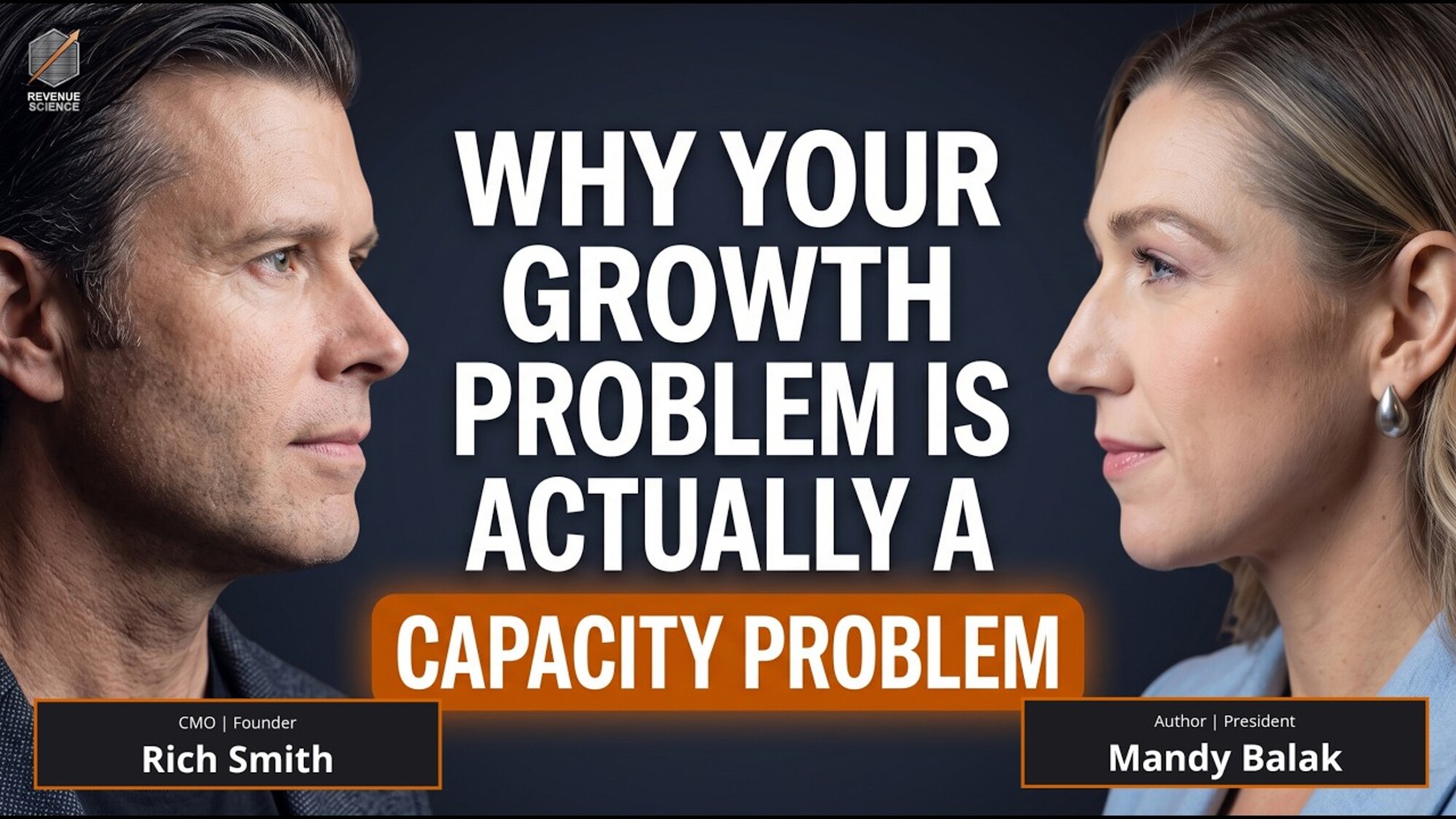
[0:52] Rich Smith: Entrepreneurship is often celebrated for growth, scale, and achievement. But behind many success stories is a reality we don't talk about enough: the cost of building. Too many leaders achieve impressive results while quietly running on empty. Today's guest is Mandy Balak, president of The Gathering festival, CEO and community builder behind the Rise Women's Conference, founder of The Well, executive coach, speaker, podcast host, and three-time founder who has successfully exited multiple businesses.
[1:28] Rich Smith: What makes Mandy's perspective especially relevant is that her work encompasses leadership, community building, behavioral science, and business growth. She's spent more than two decades building movements, scaling brands, creating transformational experiences, and helping leaders rethink the relationship between performance and well-being.
[1:45] Rich Smith: Mandy argues that growth problems are often capacity problems in disguise — organizations don't stall because they lack opportunity, leaders stall because they run out of the emotional, cognitive, and organizational capacity required to sustain success. Today we'll explore community as a growth engine, the psychology of leadership, founder evolution, sustainable high performance, decision-making, behavioral science, and why the future may belong to leaders who are well-resourced rather than simply overworked. Mandy, welcome to Revenue Science.
[2:26] Mandy Balak: Rich, so great to be here.
[2:31] Rich Smith: I'm really thrilled to have you here today. I think this conversation is going to be a little different than my typical guests, because we're going to get into things that are more about how to run a company — and when I say how, I mean how to manage your own time, your own energy, your own sanity, if you will. And that's something you talk a lot about. Maybe we could start by taking us back to the beginning — what experiences shaped your entrepreneurial drive and ultimately led you to build and exit multiple companies?
[3:18] Mandy Balak: I appreciate that intro, and just to double-tap on what you shared about this being a bit of a different conversation for your community — it's an important one, because there are two tracks to leadership. There's what we're doing — our strategy, our plan, the products we're creating — and then there's how we're doing it. Most leaders resource the first one; they spend a lot of time on the plan and the strategy, but forget it's of equal importance how we're doing that. The leaders who win are the ones operating not from reactivity, but from creativity.
[4:00] Mandy Balak: I wanted to share that first, because the through-line of my work and my experience leading businesses over the last 18 years was learning that the hard way. I was very overleveraged on the "what" — pushing harder, focusing so much on what we're doing — but I forgot to protect the most important resources: my energy, my creativity. So I burnt myself out in the process. We cannot build the businesses we want if we're running on empty and don't have the capacity to do that. And more importantly, as the leader at the top, if we're not setting that tone in our culture, our teams will burn out too. We can move fast for a short period, but that's not sustainable.
[4:57] Mandy Balak: So my work now very much talks about sustainable success. Today I'm an author and leadership adviser, and I'm also president of The Gathering festival — I host some of the biggest brands in the world every year, and our event is all around this conversation: what does it take to build a brand to last? And in order to build a brand to last, you need to build yourself to last. I've been obsessed over the last decade with studying what it takes to build yourself to last, build a brand to last, and lead yourself to last.
[5:46] Mandy Balak: If I rewind back to where my journey started — my first business, I started while still finishing university. The idea came from a personal experience I kept having in my relationships: Friday night would roll around, and my partner and I would say, "where do you want to go for dinner?" "I don't know, where do you want to go?" This ridiculous disagreement would always come up, because we make so many big decisions in a day that making the small ones — like how we're going to fuel our relationship, or where to go on date night — became a last resort.
[6:29] Mandy Balak: So I created a media company from that, all about helping people find the best places to go in the city — the core mission tied to one of my core values, relationships, and wanting to make relationships better. I built an app — it was an influencer marketing company, before the real surge of this creator/influencer world we see now, in the early days of Instagram. I monetized and built that business for 10 years, and exited in 2022. I scaled it across the country during the pandemic, brought on an operating partner, and it was time to move on.
[7:24] Mandy Balak: Simultaneously, I'd built a women's leadership community that was really about bringing forth stories from women entrepreneurs — not just the roses of building a business, but the thorns too. What I was experiencing at that time was the glamorization of entrepreneurship and of being a founder, and I was confused — am I doing it wrong? Because I was flat-out running on empty, working 24/7. Why does it look like everyone else has this all figured out? As I started having these conversations with founders and entrepreneurs, I realized everyone was just putting on a front — killing it on the outside, running on empty on the inside. Does that resonate?
[8:20] Rich Smith: Yeah. I think there's also a sense, an idea, among a lot of the entrepreneurs and founders I talk to, that if they're not working 70 or 80 hours a week, they're not doing enough.
[8:42] Mandy Balak: 100%. And that's just flat wrong, frankly — because honestly, if that's the situation you're in, one, you're going to get burned out, and two, you're likely the bottleneck in a lot of things within your organization. You're limiting the growth of your organization to the time you have to spend — and that's a recipe for total stagnation.
[9:16] Rich Smith: I often use an analogy: think about the safety speech on an airplane — if the oxygen masks drop and you're traveling with someone who needs assistance, put yours on first. That analogy holds for so many things in life, but definitely for entrepreneurs and founders — if they're not taking care of themselves, they don't have the ability to take care of anybody else or really lead the rest of the organization.
[9:58] Mandy Balak: Absolutely, it's so true. That's often the question — the CEO is really responsible for three things: setting the vision and clarifying where we're going, setting the culture and expectations for how we work together, and being responsible for growth and the results of the business. When we understand those are our three most important responsibilities, we have to get honest: how much of my time is spent operating in that space, and what's getting in the way of me doing those things well?
[10:40] Mandy Balak: If we're operating from reactivity all the time, or micromanaging our team, or caught up in the day-to-day minutiae, we can't deliver on those three most important roles — and we're probably exhausted from trying to insert ourselves everywhere. That trickles down to the team not having the clarity or support they need to be successful in their role. Well-resourced leadership at the top isn't just taking care of your personal well-being, it's also making sure you're doing your most important role in the business.
[11:20] Rich Smith: You often talk about being successful on the outside but depleted on the inside. When did you first realize achievement and fulfillment were not the same thing?
[11:34] Mandy Balak: I feel like I've landed at this place more than once in my life. You check all the boxes, do all the things, win the awards, get the press — by all accounts everything seems to be working — but it doesn't feel the way you want it to feel. I had that moment while building the women's leadership organization I mentioned — we were active in six cities across the country, amazing brunches, amazing press, all the things. I had a moment on a flight between cities, feeling pretty empty about all of it, wondering what I was doing wrong.
[12:25] Mandy Balak: I had to step back and go through some exploration, and I realized I'd never paused to stop and celebrate the moments along the way — I just kept pushing the finish line out. "When this happens, I will feel content. When we reach this target, when we have this many members, when revenue hits this much, when I get an article in Forbes." That's exhausting, because it's a chase you never end up catching up to.
[13:06] Mandy Balak: I think the reality for high achievers, for people striving to create big things, is there will always be the next destination, the next finish line. But if we don't actually choose the destination, stop, and celebrate the milestones along the way, we'll just be in perpetual chase. Sometimes stopping to celebrate or pause feels like settling, because we know there's more to do — but it's so important for our own fulfillment, and for our culture, that we actually pause to do that.
[13:49] Rich Smith: I completely agree. It's really easy to get caught up in the more, more, more — and this is true for founders, but also for everyone, executives and middle managers of all shapes and sizes. You get the promotion, and instead of celebrating it, you're thinking about the next promotion. There's always something else, always another level.
[14:20] Rich Smith: Even Elon Musk — first trillionaire in history — I'm sure he's already thinking about the next thing. It doesn't matter how high up you are, we're all susceptible to that. And the sad part is your life is just passing you by. One of my favorite quotes from Meditations by Marcus Aurelius: "Each of us only has this present moment — the rest is either past or uncertain." If we're not living in the moment, being present with ourselves, the people around us, our teammates, we're not going to be effective leaders — we're just going to be going through the motions.
[15:23] Mandy Balak: Totally agree. It's not always about more — sometimes it's about less. Elon's a good example, because sometimes we have to let go of things that are working in order to create space. He just made a decision to cut a very profitable line item to go all in on robots. It's not always adding more — sometimes it's letting go of things holding you back.
[15:54] Mandy Balak: I had to wind up a business because I realized I'd built it on a foundation of chasing and proving, and it wasn't healthy — I needed to rebuild the foundation on values, on the energy behind the ambition, which had been about doing it for everyone else. I needed to get back to being connected to my own why, my own values, and the how of how I wanted to show up as a leader.
[16:32] Rich Smith: I think in our culture, our society, we're programmed that when we have a problem, we add something — buy this book, do this course, go to this spa, hire a physical trainer, hire an executive coach. We're always programmed to add. The reality is problems can often be solved better through subtraction, not addition. Particularly in a burnout scenario, chances are you're doing a lot of things that aren't really adding value — and if you examine them, maybe everything you do is adding value, but you can still rank order them: what creates the most value versus what someone else could do better, and offload those.
[17:41] Rich Smith: I liked your definition of the role of the CEO or founder as basically three things — I have three that are a little different but don't conflict: vision, people, and money. Vision is everything you just described. People is putting the right people in place. Money, because capital is the fuel of the business, and the CEO's job is to make sure the business has enough fuel. If you're doing anything outside those three things, you need to examine whether you really need to be doing that. There are seasons in a business where you wear lots of hats — that's what has to be done to get it off the ground — but once you've got market traction and are trying to scale, chances are really good there's somebody else who'd be better at that task, freeing you up to do things that create more value.
[18:59] Mandy Balak: I think we're at a really interesting time for this with AI. There's two sides to the coin. If I'd had AI back in my early founder days, oh my gosh, it would've been amazing — it can help with execution, automating workflows, taking care of tedious things. This is the perfect time to truly step into your CEO function, focused on the things only you can do. Getting really clear on anything in your way, and learning how AI can support you, is really powerful.
[19:47] Mandy Balak: At the same time, it's also extended the chase and sped up the treadmill, because it feels like there's an even more limitless amount of things to do. Without being intentional, we're potentially creating a lot more open loops and mental drain. I think those who are most advanced with AI right now may also be feeling the most burned out, because there's been so much cognitive load in this chaos phase of figuring it out. I've been reading a lot of articles — HBR is calling it "AI brain fry." People tool-switching and task-switching between more than four or five AI tools are actually less effective than those who are clear on their top three, implement things all the way, close loops, and do full pass-offs rather than starting a bunch of tasks.
[20:59] Mandy Balak: It's like that movie Limitless, where the guy takes the pill and becomes the superpowered version of himself — without a boundary, we just speed up the chase, more and more, endless amounts to do. I think we need to be really mindful of that right now.
[21:14] Rich Smith: I completely agree, and I think AI is doing a lot of wonderful things, but if you're replacing something you did by using AI and then just filling that time up — that's what we tend to do, right, we get a new tool that lets us do things faster, so we're back on that more-more-more treadmill — rather than being intentional about how we spend the time the tool is now saving us.
[21:56] Rich Smith: I want to change gears and ask you a pretty personal question. Your father was imprisoned in Colombia for a period of time, and you've written about that. What did that teach you about resilience, leadership, and perspective?
[22:14] Mandy Balak: Thinking back to that period — I received that phone call in 2017. I was leading three businesses at the time, all startups, already in survival mode with a small team, wearing many hats. My personal relationship was hanging on by a thread. I was at the bottom of my own to-do list, working what felt like 24/7, running on empty.
[22:57] Mandy Balak: Receiving that news — my dad was in prison — put me into crisis management mode. There are many layers to that conversation, of course, including the relationship with my father and the surprise of the situation. But I think my biggest lesson from surviving it all was recognizing the importance of building capacity before you need it.
[23:36] Mandy Balak: For the next six months after that news, I wasn't sleeping — it got even worse. I was having panic attacks in the middle of the night, trying to find additional money to pay legal fees and get my dad out of prison, taking care of everyone else around me. At the end of the day it inevitably brought me to a complete shutdown, where everything suffered — the only solution was burning it all to the ground, because I'd burnt myself to the ground.
[24:20] Mandy Balak: That "build capacity before you need it" — you mentioned the oxygen mask example — had I had better routines, had I felt like I could take time for myself, had I been prioritizing my physical and mental capacity and energy at all, I would've been able to support my father, support myself, and support my business with a little more energy. Instead I was completely running on reserves.
[25:02] Rich Smith: I often describe it — and I love that example, I'm sure it was a very difficult time for you — as building slack into the system. You've got to build slack in, for a number of reasons: one, you could have a crisis event like the one you're describing; but I think an underappreciated one is that if you don't have any slack, or excess capacity to use your term, you can't take advantage of opportunities when they arise. A founder, CEO, or entrepreneur just cannot afford to miss opportunities because they haven't built slack into their schedule or how they operate day to day.
[26:07] Mandy Balak: Totally. I talk about it as an equation — life isn't about balance. I don't believe work-life balance actually exists; it insinuates everything needs to be perfect on both sides all the time to experience harmony. I prefer to think about capacity, and resourcing yourself for the season you're in. As leaders, we have six different currencies we use to resource ourselves: physical energy, mental capacity, emotional bandwidth, time, and relationships. We have to ask, how are we funding those resources so we can show up and resource ourselves for the season we're in?
[26:57] Mandy Balak: Back then, I didn't even know how to ask for help. I was taking on way too many things in my business, not operating from my CEO's three most important roles — I was micromanaging, afraid to fully delegate. Those were negative survival patterns holding me back. Could I have done it differently? Absolutely — I could've learned to ask for help, learned to lean on people. As leaders we often think it's faster or better if we just do it ourselves — that might be true, but at the end of the day we'll just continue to be the one who always does it, if we hold that mindset.
[27:46] Mandy Balak: That would've helped me get through that season — care for my father, but also care for myself at the same time. Instead, because I did navigate that personal crisis but became very resentful, it took me three years to recover — having to wind down a business, going through massive burnout recovery. The pandemic was actually the first time I really had the opportunity to slow down, because the world forced me to, in 2020.
[28:27] Mandy Balak: My dad had passed away in 2018, and my response to that grief actually just spiraled me into working harder, because it was easier to avoid it than feel it. I didn't think there was time for my feelings in my business, didn't think there was time to be a human — I just needed to do more, work harder, and outwork it. But that's not real, and it's not sustainable.
[29:04] Rich Smith: Why do so many leaders confuse busyness with progress?
[29:09] Mandy Balak: I think it's a worth thing — this old adage that needs to die, that what we produce, our output, is our worth. I had a personal experience at the dining room table as a kid: family dinner, everyone would come and share what they're up to, and if your grades weren't enough or you weren't enough, it was, "you're not welcome here" — that's kind of how it felt. My grandparents used to compare me to their friends' kids — I'd be excited to share about a grade or a paper, and it was immediately, "well, Suzy's kids are learning seven languages."
[29:59] Mandy Balak: From an early age I learned that what I achieve, what I do, what I produce, equals being valued, loved, and appreciated — and those survival patterns show up in entrepreneurship and leadership, because we take them with us if we're not aware of it.
[30:27] Rich Smith: We really do. And I think, ultimately — since this show is about creating predictable revenue growth — how does leader depletion ultimately show up in revenue growth, customer experience, and execution?
[30:53] Mandy Balak: At the core of all of it, it requires us to lead with creativity, not from reactivity. When you think about what's required to hone your business model, your competitive edge, lead your team, see around corners, own your value, be creative in customer solutions, and make decisions — all of that requires operating from a well-resourced place. You can't do those things running on empty.
[31:33] Rich Smith: How much do you think community can play a role in this? You've built communities, conferences, media brands — what have you learned about why people truly join communities, and how they can benefit people experiencing some of what we're talking about?
[32:03] Mandy Balak: Community is so valuable, especially for founders and leaders — often it's very lonely at the top. The laptop might close at 5 or 6 o'clock, but the leadership load doesn't — we carry it with us, often lying awake at two or three in the morning wondering about the next decision, the next hard thing.
[32:26] Mandy Balak: When we find spaces with peers experiencing the same challenges, there's a level of permission, a level of belonging — "oh wow, I'm not the only one who feels this way." I've had many think tanks and mastermind communities, brought groups together — it's not even about solving each other's problems, it's just knowing you're not alone, which allows people to feel inspired to keep moving.
[33:08] Mandy Balak: Learning from other people's paths — we can create at the whiteboard all we want, but as soon as we bring people in and get feedback, we get to grow, iterate, think differently, have different perspectives. Bringing in people from different industries, or thinking about similar problems through a different lens, helps us expand our point of view, find possibilities, and get inspired.
[33:47] Rich Smith: Do you think communities can become a competitive moat? And if so, how does that work?
[33:56] Mandy Balak: Everyone's using this word "moat" right now — Alex Hormozi will tell you the moat is brand, Gary Vee will tell you the moat right now is experience. I think community, connection, and experience could absolutely be the moat right now, because it's the one thing that can't be replicated by AI.
[34:21] Rich Smith: And it's a long game — not something you can build overnight. It takes time to build, and it's an asset once it's created.
[34:34] Mandy Balak: There's that saying — your network is your net worth. Community is full of people and relationships, and relationships are everything. A degree of connection and a warm intro can really be a game-changer. For me, with The Gathering, I'm always looking for different speakers for our stages, and it's other brand leaders opening those doors through their network and relationships. So nurturing relationships is so, so important — it's one of the relationship currencies I have. I do think it can be a competitive moat: who's fighting for you, who's talking about you in rooms you're not in — that's powerful.
[35:30] Rich Smith: Very powerful. And if you build a community of the right people, the right team, that can be an amazingly powerful accelerator to your business.
[35:48] Mandy Balak: What would you say are some growth lessons — you were talking about The Gathering — any stories about growth lessons or things you experienced building it that would surprise most CEOs in the audience?
[36:12] Mandy Balak: Some good lessons over the last few years. I stepped into this role three years ago; we've grown the business over 140% since I started — 25% growth year-over-year. We now have 2,500 people, versus 1,100 when I started. I've added a few different tracks of conversation — it was originally just about building brands to last, and now we're expanding into building yourself to last as well.
[36:47] Mandy Balak: Over the last three years we've rebranded, started establishing new revenue streams, tried things like retreats and workshops, thought about how the business could not just be a three-day event but a 365-day experience — leveraging the conversations on our stage into a media platform. When you're trying new things, you find out what works and what doesn't, and when you're trying to scale, it reveals all your gaps and weaknesses.
[37:24] Mandy Balak: One of the biggest lessons over the last three years has been the cost of change — not minimizing the impact one particular decision can make in the business. I've developed a lot of discernment around whether something is really worth changing. Sometimes the things we want to change can be a distraction from what really needs to happen. Take a rebrand: a lot of companies think "great idea, we need new colors," and now they're scheduling photo shoots, doing websites, writing copy, working with graphic designers — that's great, but underneath all of it, what's the outcome you're really hoping for? Is the rebrand a distraction from a core revenue opportunity, business model challenge, or team/cultural challenge that actually needs to be addressed first, and would be a much more valuable use of time?
[38:32] Mandy Balak: I'll argue our rebrand was necessary — when I stepped in, we were still calling ourselves "Cult Gathering," which was a bit of a deterrent. So it was good, but I've made the mistake in the past of thinking changing the branding changes the problems underneath it — it doesn't. Now our team has a lot of discernment: what's the revenue impact, the capacity impact, the outcome and ROI of the changes we're making? Slowing down and getting really clear on those answers has been one of my biggest lessons, and a really powerful tool at our table.
[39:23] Rich Smith: I loved everything you said about rebrands — it's something I've experienced both being asked to do as a marketing consultant or leader, and as a CMO myself. A lot of people go into it thinking "we just need a new logo, new colors, slap it on the buildings and a new website and we're rebranded" — but that's not really what a brand is. It's part of it, just like your signature is part of you, but it's not the entire thing.
[40:12] Rich Smith: A lot of the impetus to rebrand comes from boredom, honestly — because we hear our own stuff more than everybody else does. We get this feeling everyone else is hearing it too, since we're hearing it all the time. But the reality is they're really not paying that close attention — you might post 20 things on LinkedIn, and what would most of your followers see? Maybe one. So a lot of the impetus to rebrand is "we just need to change something" — but the reality is your customers are probably just starting to get used to it, and you're abandoning it at exactly the wrong time.
[41:06] Rich Smith: I was chief marketing officer of AIG Bank during the financial crisis — talk about ground zero. That was not a fun planning environment. Most days I showed up to work not sure whether there'd be a lock on the door and regulators outside. We had our own independent board of directors and our own banking regulators, separate from most of the rest of AIG. The board charged me with: should we rebrand, should we change our name, how are we going to go to market now, how are we going to be solvent?
[41:58] Rich Smith: It was a difficult decision, but ultimately I recommended sticking with the brand we had, and that's the way we went. First, we weren't in a situation with time, money, or resources to rebuild a brand-new name in the marketplace. Second, up until that point, most of my time at AIG we'd complained about being one of the biggest organizations in the world nobody had ever heard of. When the financial crisis hit, that flipped overnight — we became the villain on the lips of every news broadcaster and media outlet, every single day, in financial news and the regular news.
[42:59] Rich Smith: So we had massive brand awareness, just really poor favorability — and I got the feeling that no amount of money can buy that kind of brand awareness, even for a negative reason. So let's figure out how to turn that negative into a positive — and that's ultimately what we did with the AIG brand. Some AIG business units rebranded away from the name, then came back a few years later, because we'd rehabilitated it into a much stronger entity than it had been before.
[43:37] Mandy Balak: Trust is more expensive than ever with our customers, and changing the brand can actually deplete that — we want to be as consistent as possible, for as long as possible. We have the Brand Hall of Fame as part of The Gathering event, and we study what it really takes to build a brand to last. The brands that have endured — it's not the rebrands that count, it's how they earn their customers' trust and how consistent they are on their brand promises. That's so much more important than your colors, your logo, your aesthetic, your website. Just deliver on who you say you're going to be, and the value you say you'll deliver — do that longer.
[44:27] Rich Smith: I certainly think authenticity is a requirement for trust, because if people don't feel like you're authentic, there's no way they're going to trust you. And many times it's not even a conscious thing — humans are wired through millions of years of evolution to pick up on things subconsciously, in someone's tone, their facial expressions. We get that gut feeling — but it's coming from being able to read things at an unconscious level. Whether it's as an individual or a brand in the marketplace, you've got to be authentic to build trust — and with the advent of AI, that's becoming an even more critical skill. How do you build trust, how do you be a human leader, not try to be a machine?
[45:44] Mandy Balak: That's the moat, Rich — humanity is the moat.
[45:49] Rich Smith: I think you're right.
[45:51] Mandy Balak: Don't talk about it, be about it — I love that quote. I did a podcast interview recently with Dr. Michael Gervais — I don't know if you're familiar with his work, he's a high-performance coach, he was the coach for the Seahawks. I asked him what it takes to win the Super Bowl, to have the mindset for a winning team at that scale, and how you take individual high performers and get them all moving in the same direction, a culture moving toward winning at that level.
[46:26] Mandy Balak: He said, I'll give you an example — Marshawn Lynch came to him and said, "Michael, I looked in the mirror and I didn't like the man I was being. I keep saying I want to do these things, show up like this, but I'm not really walking the walk." He was standing in front of the mirror one day, naked, looked at himself and said, "Don't talk about it, be about it." From there, he created a manifesto for himself — the man he wanted to be, the athlete he wanted to be, the way he wanted to show up.
[47:07] Mandy Balak: That "be about it" spirit was the core catalyst for the team — they all set that intention for themselves individually, almost creating their own leadership manifestos for how they wanted to lead themselves. By sharing that with the whole team — back to your point about community — they held each other accountable. At the core of that winning team and winning mindset was a team that decided to call each other out and hold each other accountable for who they said they wanted to be. That "don't talk about it, be about it" was the catalyst for the Seahawks winning the Super Bowl. I always come back to that reminder: don't talk about it, be about it.
[48:01] Mandy Balak: Whether it's your brand, your leadership, or yourself — are you really being the leader you say you want to be? Are you really doing the things you want to do?
[48:10] Rich Smith: That's a great example, I'm going to have to dig further into that one. It comes back to: people don't follow what you say, they follow what you do. It's so important to make sure those two things align, because it's a really quick way to destroy trust if they're not. What would you suggest to a CEO in the way of metrics, if they want to measure their organizational capacity, not just monitor performance?
[48:50] Mandy Balak: I think it starts at the individual — looking at all those currencies. I have a process I take individual team members, or the leader at the top, through: rate your capacity, and rate your demands. If your demands are greater than your resources, you'll be operating from reactivity, running on empty. But if your resources are greater than your demands, you'll be operating from creativity, from that well-resourced space.
[49:21] Mandy Balak: We want to get honest about the season we're in, the demands on our plate, and the resources and capacity we currently have — physical energy: are you taking care of yourself, getting to the gym, feeding yourself well, getting sleep, the very basics. Mental capacity: do you have the bandwidth to think clearly? Emotional capacity: how much can you hold under pressure right now? Relationships: how much team and support do you have, both at home and at work? Time: do you have white space, are you operating only in the roles that you can do?
[50:05] Mandy Balak: Go through a rating of all those, out of 10, and compare that to the demands of the season — does the math math? It really needs to. Look at the personal capacity and the organizational capacity the same way: what does the talent pool look like, what does the authority look like, how resourced are we financially, can we resource the season with revenue? Those are all really valuable questions.
[50:35] Mandy Balak: We need to spend more time looking at the gap between where we want to be and where we really are. Most people resource the plan and the strategy, but not that. So, get real — that's the first question: what resources do we actually have? Then get clear: what resources do we need to get to that next level, to move through this season, to hit that next target? Then we start moving from an aligned, resourced place. I believe that model of thinking helps us create more sustainable success in our lives and businesses.
[51:16] Rich Smith: It's probably oversimplifying, but a possible analogy — I've been to lots of NASCAR races, IndyCar, Formula 1 — there's this situation where a car in the lead has another car right behind them, drafting off their bumper. The lead car's driver has his foot on the floor, the accelerator's floored, he's going as fast as he possibly can — he can't go any faster. The car behind, drafting, gets less air friction, and that driver does not have his foot on the floor — he's got capacity. That's why that driver is able to pull out and pass: he's got that extra headroom, that extra capacity to call on when needed.
[52:24] Mandy Balak: No, it's great, I love that. It's like the difference between riding in fifth gear and going fast on the highway in a Maserati — you can move fast, do big things, it's not about doing less, but doing them from a resourced place.
[52:42] Rich Smith: Right — and if your foot's already on the floor, your only option is to slow down. So, if a CEO or one of our audience members is listening today, feeling successful but exhausted, what are the first three actions you'd recommend they take?
[53:10] Mandy Balak: I think it's coming back to that capacity audit. I write about this in my book, Chasing Enough — the high achiever's guide to sustainable success. I've created a toolkit that accompanies the book, a really wonderful prompt and guide to help integrate these questions. My book wasn't designed to be another book that adds more — it was designed for transformation, getting honest with ourselves about the resources we have, the capacity we have, the foundation we've built, and the life or business we've built — auditing, sharpening, and editing so we create more space for ourselves within it.
[54:09] Mandy Balak: Something I think is really important: the chase for enough will always be there, but can we actually start choosing enough in really small ways in our life? Often we forget to celebrate something, forget to pause, forget to let it land — we just add another finish line. One of the first things I love to do with clients is invite them to pause and celebrate — what's one thing you're proud of, one thing you forgot to celebrate — and really take that in. We get to choose enough in small moments every day: enough for the day, enough work for the day, enough for the project, enough for the week. That doesn't mean sacrificing pursuing big things — it's normalizing that it's okay to be hungry for more, but also present to what we have.
[55:04] Rich Smith: I love that phrase, "choose enough." And just to poke at "choose" a little — busyness is a choice. A lot of times we get caught up in "we have to do this, we have to take that meeting, go to that business dinner, go to that conference" — but all of those are frankly choices, not have-tos. Most of the time, no one has a gun to your head; you're choosing to do it. And being intentional about defining what is enough — enough work for the day, enough money to make — examining for yourself what really is enough is one of the recipes to not getting caught in the cycle of always moving the goalposts every time you achieve something.
[55:57] Mandy Balak: Totally, and that changes per season — we have to stop and take a step back. My definition of success used to be how full my calendar was; now it's how present I can be in my life. If I'm present, it means I've made that choice, delegated properly, I'm in the role only I can do — and there's a lot more satisfaction and fulfillment in that. So, what is your enough? I'll leave that for your community to think about: what is enough for you in this season?
[56:52] Rich Smith: That's great, and a great place to bring our conversation to a close, sadly, today. Really good question — so if people want to learn more about you, your book, your companies, how can my audience connect with you?
[57:07] Mandy Balak: I would love to hear from anyone — you can reach out to me on LinkedIn, find me at Mandy Balak. Mandybailock.com has all my information. When you purchase the book, you also get the audio version and the toolkit. Chasing Enough is launching this fall — you can find all the info on my website, and it's sold everywhere: Amazon, Indigo, Barnes & Noble. And if anyone's interested in speaking or having me facilitate workshops for your team, I'd love to explore that too — feel free to reach out.
[57:42] Rich Smith: Great, and we'll put all those links in the show notes to make it easy for everybody. Hey Mandy, thanks again for being here today — this has been a really great conversation, a little different than what we normally talk about, but I think it'll be really valuable to a lot of the CEOs, founders, and execs in our audience.
[58:03] Mandy Balak: Thanks so much, Rich. Appreciate it. Great to be here.
[58:08] Rich Smith: Thank you for your time and attention on Revenue Science today. I hope you have gained valuable insights to put into practice in your own life and work. Please join our goal of helping more leaders successfully grow their companies by liking and subscribing to this podcast. To connect with me, go to richsmith.com.