Forty-eight nations are competing on the world’s biggest stage right now, and the story that has captured global attention isn’t Argentina, France, or Spain. It’s a small island nation off the coast of West Africa with a population of 525,000 people and no World Cup history whatsoever.
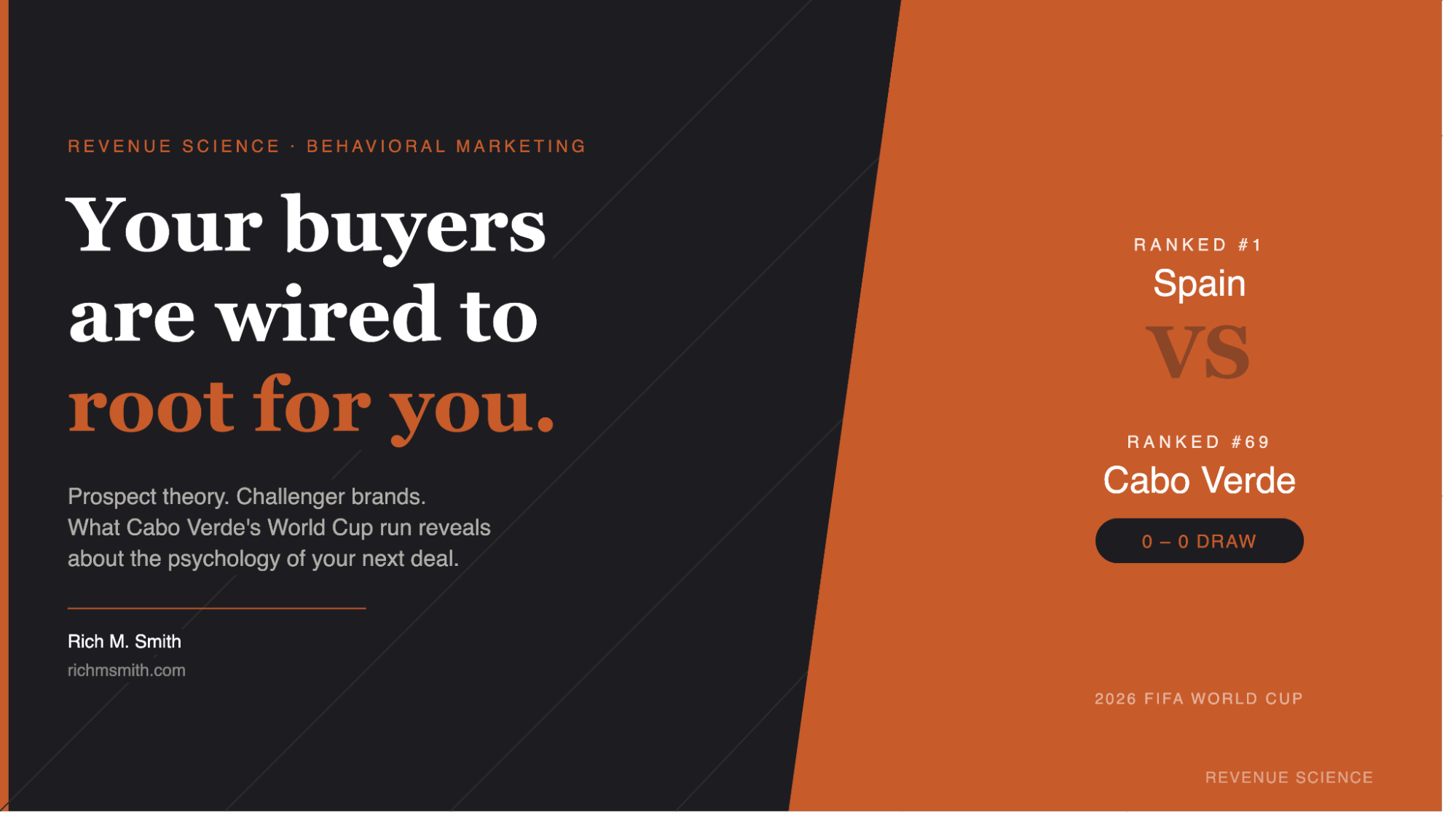
Cabo Verde — ranked 69th in the world — held European champions Spain to a 0–0 draw in their World Cup debut. Then drew 2–2 with two-time World Cup winners Uruguay. And as of this writing, they are alive to reach the knockout rounds (FIFA.com, 2026).
The entire world is rooting for them.
That is not a coincidence. It is behavioral science.
Why Underdogs Hijack Our Attention
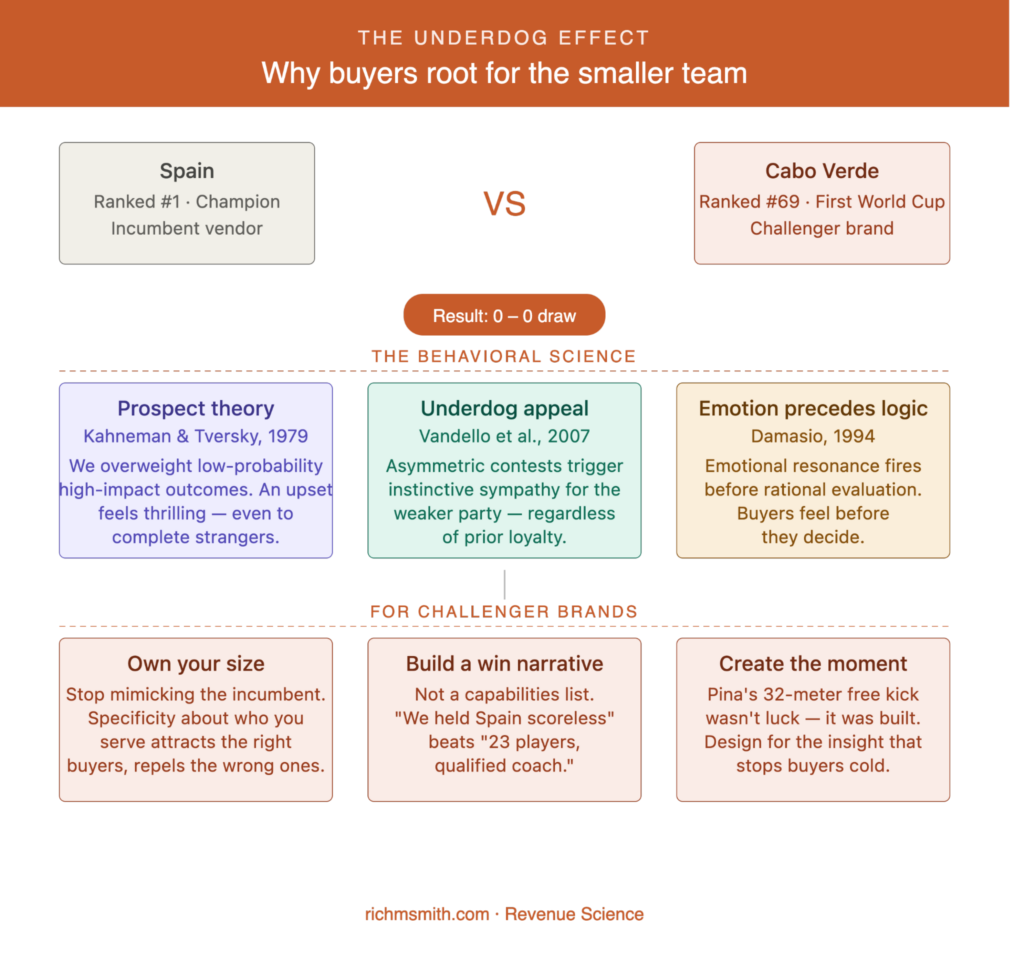
In 1975, Jerold Zanna and Joel Cooper published research on what they called “rooting for the underdog” — a near-universal psychological response to perceived imbalance of power. Decades of subsequent work, including research by Joseph Vandello at the University of South Florida (2007), confirmed the pattern: when we observe an asymmetric contest, we instinctively shift our sympathies toward the weaker party. Not because we expect them to win. But because the possibility that they might triggers a specific emotional response.
Kahneman and Tversky called the underlying mechanism prospect theory (1979). The potential gain of an unexpected Cabo Verde victory feels disproportionately large relative to its probability. Our brains are wired to overweight low-probability, high-impact outcomes — and to feel that emotional weight even when we have no rational stake in the result.
This is why billions of people who couldn’t find Cabo Verde on a map last month are checking scores this week.
The Business Translation
Your buyers experience this exact psychology every time they consider a smaller, newer, or lesser-known vendor.
When a mid-market company sits across from a Fortune 500 prospect, the buyer’s brain runs the same calculus it runs watching Cabo Verde face Spain. What if this company is the one? What if I find the hidden gem before everyone else does?
That emotional signal is real. And you can make use of it — but only if you know it’s there. The mistake most challenger brands make is trying to minimize the perception gap. They borrow enterprise language. They feature logo farms of clients they barely have. They create the illusion of scale because they assume buyers are scared of small.
Some buyers are. But many are not. And the ones who aren’t are your highest-value targets.
What Cabo Verde Did Right
Cabo Verde’s coach Bubista didn’t pretend his team belonged at this level because of their resources. He built an identity around how hard they were to beat (Al Jazeera, 2026). During qualifying, they went undefeated at home across five matches without conceding a single goal — topping a group that included Cameroon, Africa’s most World Cup-experienced nation (Al Jazeera, 2026).
They didn’t say “we’re as good as Spain.” They said “we came here to compete and to chase a dream” (Olympics.com, 2026).
That is positioning. And it created something Spain’s pre-tournament PR machine could not: genuine emotional investment from people who had never seen them play.
The Strategic Implication for Founder-Led Businesses
If you are running a $3M to $20M B2B service business, you are Cabo Verde. And the companies you are selling against are Uruguay.
You will not win by pretending to be Uruguay. You will win by making your differentiation feel so specific and so human that the buyer starts to want you to make it through. That’s not inspiration-poster advice. That is a documented cognitive response to asymmetric competition.
Three things it requires operationally:
Stop hiding your size. Buyers who penalize you for it are the wrong buyers. Buyers who lean in when you’re specific about who you serve and how you win — those are your Spain and Uruguay. Compete there.
Build a documented performance narrative, not a capabilities list. Cabo Verde’s story isn’t “we have 23 players and a qualified coach.” It’s “we held Spain scoreless and we’re still standing.” What’s the equivalent story in your pipeline conversations?
Manufacture the emotional moment. Kevin Pina scored Cabo Verde’s first-ever World Cup goal with a 32-meter free kick — the longest-range goal of the entire 2026 tournament (Olympics.com, 2026). Nobody planned that specific moment. But they created the conditions — the identity, the belief system, the preparation — that made it possible. Your version of that goal is the unexpected case study, the unsolicited client testimonial, the insight in the sales call that stops the buyer cold. You have to build toward it deliberately.
The Real Lesson
The Cabo Verde story is not about being small. It is about being so clear in your identity, so specific in your preparation, and so unapologetic about who you are competing against, that buyers experience the emotional pull of the underdog narrative before they ever see a proposal.
Prospect theory tells us we are moved by asymmetric possibility. Independent research confirms that emotional resonance precedes rational evaluation in purchase decisions (Damasio, 1994). And this World Cup is proving both in real time, on the world’s largest stage.
The question isn’t whether your buyers want to root for an underdog.
They do. The question is whether you’ve given them a reason to root for yours.
About Rich Smith: Rich M. Smith is an executive advisor, behavioral marketing strategist, investor, and CMO known for helping leaders finally understand not only how their strategy works, but why. Rich is also the host of the Revenue Science Podcast, a contributing author on Entrepreneur.com, and a keynote speaker. He is completing his forthcoming book, Revenue Science: The Architecture of Predictable Growth. With three decades of experience leading growth across financial services, healthcare, technology, and consumer brands, Rich has guided companies through crises, rebuilt brands from the ground up, and helped position organizations for nine-figure exits. He blends behavioral science, human psychology, and real-world executive experience to take the smoke and mirrors out of marketing—giving CEOs a clear, trustworthy path to growth. Rich is the bridge between marketing and the boardroom, known for translating complex ideas into practical strategies teams can use immediately. Whether he’s speaking to founders, executives, or investors, Rich shows audiences how to think differently, communicate with confidence, and use what sets them apart to win. Connect at RichMSmith.com · LinkedIn
References
Damasio, A. R. (1994). Descartes’ error: Emotion, reason, and the human brain. Putnam.
Kahneman, D., & Tversky, A. (1979). Prospect theory: An analysis of decision under risk. Econometrica, 47(2), 263–291.
Vandello, J. A., Goldschmied, N. P., & Richards, D. A. R. (2007). The appeal of the underdog. Personality and Social Psychology Bulletin, 33(12), 1603–1616.
Al Jazeera. (2026, May 24). Cape Verde at World Cup 2026: What to know. https://www.aljazeera.com/sports/2026/5/24/what-to-know-about-cape-verde-at-world-cup-2026
Olympics.com. (2026, June 22). FIFA World Cup 2026: Small nation, big dream — Cabo Verde eye knockouts after fairytale start. https://www.olympics.com/en/news/fifa-world-cup-2026-cabo-verde-eye-knockouts-after-fairytale-start