In April 1884, Mark Twain sat down to write a letter to his business partner, Charles Webster, about a book that didn’t exist yet — at least not in printed, bound form. Adventures of Huckleberry Finn was written. It was not, however, going to print. Twain’s instructions were specific: “Keep it diligently in mind that we don’t issue till we have made a big sale… but if we haven’t got 40,000 orders then, we simply postpone publication till we’ve got them” (as cited in ZSR Library, n.d., quoting Mark Twain’s Letters to His Publishers, p. 172).
Twain wasn’t hedging. He was running a business. He sent agents — many of them Union veterans, working door-to-door with a prospectus — out to sell the book before a single copy was bound. Huckleberry Finn moved roughly 40,000 advance copies before its 1885 publication date (Publishing Xpress, n.d.). The following year, Twain ran the same play at far greater scale to publish the Personal Memoirs of Ulysses S. Grant, deploying nearly ten thousand agents to sell the two-volume set before it existed as a physical object. The advance subscriptions funded the print run. The book became one of the best-selling titles of the 19th century, and Grant’s widow received roughly $450,000 over the following three years (Wikipedia, “Personal Memoirs of U.S. Grant,” n.d.) — proceeds that depended entirely on Twain having proven demand before committing a dollar to production.
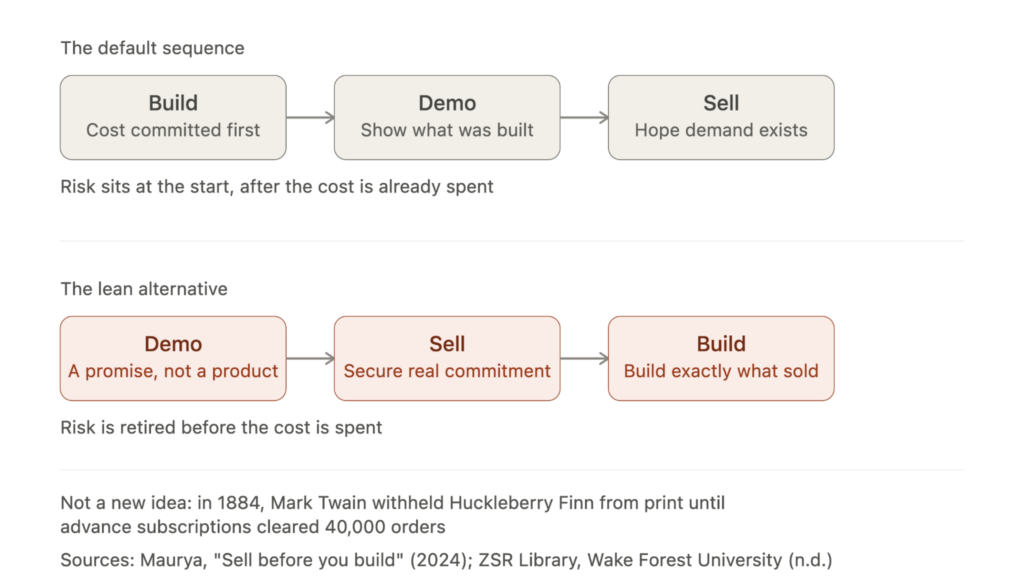
This is, in every meaningful respect, the same discipline a generation of startup founders would later rediscover and give a name to. Most organizations today still run on the opposite instinct: build the thing, demo the thing, then try to sell the thing. It feels methodical. It is, in fact, a bet placed with real payroll and real runway on an assumption that has never been priced by an actual buyer.
The better sequence has a name
Ash Maurya, creator of the Lean Canvas and author of Running Lean, has spent over a decade making the case for inverting that sequence: Demo-Sell-Build instead of Build-Demo-Sell. Design the offer. Sell it before a line of production code is written. Then build exactly what you sold. As Maurya puts it: “Demo-Sell-Build, not Build-Demo-Sell” (Maurya, 2024a). This isn’t a startup curiosity for garage founders — it’s a strategic posture for any CEO or revenue leader weighing a new offer, segment, or pricing model.
Why your brain resists the better sequence
If this is so clearly the smarter sequence, why do experienced executives keep building first? Because the bias runs deeper than process.
Loss aversion. Once engineering hours are committed, every additional dollar spent starts to feel like protecting an investment rather than creating one. Tversky and Kahneman’s foundational research on judgment under uncertainty established that the pain of a loss looms larger psychologically than the pleasure of an equivalent gain (Tversky & Kahneman, 1974). Pausing a build to test demand can feel like admitting a loss, even when it’s the only rational move left.
The IKEA effect. Teams overvalue what they personally build, attaching disproportionate worth to a product simply because they made it (Norton, Mochon, & Ariely, 2012). This breeds quiet, dangerous confidence that the market will love what the team is already proud of, long before any customer has said so.
The planning fallacy. Executives consistently underestimate the cost and risk of their own build phase while overestimating their certainty about market demand (Kahneman & Tversky, 1979). Build-Demo-Sell treats the build as a foregone conclusion. It rarely is.
Demo-Sell-Build doesn’t talk you out of these biases. It removes the conditions that let them operate, by forcing the validation conversation to happen before the cost is sunk and before the team has fallen in love with its own creation.
The modern playbook, run twice
Dropbox is the cleanest contemporary case. Drew Houston’s product — frictionless file sync across every device — was genuinely difficult to build. Rather than build it first, he made a simple, unpolished demo video, deliberately seeded with references that would resonate with the early adopters he targeted on sites like Digg and Hacker News (Thrive and Grow, 2025). No working product existed. The video alone was compelling enough that Dropbox’s beta waitlist jumped from 5,000 to 75,000 signups overnight.
Buffer ran an even more disciplined version. Joel Gascoigne’s first “product” was a two-page site: page one explained the concept with a “Plans and Pricing” button; clicking it led not to checkout but to a notice that the product wasn’t ready, with a request for an email. That extra click let Gascoigne separate curiosity from genuine intent to pay (Gascoigne, 2013). Only after that signal did he spend six weeks building version one. Buffer had its first paying customer within three days of launch.
What Twain did with a prospectus and a network of door-to-door agents, Houston and Gascoigne did with a video and a landing page. The tools changed. The discipline didn’t.
Translating this for an existing company
CEOs at established companies rarely face the “should we build the whole product” question. But the same decision shows up constantly in different clothing. A new service line: before building delivery capacity, can you sell the offer — even manually, even imperfectly — to three or four real prospects? A new vertical: before retooling messaging and onboarding, run the discovery-to-close motion with a handful of target accounts using what you already have. This mirrors how high-ticket B2B sales already work; most complex deals run a discovery-demo-close-pilot sequence, and a finished product typically isn’t required until the pilot stage, often months downstream (Maurya, 2024a). A new pricing model: sell it verbally to existing accounts at renewal before rebuilding billing infrastructure around it.
The mechanism is identical in every case, and it’s the same one Twain used in 1884: replace internal conviction with external commitment as the gate for investment. A signed commitment from a real buyer is traction. A confident roadmap is not.
The discipline question
None of this argues against building well. It argues against building first. As you stress-test the back half of 2026 — a new offer, a new segment, a new price point — ask the question before you ask anyone to build anything: have we actually sold this yet? Twain wouldn’t print until the orders cleared 40,000. Your threshold doesn’t need to be that high. It just needs to exist.
References
Gascoigne, J. (2013, November 30). How to successfully validate your idea with a landing page MVP. Medium. https://medium.com/@joelgascoigne/how-to-successfully-validate-your-idea-with-a-landing-page-mvp-ef3c2d02dc51
Kahneman, D., & Tversky, A. (1979). Intuitive prediction: Biases and corrective procedures. TIMS Studies in Management Science, 12, 313–327.
Maurya, A. (2024a, February 24). Sell before you build. LEAN 1-2-3 Newsletter, LEANFoundry. https://www.leanfoundry.com/lean-1-2-3/feb-24-2024
Norton, M. I., Mochon, D., & Ariely, D. (2012). The IKEA effect: When labor leads to love. Journal of Consumer Psychology, 22(3), 453–460. https://doi.org/10.1016/j.jcps.2011.08.002
Publishing Xpress. (n.d.). Famous self-published authors. https://www.publishingxpress.com/book-printing-ideas/book-self-publishing/famous-self-published-authors/
Thrive and Grow. (2025, May 17). Pre-launch traction: How Dropbox got 75,000 signups. https://thriveandgrow.com/2025/05/17/pre-launch-traction-how-dropbox-got-75000-signups/
Tversky, A., & Kahneman, D. (1974). Judgment under uncertainty: Heuristics and biases. Science, 185(4157), 1124–1131. https://doi.org/10.1126/science.185.4157.1124
Wikipedia. (n.d.). Personal Memoirs of U.S. Grant. https://en.wikipedia.org/wiki/Personal_Memoirs_of_U._S._Grant
ZSR Library, Wake Forest University. (n.d.). Adventures of Huckleberry Finn, by Mark Twain (1885). https://zsr.wfu.edu/2013/adventures-of-huckleberry-finn-by-mark-twain-1885/