The VP of Sales pulled up the forecast slide before the Monday pipeline call. “We told the board $9.2 million for the quarter,” she said. “We’re going to land at $8.9 million.”
The CRO exhaled. “That’s 97% of target. That should read as a strong quarter.”
“It won’t,” she said. “Nobody remembers what we actually made. They remember the number we told them to expect.”
He wanted to argue. He’d watched it happen before — a team delivering real growth and still walking into a board meeting bracing for hard questions, because someone, months earlier, had put a bigger number on a slide.
Same revenue. Different reaction. The number that mattered wasn’t the one in the spreadsheet. It was the one already sitting in everyone’s head.
Three weeks later, Netflix ran the exact scenario for real, on a $12 billion stage.
The number that erased the beat
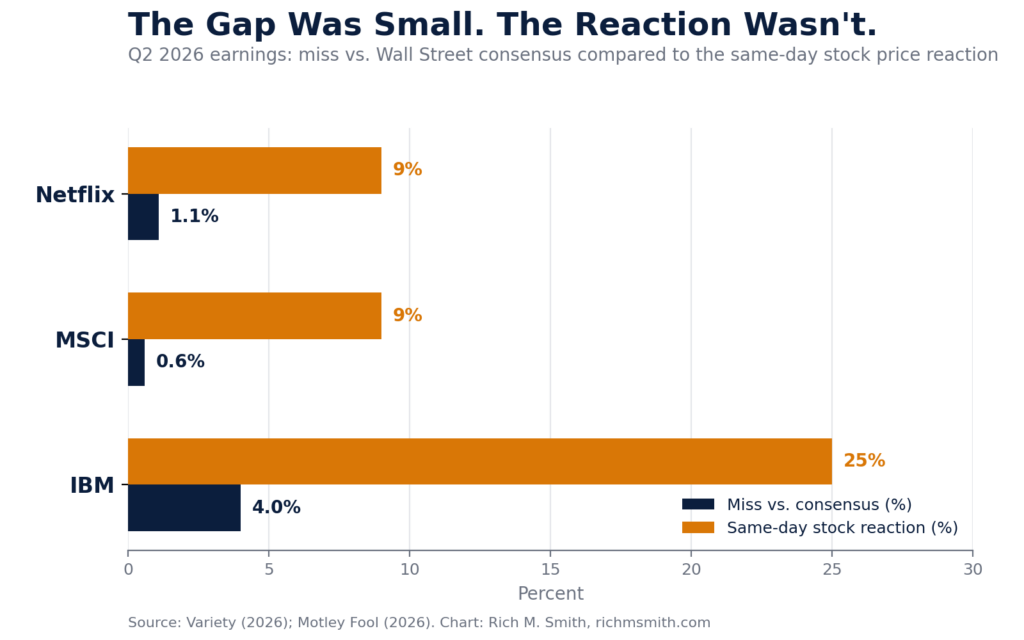
In its Q2 2026 report, Netflix delivered revenue of $12.56 billion, up 13.4% year over year, with earnings in line with Wall Street’s model (Variety, 2026). By almost any measure, it was a solid quarter. Then management guided Q3 revenue to $12.86 billion — about $140 million, or roughly 1%, below the $13.0 billion analysts had already priced in (Variety, 2026). Shares fell nearly 9% in after-hours trading (Variety, 2026).
Nothing about Netflix’s business changed that day. What changed was its position relative to a number that existed only in analysts’ models. Investors weren’t grading the company against last year. They were grading it against the anchor already sitting in their heads.
Netflix wasn’t alone that earnings season. IBM pre-announced preliminary results that fell about 4% short of consensus revenue and lost 25% of its market value in a single session — the worst one-day drop in its history (Motley Fool, 2026, July 19). MSCI beat on revenue but missed EPS consensus by less than 1%, and still sold off nearly 9% on concerns about rising expense guidance (Motley Fool, 2026, July 21). United Airlines beat Q2 estimates outright and raised full-year guidance, yet shares still slipped because next-quarter guidance landed under the Street’s model (PR Newswire, 2026). Four companies, four industries, one identical pattern: the size of the miss and the size of the market’s reaction had almost nothing to do with each other.
Why a 1% gap feels like a crisis
This is the anchoring effect, one of the most replicated findings in behavioral science. Amos Tversky and Daniel Kahneman showed that once people form an initial reference point — even an arbitrary one, like a number spun on a rigged wheel — every later judgment gets evaluated as an adjustment from that anchor rather than assessed fresh (Kahneman & Tversky, 1974). Northcraft and Neale (1987) found the same bias in experienced real estate agents, who priced identical homes differently based solely on the asking price they’d been shown first, while insisting their judgment was purely objective.
Prospect theory explains why the resulting swings feel so lopsided. Kahneman and Tversky (1979) demonstrated that people weigh a loss against a reference point roughly twice as heavily as an equivalent gain — so a guidance number that lands even slightly below the anchor doesn’t register as “almost there.” It registers as a loss. Dan Ariely’s pricing research extends the same mechanism to willingness to pay: the first number a person encounters shapes every valuation that follows it, far more than the underlying facts do (Ariely, 2008).
The companies that use this on purpose
Some organizations have learned to make anchoring work for them instead of against them. Apple built a multi-year reputation for guiding conservatively and then clearing its own bar most quarters — a pattern widely enough noticed that analysts began describing it as “sandbagging” (AppleInsider, 2013). The tactic isn’t dishonesty; it’s expectation architecture. A company that consistently sets an anchor it can beat converts every earnings call into a trust-building event instead of a coin flip.
CEOs, sales leaders, and marketing executives run this same experiment constantly, whether they intend to or not. A sales forecast, a client delivery timeline, an ROI projection in a pitch deck — every one of them plants an anchor that will later be used to judge you, regardless of how strong the actual outcome is.
What to do with your next forecast
Before the next board deck, pipeline call, or client proposal goes out, ask what number you’re anchoring people to, and whether it’s one your team can beat under normal execution — not just in a best case. Ask whether a 95% outcome against that number would read internally as success or failure, because that answer tells you whether the anchor is calibrated or aspirational. And ask, deliberately, whether you’d rather explain a miss after the fact or engineer a beat before you ever set the number.
Growth doesn’t only come from doing better work. It comes from making sure the work you do is measured against a fair reference point — one you set on purpose, rather than one the market, the board, or the buyer assigned to you by accident.
References
AppleInsider. (2013, January 25). Apple shifting its guidance to stop being blamed for “missing” analyst expectations. https://appleinsider.com/articles/13/01/25/apple-shifting-its-guidance-to-stop-being-blamed-for-missing-analyst-expectations
Ariely, D. (2008). Predictably irrational: The hidden forces that shape our decisions. HarperCollins.
Kahneman, D., & Tversky, A. (1974). Judgment under uncertainty: Heuristics and biases. Science, 185(4157), 1124–1131.
Kahneman, D., & Tversky, A. (1979). Prospect theory: An analysis of decision under risk. Econometrica, 47(2), 263–291.
Motley Fool. (2026, July 19). Why did IBM stock plunge 25% in one day? Preliminary Q2 results were weak, but not terrible. https://www.fool.com/investing/2026/07/19/ibm-stock-q2-preliminary-warning-ai-capex/
Motley Fool. (2026, July 21). Why MSCI stock is plummeting lower today. https://www.fool.com/investing/2026/07/21/why-msci-stock-is-plummeting-lower-today/
Northcraft, G. B., & Neale, M. A. (1987). Experts, amateurs, and real estate: An anchoring-and-adjustment perspective on property pricing decisions. Organizational Behavior and Human Decision Processes, 39(1), 84–97.
PR Newswire. (2026, July 15). United posts Q2 results above Wall Street expectations and raises full-year 2026 adjusted EPS guidance despite a nearly $6 billion increase in anticipated fuel costs. https://www.prnewswire.com/news-releases/united-posts-q2-results-above-wall-street-expectations-and-raises-full-year-2026-adjusted-eps-guidance-despite-a-nearly-6-billion-increase-in-anticipated-fuel-costs-302826793.html
Variety. (2026, July 17). Netflix Q2 earnings results in-line with expectations, stock drops on lower Q3 revenue outlook. https://variety.com/2026/tv/news/netflix-q2-2026-earnings-1236812558/