Forty years after New Coke, another iconic American brand discovered the same thing: customers don’t evaluate change on its merits alone. They compare it with what you’re taking away.
The product VP pulled up the redesign deck before the Thursday leadership sync. “The new interface tested better in every usability session,” he said. “Faster task completion, higher satisfaction scores, cleaner UI. It’s just better.”
The CMO nodded, then paused. “Better than what, though?”
“Than the old one. Obviously.”
“That’s not the comparison your customers are going to make,” she said. “They’re not going to compare your new product to your old product. They’re going to compare gaining the new product to losing the one they already know how to use.”
He wanted to push back. The data was clear. Better was better.
Two weeks later, Cracker Barrel ran the exact experiment on a national stage — and the market answered the CMO’s question for her.
The Logo That Came Back in Six Days
On August 19, 2025, Cracker Barrel unveiled a refreshed visual identity: a simplified logo, new restaurant remodels, and updated marketing built around what the company called the fifth evolution of its brand. The familiar “Old Timer” leaning beside his barrel was gone. CMO Sarah Moore framed it as continuity — the company’s story and values hadn’t changed, she said, only their expression (Cracker Barrel, 2025).
Customers didn’t experience it as continuity. Shares fell as much as 13% intraday on August 21 amid the backlash (Reuters, 2025). Six days after the launch, Cracker Barrel reversed course and brought the Old Timer back (Associated Press, 2025). Weeks later, it quietly shelved the modern restaurant-remodel concept after testing it in only four locations (CBS News, 2025). Nearly a year later, CEO Julie Masino departed, with David Deno taking over August 10, 2026 — a transition Cracker Barrel has not tied directly to the rebrand, though the failed redesign became one of the defining episodes of her tenure (Cracker Barrel, 2026).
Forty Years Earlier, Coca-Cola Ran the Same Experiment — With Better Data
Here’s what makes this more than a story about one bad logo: Coca-Cola had already run this exact test, forty years earlier, with far stronger evidence behind the decision.
By 1985, Coca-Cola had a legitimate strategic problem — softening consumer preference and a sluggish category — and it responded with one of the largest product-development efforts in its history. The reformulated recipe was preferred in blind taste tests involving nearly 200,000 consumers (The Coca-Cola Company, n.d.). On April 23, 1985, the company retired the 99-year-old formula and replaced it with what the market would call New Coke (The Coca-Cola Company, n.d.).
The reaction was immediate: consumer hotline calls jumped from roughly 400 a day to 1,500, protest groups formed, and customers hoarded the original product (The Coca-Cola Company, n.d.). Seventy-nine days later, Coca-Cola brought the original formula back as Coca-Cola Classic. In its own retrospective, the company concluded that its taste tests had measured preference but missed the emotional bond consumers felt toward the product they already owned (The Coca-Cola Company, n.d.).
That’s the detail worth sitting with. Coca-Cola wasn’t wrong about which product tasted better. It was answering the wrong question. “Which do you prefer?” and “Will you give up what you already have?” are not the same decision — and the second one, not the first, is the one that determines whether a change survives contact with the market.
The Status Quo Tax
William Samuelson and Richard Zeckhauser (1988) gave this phenomenon its name: status quo bias, the tendency to disproportionately favor an option simply because it’s the one already in place. Loss aversion compounds it — Kahneman and Tversky (1979) showed people weigh a loss roughly twice as heavily as an equivalent gain, so the moment your new offer becomes a replacement rather than an addition, the customer isn’t just comparing features. They’re pricing in what they’re about to lose.
Think of it as a tax on every change you introduce:
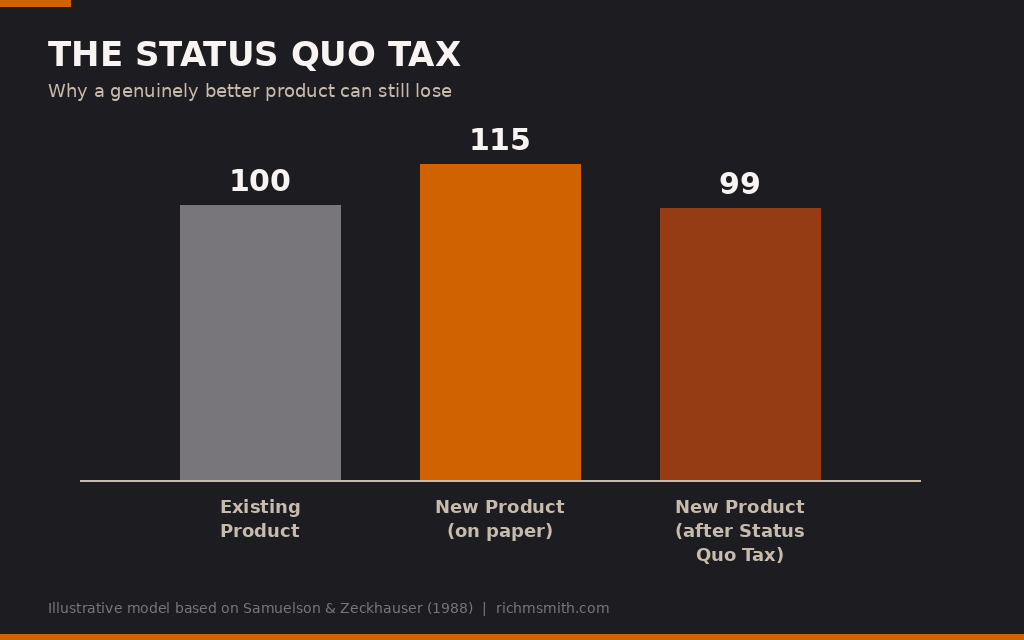
New Value − Familiarity Loss − Switching Cost − Uncertainty − Loss of Control = Perceived Value
A product that’s a genuine 15-point improvement can still lose if the switching costs, relearning, and loss of the familiar add up to more than 15 points of friction. That’s not a flaw in the customer’s judgment. It’s the actual math they’re running, whether your research measured it or not.
Why This Is a Revenue Problem, Not a Branding Problem
B2B leaders run this exact experiment constantly, just with less visible consequences than a logo. “We simplified pricing” often lands as “you’re taking away my current deal.” “We migrated the platform” lands as three months of broken integrations. “We restructured account coverage” lands as losing the rep who understands the account.
It also explains why qualified prospects don’t buy from you even when your product wins head-to-head. The real competitor in most B2B sales cycles isn’t the other vendor. It’s the prospect’s current process — and status quo bias is defending it for free, whether or not anyone at the incumbent is doing a good job.
Three Questions Before Your Next Change
Before your next rebrand, pricing change, platform migration, or account restructuring, ask three questions instead of one. Not just “is the new version better?” but: What would customers or employees miss if we removed it? What’s the smallest version of this change that still gets us the benefit? And if this goes badly, how fast can we reverse it?
Cracker Barrel’s ability to restore its logo in six days limited the damage to a bad week instead of a lost brand. Coca-Cola’s reversal after 79 days did the same. Reversibility isn’t indecision — it’s the cheapest insurance policy against a Status Quo Tax you didn’t calculate correctly the first time.
The better product doesn’t automatically win. The product that accounts for what people are being asked to give up does.
References
Associated Press. (2025, August 26). *Cracker Barrel reverses course, will keep its old logo after backlash.*
CBS News. (2025, September). *Cracker Barrel drops modern restaurant redesign after backlash.*
The Coca-Cola Company. (n.d.). *New Coke: The most memorable marketing blunder ever?* https://www.coca-colacompany.com
Cracker Barrel. (2025, August 19). *Cracker Barrel unveils refreshed brand identity* [Press release].
Cracker Barrel. (2026, July). *Cracker Barrel announces CEO transition* [Press release].
Kahneman, D., & Tversky, A. (1979). Prospect theory: An analysis of decision under risk. *Econometrica, 47*(2), 263–291.
Reuters. (2025, August 21). *Cracker Barrel shares tumble as logo backlash intensifies.*
Samuelson, W., & Zeckhauser, R. (1988). Status quo bias in decision making. *Journal of Risk and Uncertainty, 1*, 7–59. https://doi.org/10.1007/BF00055564