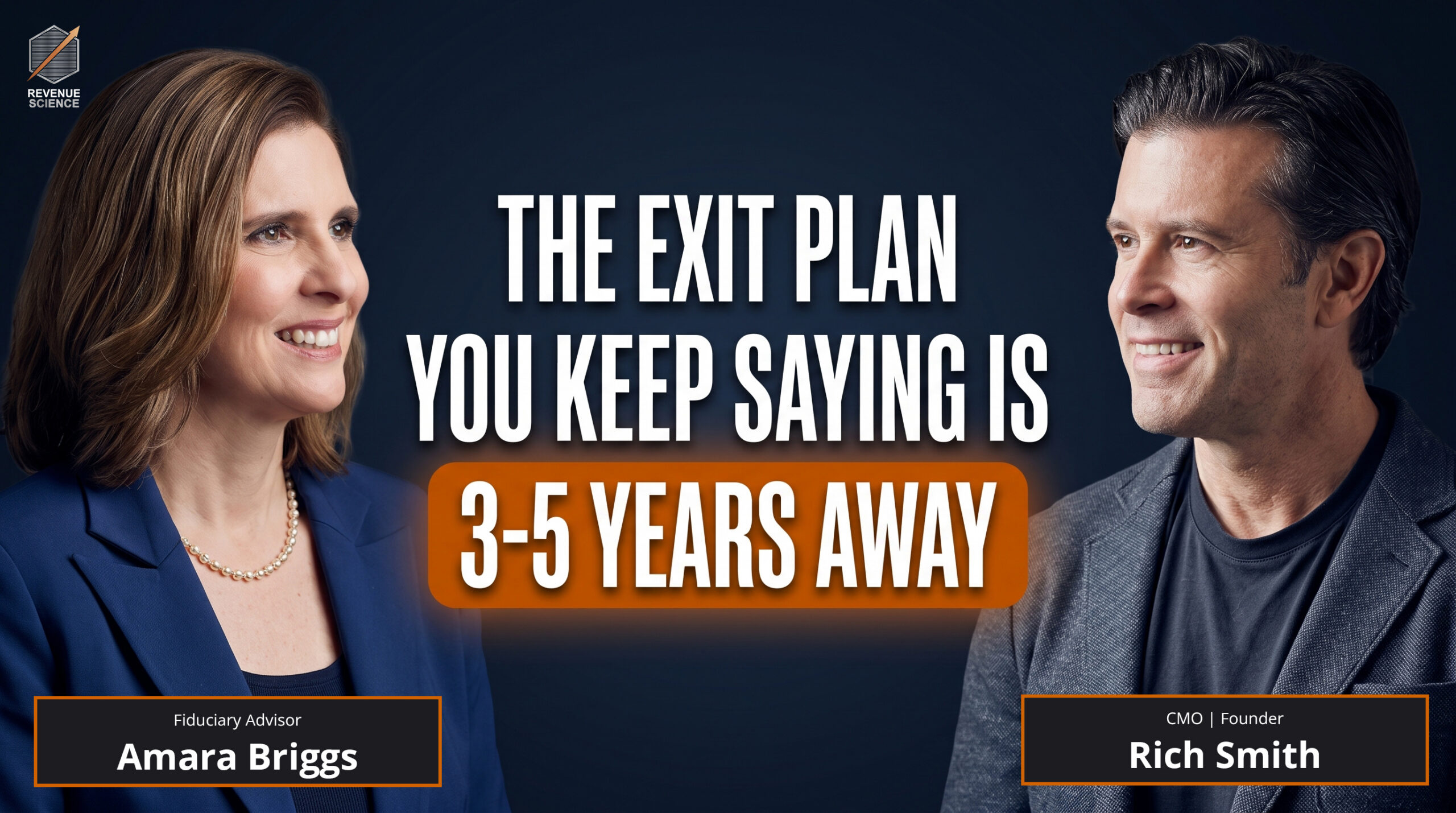
[0:00] Rich Smith: It's always three to five years. I might go back a year later and ask them, and it'll still be three to five years. What's really going on behind that answer?
[0:07] Amara Briggs: That three to five years, I think, is the old-school way of thinking about an exit. It's an all-or-nothing exercise.
[0:29] Rich Smith: Welcome to Revenue Science, the show where we translate marketing and sales complexity into boardroom clarity for CEOs, founders, and growth leaders building predictable revenue growth systems. I'm Rich Smith — CMO, founder, executive adviser, investor, and your host. Thank you for joining us today, and please help us reach more leaders by liking, subscribing, and sharing this episode.
[0:54] Rich Smith: Entrepreneurship is the engine that drives our economy. And when founders succeed, they improve the lives of their families, their employees, their communities, and most importantly, their customers. My guest today spent nearly three decades as a commercial banker structuring debt for middle-market businesses, until she kept running into a problem she couldn't solve from the lending side of the table. The needs of a business owner change as the business grows, and a lender can only do so much. So Amara Briggs became something different: an independent fiduciary adviser.
[1:24] Rich Smith: Today she works with business owners, high-net-worth individuals, and nonprofits, guiding them through some of the highest-stakes financial decisions of their lives — from owners weighing growth capital or a transition, to executives holding concentrated stock who need a plan to diversify. She also serves on nonprofit boards, because she believes the work should serve something larger than just the balance sheet.
[1:48] Rich Smith: Here's why this conversation is important to Revenue Science. I write about the behavioral science behind how people make decisions. Amara spends her days watching those same biases play out when smart, successful people finally confront money, legacy, and letting go. Today we'll explore the transition most founders keep postponing, why diversification is so psychologically hard, what capital providers actually evaluate in a private company, and how an owner moves from building enterprise value to protecting their own personal wealth.
[2:23] Rich Smith: Before we dive in, a quick note: today's conversation is for educational and informational purposes only. Nothing Amara or I discuss should be taken as personalized financial, investment, tax, or legal advice, and it is not a recommendation or a solicitation to buy or sell any security or pursue any strategy. For guidance specific to your own situation, please consult your own qualified advisers. Amara, welcome to Revenue Science.
[2:54] Amara Briggs: Thanks, Richard. I'm excited to be here.
[2:57] Rich Smith: I'm looking forward to this conversation, because I think we're going to cover some ground that's really important to a lot of the founders, CEOs, and investors who listen to this show. You spent 29 years as a commercial banker structuring debt for middle-market businesses. What was the pattern you kept seeing — the thing you couldn't fix from the lending side — that eventually pulled you across the table to become an adviser?
[3:25] Amara Briggs: Thanks, Rich, it's a really interesting question. I started out as a banker working with public companies, and then eventually moved into my core business, which I really enjoyed: privately held businesses. These are middle-market businesses with multi-generational ownership — some have been in business a hundred years, some 20 or 30. Many of them had amazing stories that carried through the business, and obviously I was at the table because I was trying to lend money to these businesses, which tells you how strong they were financially.
[4:18] Amara Briggs: But what I found again and again was that many of the founders, or the patriarchs of the family, were running into a wall with themselves. They loved the business they'd built and patted themselves on the back for getting where they were, but they didn't have that passion for the business anymore. Some wanted to move into something slightly different — they'd found a different niche. Or there was concern that the next generation wasn't ready to take over, or to keep the business the same way the patriarch or matriarch had left it. That happened again and again, and it's not something you can do a whole lot about as a lender, because you're waiting to get paid back — you're not going to tell the family how to run their business.
[5:30] Rich Smith: Right. And moving out of lending into fiduciary advising completely changed your perspective and what you're able to do. In plain terms, what changed about how you could serve a business owner once you were on their side of the deal?
[5:50] Amara Briggs: Great question. I want to explain first the importance of a fiduciary — you see it in the Fisher Investments commercials, but people sometimes wonder what it means. As a fiduciary, my responsibility is to look out for the interest of the shareholders. I don't get paid a commission for the products I sell — my responsibility is to charge a fee irrespective of what type of investment you're in. If you choose an in-house fund, or a fund we offer on our platform, I get paid the same. That's a really important piece of information.
[6:47] Amara Briggs: The second thing I'd add is that many families are wealthy and don't want the day-to-day saddling of decision-making on funds or stocks they're going to buy. A fiduciary is allowed to make trades and decisions as long as it's within the allocation or plan we've agreed upon. That gives the investor freedom to do what they want to do — we want you to live life and enjoy your wealth.
[7:24] Amara Briggs: Being on the other side of the table with business owners you've lent money to — first of all, they have to get out of their head that I'm not a lender anymore. But the second thing is I'd already earned their trust, because I'd been with them through ups and downs in the business for many years. I have a client who owns a 75-year-old business with a business partner — I financed his buyout of the original owner around 2010 or 2011. I'd already seen how he reacted through thick and thin.
[8:23] Amara Briggs: What I saw in him — as I told him, and I'm now telling you — was that his risk appetite was very different for himself versus his business. He was a little more conservative when it was the business, because other lives were at stake — employees who would benefit or not from his decision-making — whereas in his mind, with his wealth it was just him and his wife, and he could make some riskier decisions about how he wanted to spend it. That was really different.
[9:11] Rich Smith: That's an interesting dynamic, and I'm sure one a lot of our listeners can identify with — they're much more willing to take bigger chances with their own finances than with their organizations, because the organization has other stakeholders to care about. But it's also very public — people can see what's happening with the company — whereas what you do with your own wealth is more private. That may have something to do with it as well.
[9:44] Rich Smith: You've said one of your favorite books is Ron Chernow's "Titan," the biography of John D. Rockefeller. What is it about Rockefeller's arc — the rise, the breakup, the pivot to philanthropy — that's shaped how you think about wealth and balance?
[10:09] Amara Briggs: The first thing I'll say about the book is that it tells you the quintessential American story. He grew up as the son of a snake oil salesman out west, and no one thought — or he was told — that he was going to amount to anything. In some societies, being the son of a snake oil salesman meant you were going to be a snake oil salesman, or worse. So it's the quintessential American story: he used his background, his education, his relationships to build a business that, even today, is still producing very successful amounts of revenue and profit for individuals.
[10:54] Amara Briggs: The ethical and, I'd say, hard-headed business decisions he made for himself I wouldn't have made for myself — I just found that interesting, and in some ways kind of comforting. And as he gained power and became more successful, he became much more stalwart in what he wanted to do and listened less to the individuals around him. I find that's sometimes the case with business owners — they're successful in their own right, and they feel, "I'm going to stick with my plan." In some ways I feel the same way, but he took it to a much greater degree.
[11:56] Rich Smith: Another really interesting story that a lot of people can identify with: here's a titan of American industry who came from nothing, but got so caught up in his own success that he felt he didn't need the advice or the ears of others. That's a blind spot many of us can fall into if we're not careful. You told me the hardest conversations you have are helping an owner move from the business to thinking about themselves. What have you learned about who founders are once the business is no longer the answer to "what do you do?"
[12:51] Amara Briggs: Thank you for your well-said commentary on Rockefeller. What I've found is that when it switches from the business to them, the first thing is including their family in these discussions. When they're thinking about their business — let's say John Smith — the business asset belongs to him and his business partner. Then I'll say, "now we're talking about not just you, but you and your wife, or you and your kids or grandkids." Many of them say "my wife and I," but I'd say half of them or fewer actually include their spouses in those discussions — it depends on how the marriage is.
[14:05] Amara Briggs: But that wealth belongs to both of them now. If the gentleman is out of the business, they have to think about what the couple will jointly do with the wealth.
[14:21] Rich Smith: Another difficult transition, because it's blending business and personal together, and we like to compartmentalize those aspects of our lives. I write a lot about what I call the rationality gap — the distance between how smart people think they decide and how they actually decide. Where do you see successful, sophisticated people making the most predictable mistakes with their own money?
[14:56] Amara Briggs: Great question. To me, the most successful business owners and businesses are the ones that consider other advisory people around them — they view the banker as their adviser, their lawyer as more than just a lawyer, more than a transaction. Where we see mistakes is, looking at my notes here: again, including the family in conversations. Then there's viewing their children being in the business as "not prepared." In my experience, it's more that the kids have a different way of leading, one that's not as comforting to the owner — it's just different. That doesn't mean they won't be successful.
[16:15] Amara Briggs: The third thing is, particularly with private businesses, not investing at the CFO or C-suite level — individuals who can help the business have the most successful exit it can. I see again and again owners who are really smart, capable business people who don't hire a really good second finance person or HR person to help with that transition.
[16:54] Rich Smith: That's a common problem I see with the companies and CEOs I speak with. You pointed out HR and finance, two very important places — typically I find the lack of hiring goes beyond those functional roles to sales, marketing, customer success, and operations. The founder is involved in all of those things and actually becomes the bottleneck, because the company can't scale beyond the time they have available. Sometimes they've put good people in those places, but never figured out how to create a system to make sure everybody's aligned and making decisions based on the company's objectives. That creates a lack of trust from the founder — they can't let those things go, because they haven't put things in place to give them assurance those people will make decisions similar to what they'd make.
[18:14] Rich Smith: Another thing I find, and I'm going to laugh a little: I often tell founders, "tell me about the end of the movie" — where are you trying to get to ultimately? Let's write that script. That's a lot of what you're talking about — what do they do when they get to the end of the movie? When I ask that and get an answer, I'll ask what time frame they're thinking about, and the answer is almost always three to five years. It's always three to five years. I might go back a year later and ask, and it'll still be three to five years. So when you talk to founders and business owners, what's really going on behind that answer, and what does that delay actually cost them?
[19:06] Amara Briggs: That three to five years, I think, is the old-school way of thinking about an exit. It's an all-or-nothing exercise: "in three years I'm going to get a valuation of X, once I build out this product line I've been talking about for five years and get it to a certain scale — because my business-owner friend told me that's the case." Many people have started to do this better, but some don't put stock back into the business, and they're left with this all-or-nothing result that costs them dearly in the future if something were to happen.
[19:51] Amara Briggs: Maybe the business isn't performing where it should be, or — in one case I had — the wife was sick, and the owner wanted to move on, but they weren't in a position to buy his stock back from the business. So rather than a grand plan of "here's what the value will be in the future because I'm going to build out this particular business line," I'd suggest staging it: start by selling 15% or 20% so I can get some diversification — an overused word — in my own income strategy, and make sure I'm not stuck in the future with those types of situations.
[20:42] Amara Briggs: Then there's the lack of understanding or feeling about who the successor is — whether it's their children, private equity in many cases, or an ESOP — just a fear of the unknown. And third, where am I going to put my money? That comes up a lot. The market is viewed in many cases by the private business owner as a casino — we see valuations of public businesses again and again that make no sense. And there isn't a lot of tax harvesting in the markets these days, whereas in businesses — many of my clients were S corps — there are great ways to be tax-efficient or tax-savvy.
[21:51] Rich Smith: You point out a couple of really important things. One I want to highlight is that all-or-nothing thinking — "the only way to exit is to sell the whole business to a buyer." That's not always the case. There are many types of businesses, particularly professional services, that don't garner big multiples, but that doesn't mean there isn't a great way to diversify and exit over time with the right planning. There's a menu of ways to transition a business — third-party sale, family succession, management buyout, ESOP, recapitalization, partial liquidity — a lot of options. Once you get the founder to the point of thinking there's a plan that's not all or nothing, how do you help them choose the right path?
[22:57] Amara Briggs: Choosing the right path means understanding their and their family's goals in terms of income, what they would need to spend, what they're trying to accomplish with their spending and philanthropic giving. Then we can back into what the options are for the business. I'm just making this up: someone might say, "I don't mind having some ordinary income, because I have another project that's generated losses that can offset it." Then we can think about making them a consultant or a W-2 earner and transitioning the plan that way — whether that's a sale to private equity where they work for a year or two, or longer, on some type of contract basis.
[23:58] Amara Briggs: Those are the conversations we have, based on their spending, what they have in assets today, and their goals, so we can put together the right path. And again, I'm not an investment banker, but my goal is to get an investment banker in the mix to make sure they're getting the best deal for themselves — and many of the very good ones will consider different avenues to monetize the sale.
[24:38] Rich Smith: That's really helpful. What would you say is the most expensive mistake owners make in the few years before a transition — the thing they could have fixed early if someone had told them to look?
[24:47] Amara Briggs: It goes back to that situation with the C-suite and HR: just going in and doing their own kind of audit, a quality of earnings, so to speak — having somebody take a look at the business and making sure they're aware of what the market's going to be looking for in terms of valuation, and fixing those mistakes. If there's a concentration issue with a certain client, we have to nip that in the bud or have a plan to diversify. If it's dependence on the founder for certain income streams, we have to reduce our reliance on that. And making sure we have our books and records in order — I've seen cases where we're well into diligence and learning there's too much dependence on the founder to make certain decisions about sales or contracts, or workarounds that are going to implode the value of the business going forward.
[26:11] Rich Smith: I often write and talk about a cognitive bias we all have called the endowment effect — we tend to overvalue what we own. You probably run into that a couple of ways: owners who overprice the business, executives who won't part with a single share of company stock. How does it show up, and how do you help move people past it?
[26:38] Amara Briggs: Well, it takes a lot of discussion. [laughter] In particular, I think in the technology sector we're seeing more and more of that — folks saying, "I'm in technology, I have a SaaS business, a subscription-based business" — and with AI, a lot of the buyers of those products are trying not to box themselves into technological obsolescence. So there are different impacts to the models these businesses have. I agree that we have to go beyond the headlines and not be too focused on AI all the time — there are a lot of businesses that don't need tokens and things like that.
[27:30] Amara Briggs: But the reality is it takes a lot of time, a lot of discussion, and a lot of open-mindedness on behalf of the shareholder to say, "listen, there's stuff out there that's a better fit than your concentrated stock position." And secondly, there's nothing to fear in the market in terms of tax planning and tax harvesting once we get past the business side of things. It takes good communication and, as I mentioned earlier, trust — having that earned trust from being a lender in the past, so they see that you've been there for them and understand what they've been through.
[28:31] Rich Smith: I'd imagine a lot of this challenge is due to anchoring — the owner hears that a friend sold his business for eight times earnings, and that number becomes the gospel multiple stuck in their head. How do you reset an anchored valuation like that without blowing up the relationship?
[28:59] Amara Briggs: It does take a lot of patience. It comes down to pulling apart what this client's plan is for himself in the future and what he needs to live on — showing him, or her, and the family what they need to live on first and foremost. Let's take it back to that. Secondly, introduce early a noted industry investment banker, or someone well-tuned to the space, who can say what the true valuations in the market are and whether they can meet these needs. Where clients tend to get anchored is when they don't really know what they need to live on, so they feel they need that eight-times valuation to make sense of their lives going forward. Once you give them that road map, I've seen it gives them more comfort in moving forward on their plan.
[30:29] Rich Smith: That makes a lot of sense. Changing gears a little — you also work with owners seeking growth capital, not just an exit. When an investor evaluates a private company, what are they really underwriting, and how does that often differ from what the founder thinks they're selling?
[30:50] Amara Briggs: If you're in a high-growth space, you're not underwriting to earnings, you're underwriting to slices of future revenue. I gave the example earlier of the true story of the person waiting for a certain product to scale — that's basically what these investors are underwriting to. A lot of these owners have legacy business lines that have been the engine fueling growth over time, and nobody cares about that — what they care about is the new product they're investing in. So we have to take our minds away from what's gotten you here and think forward: what's the market for this product, and what's the revenue stream for it.
[31:51] Rich Smith: I often think of it as: what an investor is buying is really a future earnings stream.
[31:57] Amara Briggs: Correct.
[31:58] Rich Smith: As a result, I argue that predictable revenue is both a valuation driver and a confidence driver for investors. From the capital side, how much does revenue predictability actually move the terms of a deal?
[32:16] Amara Briggs: From a lending perspective, it's not that much. Revenue is obviously important because it gives you a sense of stability, but it's really EBITDA — earnings — that drives most lenders and investment bankers when they consider a valuation. "Stability" and "predictability" are kind of overused words, but the durability of earnings is really what's critical for valuation going forward.
[32:54] Rich Smith: We may be using two terms and meaning a very similar thing. I've been involved in the sale of several businesses, and one thing I'd coach organizations on that I think investors really valued was this: if you have the ability to pretty accurately predict what your sales will be 90 days from now — and these conversations often happen over months, not days — and then you come back 90 days later and actually hit what you said you'd hit, that gives the potential investor or lender a lot more confidence that this team has a system and repeatable, predictable growth on the revenue top line. The same holds true for managing expenses, and ultimately profit and EBITDA, which is really what they're buying — an earnings stream, not a revenue stream.
[34:07] Amara Briggs: Correct. Definitely — reporting is so important. For us as lenders or investors, we look at backlog or pipeline for particular revenue, and at hitting it — and how you've performed during ups and downs in the market. We have so many recent examples of down markets, and many of my clients have been through several. Again and again they've shown they can go through those markets, not only generate revenue and take advantage of opportunities to bring in new clients through service or new product lines, but also right-size expenses really quickly. Those are really important for a lender to consider, and for an investor to see how management has performed during difficult cycles.
[35:24] Rich Smith: I write a lot about how being founder-led can actually add to a company's valuation, whereas being founder-dependent is a discount. How does founder dependence show up in due diligence, and what does that cost the owner, both in valuation and in their freedom to walk away?
[35:53] Amara Briggs: It has happened before. As we discussed earlier, founders become almost too involved in the day-to-day — making decisions about contracts, where product is built, who answers the phone after five o'clock — we have those discussions too. I had a situation where we were well into diligence with a private equity firm, and when they were doing diligence with the top customers, they learned about the dependence on the founder in those discussions, and it made it very challenging for them to take the founder away from the situation. It matters a lot. And at the end of the day it's difficult for everyone in the business, because how do you tell a founder, "you need to step away for the good of the business"? It can be very difficult.
[37:13] Rich Smith: That's really the challenge. I often ask: let's just say you couldn't work for 60 days — what would happen to your company? If they look at me with panic and say "oh, everything would fall apart," that helps underscore the point. Imagine an investor buying your business — if they see everything depends on you, they're probably expecting you not to stick around very long, and if they buy it, they're going to want to buy your time. If your goal is to remove yourself from the business, you have to start doing that well before you get to a sale or exit.
[38:03] Amara Briggs: Absolutely.
[38:03] Rich Smith: There's often a gap as well between a company that's ready to sell and an owner who's ready to sell. How do you diagnose that gap, and which side is usually the bottleneck?
[38:21] Amara Briggs: I've seen both. Unfortunately, I've seen owners who've been ready to sell, and the management team isn't ready, because they might be out of a job. And we have to be patient — you can be into legal documents and get a call in the middle of the night that the founder has made another ask, basically telling you this person doesn't want to sell. It's a very emotional situation.
[39:09] Amara Briggs: Part of it is planning in advance, making sure the owner has a brand beyond the business — a purpose beyond the business. Whether that's a philanthropic plan, or fishing in Florida with their grandkids — I don't care what it is, we've seen both — the point is they have something giving them purpose. That's challenging at times for someone who's been in the business 20 or 30 years and doesn't have a purpose other than that business. So it takes time, and it takes coaxing, not only from the family but from outside individuals around the business.
[40:13] Rich Smith: Succession to family or to employees through an ESOP looks really clean on paper, but what actually breaks down, emotionally and structurally, and how do you prevent that?
[40:26] Amara Briggs: The ESOP does seem like a very clean thing on paper. As a former lender, I'll tell you it can be a very challenging structure to get done with some banks, because you're putting an awful lot of leverage on the business, particularly with the seller note. The family typically has to take back a note in the sale of the business, and it may seem okay to them, but it might not be, depending on other factors.
[41:08] Amara Briggs: The second thing is the structure and governance — making sure there's actually a decision maker or decision makers in charge. People think of an ESOP and imagine a big committee making decisions, and that's not what an ESOP should be. There should certainly be governance involved, but there have to be decision makers in charge of the business. So those are the situations we run into from time to time on the ESOP side: just getting their house in order on how that succession would work.
[41:53] Rich Smith: What kinds of questions should they be asking themselves when they get to that point?
[41:57] Amara Briggs: The ownership or the management team, or both?
[42:01] Rich Smith: Both really, but oftentimes it's the owner who's in the driver's seat to make the decision. What should they be asking themselves when thinking about something like family succession or an ESOP?
[42:20] Amara Briggs: They should be asking themselves: am I comfortable sitting on the sidelines, not making decisions, while still being a huge stakeholder in the business? This note has to get repaid — I'm getting paid interest, sometimes principal in the future — but I can't be making decisions about the business. I have to really discipline myself — you almost have to get a coach for that person to not be in the business. The second thing is: who are the business owners or managers I trust enough — family members, the CFO, or management team members — to be the executive committee of the business? Those discussions can be very challenging — there might be someone who thinks they're a really good manager but isn't the person tapped by the family member. So it's incumbent upon the owner to be a good communicator and a good leader, to know what's best for the business and why, and to have those discussions early and often.
[43:34] Rich Smith: That makes a lot of sense. Just a few more questions. Almost no conversation these days is complete without talking about the effects of AI on what we do. How is AI changing wealth advisory — both the tools you use and the questions clients bring you? What's the state of affairs?
[44:02] Amara Briggs: I use AI every day, many times a day in some cases. It helps me quickly compare and contrast strategies — whether it's a fund or certain allocations — to make sure I'm hitting the right points, quickly and in a succinct way for clients. This has been an ongoing issue with wealth advisory: there's too much information out there that is, quite honestly, meaningless to the average investor. People just want to know: what returns am I getting, what fees am I paying, are there tax implications to what I'm considering, and where should it be placed so it makes sense from a tax perspective and a long-term regulatory perspective. Getting to the bottom of that quickly is really important.
[45:08] Amara Briggs: That's the front-facing side of wealth advisory. On the flip side, AI has been a huge tool for me to organize my calling efforts more effectively and to succinctly pull together information for clients and prospects.
[45:42] Rich Smith: AI tools are great at pattern recognition, and the financial services world has a ton of data, a lot of it behavioral, and it's very difficult to sort through it all and find what's important. I think AI tools will be a sea change — even for an owner thinking about selling their company, there's a ton of data available about the type of business they have, the types of buyers, and what they typically pay. You'd think they could get a lot closer to the answer themselves before coming to an adviser.
[46:40] Amara Briggs: At least they can thumbnail-sketch it a little bit — "I'm not Caterpillar, but I'm in a business line similar to Caterpillar's, so I know what sort of valuation they have, and I can go from there." There's still more work to do, but yes, it's a lot easier to get to the data than it used to be.
[47:03] Rich Smith: I totally agree — it's already changing things pretty dramatically, and that's just going to continue. If every founder or CEO who has told themselves "I'll deal with the wealth and transition side later" could hear one important takeaway from you today, what would it be?
[47:35] Amara Briggs: The one important takeaway is: do this for your family. Have a conversation with a wealth adviser for your family, and make sure you understand and validate what you need to live on. I see that validation as extremely helpful even to very sophisticated business owners and high-net-worth individuals. It's not a knock on that person's ability — it's just a validation of what you should expect and what you need to live on, so you and your family can make good decisions in the future.
[48:29] Rich Smith: I've got to imagine that once they really ask that question of themselves, for many people the answer would come as a relief — lessening this burden they think they're dealing with. As we're talking today, I keep coming back to an analogy: it's like writing a will. Most of these business owners and executives with families probably have a will and would never want to be without one. Planning out that transition or succession — whatever path you go down — is in some ways like writing a will for the exit of your business, making sure the things you care about are handled the way you want. So the answer in my mind is: don't wait. It's not too early to start thinking about a transition plan, even if the business is very early on. You mentioned S corps — there are important ways to structure a business at the very beginning, particularly if you're a technology company, where you can avoid a lot of taxation when that event comes. That's just one example, but there are lots of reasons why starting early on this transition is really important.
[50:09] Amara Briggs: Absolutely. Knowing what you need to live on and having that confirmed by an adviser — it's a relief, really.
[50:18] Rich Smith: That's great. Hey, this has been a great conversation, Amara — I think our audience is going to get a lot out of it. If they want to reach out to you, learn more about what you do, or connect with you, where should they go?
[50:32] Amara Briggs: I'd suggest dropping me an email — amara.briggs@comcast.net — and I'd be happy to have a conversation.
[50:40] Rich Smith: All right, great. We'll put that in the show notes, and hopefully your inbox doesn't explode on you. I look forward to it.
[50:48] Amara Briggs: All right. Thanks, Rich. Take care. Have a great day.
[50:53] Rich Smith: Thank you for your time and attention on Revenue Science today. I hope you've gained valuable insights to put into practice in your own life and work. Please join our goal of helping more leaders successfully grow their companies by liking and subscribing to this podcast. To connect with me, go to richsmith.com.