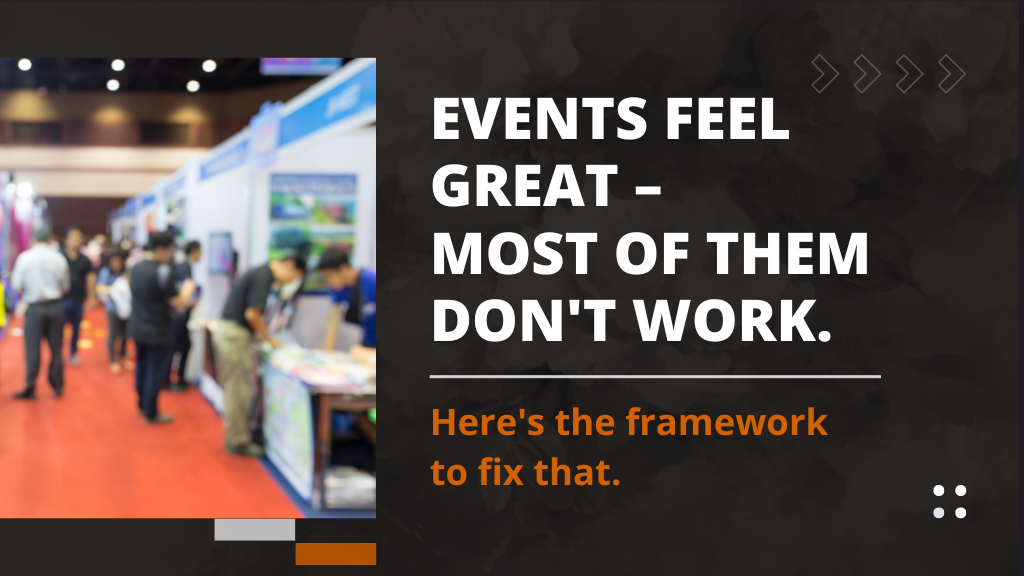
Spring is arriving. Growth plans that looked sharp in January are being pressure-tested against real-world results. Budgets are being quietly reshuffled. And in boardrooms and strategy offsites from coast to coast, someone invariably raises a hand and asks:
“Should we be doing more events?”
Trade shows. Executive dinners. User summits. Webinars. Roundtables. Hosted workshops.
Event marketing feels human and high-energy. It’s tangible in a way that programmatic display and SEO funnels simply are not. You shake hands. You read body language. You watch a prospect lean in.
But feeling good and performing well are not the same thing.
The wrong event strategy can quietly burn seven figures while your team celebrates badge scans. The right one can compress deal cycles, elevate win rates, and build the kind of trust that digital advertising can never replicate.
Here is how to tell the difference.
Why Events Work—When They Work
B2B buying has become structurally complex. Gartner (2019) found that the average enterprise buying group now involves 6 to 10 stakeholders—each with their own risk calculus, political considerations, and information needs.
Events cut through that complexity. They compress time. They build trust at a pace no email sequence can match.
From a behavioral science standpoint, well-designed events engage several powerful cognitive mechanisms simultaneously.
The Mere Exposure Effect (Zajonc, 1968) tells us that repeated contact increases liking and trust. In-person interaction amplifies this effect by an order of magnitude compared to digital impressions.
Social Proof (Cialdini, 2009) reduces perceived risk. When a prospect sees peers attending, sponsoring, or speaking at your event, they unconsciously read it as a signal of legitimacy.
Commitment and Consistency (Cialdini, 2009) means that when someone invests time attending your workshop or executive session, they become psychologically more committed to the topic—and often to you.
And then there is the Peak-End Rule (Kahneman et al., 1993)—one of my favorite frameworks. People do not evaluate experiences by averaging every moment. They remember the peak and the ending. A well-designed event, with one transformational moment and one clear call to action, creates a memory that outlives the conference badge by months.
Events are not merely marketing tactics. They are decision accelerators—but only under the right conditions.
Is Event Marketing Right for Your Business?
This is the question most leadership teams skip straight past. Before you sign a contract or book a venue, here is a simple diagnostic.
Event marketing tends to perform well when you have a high average contract value (typically $50K or more), a complex multi-stakeholder sales cycle, a concentrated ICP where your top targets gather in predictable ecosystems, and a sales team with the discipline to execute structured follow-up. Remove any one of those conditions and your risk profile changes substantially.
If your ACV is low, your deal cycle is short, and your ideal customer is scattered across a fragmented market, events are likely a distraction.
In my experience evaluating marketing investments across industries, the pattern is consistent: when ACV sits below $50K, the sales cycle runs under 90 days, and follow-up infrastructure is absent, event spending reliably underperforms. The budget almost always works harder through targeted digital ABM and webinars — channels that can be measured, iterated, and scaled without a hotel ballroom
Events are not mandatory. They are conditional.
The Biases That Distort These Decisions
Here is where leadership teams get themselves into trouble, and it is entirely predictable.
Survivorship Bias leads us to model our event strategy on Salesforce’s Dreamforce while ignoring the hundreds of user conferences that quietly failed. You remember the winners. The graveyard is invisible.
The Availability Heuristic (Tversky & Kahneman, 1973) causes executives to overweight vivid memories of a packed booth or an energized room against actual pipeline contribution. The energy felt real. But did the pipeline move?
The Sunk Cost Fallacy (Arkes & Blumer, 1985) is especially pernicious in multi-year trade show contracts. Once committed, teams find reasons to justify continued investment rather than reallocating toward what is actually working.
Vanity Metrics Bias is the silent killer. Badge scans are not pipeline. Booth traffic is not revenue. If your event success metric is attendance, you are measuring the wrong thing.
What Actually Drives Revenue: Trade Shows vs. Owned Events
Not all events serve the same function, and conflating them is one of the most common strategic errors I see.
Trade shows are best for category credibility, ecosystem networking, market sensing, and late-stage deal acceleration. Critically, Gottlieb et al. (2025) found that value is created across pre-, during-, and post-show phases—yet most companies underinvest heavily in both the pre-event meeting cadence and the structured follow-up. In the enterprise infrastructure example below, 70 meetings were booked before the event started. That discipline generated $14M in influenced pipeline and five net-new enterprise logos. Meetings drove revenue. Booth traffic did not.
Owned events—executive dinners, hosted roundtables, regional summits—offer something trade shows cannot: control. You control the guest list, the narrative, and the data. Forrester (2024) has documented meaningful growth in hosted, smaller-format events precisely because of their precision and ROI alignment. The evidence from practitioners is equally compelling. Demandbase CMO Kelly Hopping stated publicly that small, intimate dinners had become the company’s single largest driver of pipeline, explicitly outperforming large-scale trade shows for deal acceleration (Hopping, as cited in MarTech, 2024). Thomson Reuters offers another instructive example. Using a tiered ABM program built around exclusive hosted events—inviting senior decision-makers from target accounts to curated, high-value experiences—Thomson Reuters achieved a documented 95% win rate across their target account base (Gartner, as cited in Terminus, 2022). The behavioral levers at work were consistent: social proof, commitment, and peer validation—compounding in an environment the host controls entirely.
A Framework for Getting It Right
Assign every event a single primary job: pipeline creation, pipeline acceleration, expansion, category positioning, or partner enablement. If an event has five jobs, it effectively has none.
Before signing any contract, define your revenue hypothesis in advance—target accounts engaged, stage progression goals, pipeline influenced, velocity lift expectations. If you cannot articulate that hypothesis clearly, do not commit the budget.
Invest heavily in the pre-event motion. In my experience, roughly 70% of event ROI is determined before the doors open—through account-based outreach, pre-booked executive meetings, and a compelling reason to engage.
Within 48 hours of the event’s close, execute personalized follow-up with next-step commitments, SDR routing tied to engagement signals, and ABM retargeting. The end of the event is the beginning of revenue realization. Design it that way.
And measure what matters: pipeline created, stage progression, velocity lift, and buying-group penetration. Avoid last-touch attribution. Events are multi-touch accelerators, and treating them otherwise will consistently understate their contribution.
A Final Thought for This Season
Spring is an instinctive time to reassess and reinvest. New energy. New budgets looking for homes. New pressure to show growth.
Before you commit to the next conference, ask the hard questions. Does our ACV justify the investment? Is our ICP concentrated enough to make this leverage rather than lottery? Do we have the follow-up discipline to realize the value we create?
Used with intention, event marketing becomes a profit engine—shortening cycles, improving win rates, and building the kind of durable trust that compounds over time.
Used casually, it becomes exactly what behavioral science would predict: an expensive, memorable experience that never quite makes it into the pipeline report.
Choose wisely this spring.
About Rich Smith: Rich Smith is an executive advisor, behavioral marketing strategist, investor, and CMO known for helping leaders finally understand not only what strategies work, but why. With three decades of experience leading growth across financial services, healthcare, technology, and consumer brands, Rich has guided companies through crises, rebuilt brands from the ground up, and helped position organizations for nine-figure exits. Connect with him at RichMSmith.com, on LinkedIn, and The Revenue Science Podcast.
Arkes, H. R., & Blumer, C. (1985). The psychology of sunk cost. Organizational Behavior and Human Decision Processes, 35(1), 124–140. https://doi.org/10.1016/0749-5978(85)90049-4
Cialdini, R. B. (2009). Influence: Science and practice (5th ed.). Pearson.
Forrester. (2024). The global state of B2B events: 8 key findings from the Forrester 2024 B2B event trends survey.
Gartner. (2019). The new B2B buying journey and its implications for marketing.
Gottlieb, U., Brown, M., & Drennan, J. (2025). The changing role of trade shows in industrial marketing. Industrial Marketing Management, 125, 101–114.
Hopping, K. (2024, December). Demandbase rethinks ABM amid B2B marketing challenges [Interview]. MarTech. https://martech.org/demandbase-rethinks-abm-amid-b2b-marketing-challenges/
Kahneman, D., Fredrickson, B., Schreiber, C., & Redelmeier, D. (1993). When more pain is preferred to less: Adding a better end. Psychological Science, 4(6), 401–405.
Terminus. (2022). 9 account-based marketing tactics that helped Thomson Reuters achieve a 95% win rate. https://terminus.com/9-account-based-marketing-tactics-helped-thomson-reuters-achieve-95-win-rate/
Tversky, A., & Kahneman, D. (1973). Availability: A heuristic for judging frequency and probability. Cognitive Psychology, 5(2), 207–232.
Zajonc, R. B. (1968). Attitudinal effects of mere exposure. Journal of Personality and Social Psychology, 9(2), 1–27.